Greener marine operations will require leaner crews and smaller ships
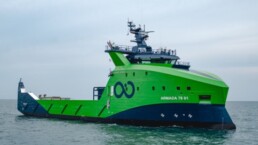

Marine robotics pioneer Ocean Infinity is actively pursuing the decarbonisation of its Armada fleet of lean-crewed, uncrewed and remotely operated vessels in alignment with its goal to achieve net-zero across the business by 2040.
In an exclusive interview with Max Hartvigsen, Marine Director, and Oliver Hibbert, Engineering Director at Ocean Infinity, we delve into the company’s multi-faceted approach to revolutionising green ship operations.
The strategy revolves around enhancing the operational efficiency of vessels, by leveraging optimised hull design, remote operations for smaller vessels, a crew competency-focused operating philosophy, and a commitment to continuous improvement through the introduction of new technologies.
Building a foundation: green technology and lean crewed ships
Ocean Infinity’s commitment to sustainability rests on two pillars: optimising operations and embracing innovative technology to reduce carbon emissions. As Max Hartvigsen emphasises; “these pillars encompass both operational efficiency and the potential transition to alternative fuel sources.”
One of the company’s notable initiatives is the introduction of lean-crewed ships designed for minimum environmental impact. These vessels, exemplified by the 78 and 86-metre models, are built and designed with facilities dedicated to future green technologies. This forward-thinking approach allows adaptability and serves as a platform for technology developers to showcase new eco-friendly solutions. Trialling new technologies, particularly propulsion technologies, by refitting existing vessels can be so costly and challenging it is often not undertaken. The green spaces on Ocean Infinity’s Armada vessels have been designed into them from the outset to greatly mitigate these potential future issues.
Green fuel exploration: methanol, ammonia, and beyond
Ocean Infinity is an active pioneer in green fuel adoption, looking beyond conventional choices like hydrogen to explore alternatives such as methanol and ammonia. Oliver Hibbert emphasises the need for partnerships: “We are working with key players like Cummins, a major engine supplier, as they work on converting engines to run on methanol. This effort is part of the ZEVI initiative, focusing on developing a methanol conversion package for engines and currently converting a vessel to operate on both methanol and diesel. We are also working with Amogy to assess their ammonia to fuel cell power packs for integration with our A78 vessels.”
Biofuels, specifically biodiesel in the short to medium term, are identified as a key solution to achieve up to a 70% reduction in fleet carbon emissions. The initial use of biodiesel will be followed by the consideration of second-generation fuels, such as HVO and co-processed MGO, to meet sustainability targets. Additionally, there is active consideration of incorporating bio-methanol into the fuel mix to expand the range of usable fuels.
In the medium to long term, ammonia stands out as the preferred alternative fuel due to its scalable production, low carbon intensity, and status as a true zero-carbon fuel. Substantial efforts are underway to enable the entire Armada fleet to operate on ammonia.
Ocean Infinity is executing a multifaceted approach to realise this strategy, involving various work streams, including the formation of an operating efficiency working group, biodiesel trials preceding fleet-wide implementation in 2024, research into an ammonia dual fuel conversion kit as part of the Clean Maritime Demonstration Competition Round 2, and the Ammonia Marine Power System project under CMDC R1, which has allowed Ocean Infinity to achieve DNV GL Ammonia Ready Fuel notation for the A78s.
Additionally, ongoing efforts involve ammonia cracking into internal combustion engines (ICE) feasibility work, exploring advanced tank technologies, and continuous engagement with global organisations, such as Society for Gas as a Marine Fuel, to deliver lower carbon intensity power solutions.
Operational efficiency and reduced crew: a win for sustainability
The reduction of offshore crew through automation and increased remote onshore operation is as a key strategy for Ocean Infinity. Performing operations from onshore operations centres has reduced travel emissions and onboard energy requirements. The centralised data collection from our ships and centralised operations enables a close understanding of offshore operations, providing opportunities for further energy and fuel operations consumption reductions.
This transition is exemplified by the decrease of onboard personnel from 50 to 15 on the 78m vessels, resulting in a notable reduction in associated costs such as flights for crew turnover and hotel loads on the ships. However, concrete figures on the carbon reduction from this crew reduction are still under development.
The company is working on a network of globally located centres with a team of mariners and data acquisition specialists executing the control and supervision of robotic ships and payload systems, with the latest Operations Centre announced to open in Hobart, Tasmania.
Battery technology and offshore complexity
Ocean Infinity has also taken a future proofing step by equipping each of the larger vessels with about one megawatt-hour of battery storage, showcasing a significant commitment to incorporating green technologies from day one. This battery capacity aligns with the company’s intention to efficiently use energy during complex offshore operations, where peak loads and quiet periods present unique challenges.
Ocean Infinity’s journey towards greener ship operations is marked by a commitment to flexibility, innovation, and strategic partnerships. The company’s initiatives in lean-crewed ships, green fuel exploration, operational efficiency, and advanced battery technology underscore its dedication to leading the maritime industry into a more sustainable future.



Related News.
Predicting the Future or Preparing for It? Cyprus Marine Club Explores the Power of Adaptability with Natasa Pilides
In a world where uncertainty has become the new normal, is predicting the future really the best strategy, or is the ability to adapt the greater…

Greece and Egypt in talks to extend EEZ Eastwards towards Cyprus following Libya’s move on Turkish Maritime Pact
Athens and Cairo have agreed to advance bilateral consultations aimed at extending the geographical scope of their 2020 Exclusive Economic Zone (EEZ)…
Seafarers face widening competency gap as digital shipping accelerates, recent research finds
Eighty two per cent of maritime professionals surveyed say current training does not adequately prepare crews for the realities of modern,…
Wärtsilä and WinGD sign new Service Framework Agreement to ensure long-term continuity and support for the global fleet
Technology groups Wärtsilä and WinGD have entered into a new long-term Service Framework Agreement, reaffirming their shared commitment to supporting…
Seatrium and Karpowership sign contract for a series of whale class Powership Conversion and Integration Projects
Seatrium and its strategic partner, floating power leader Karpowership, have strengthened their longstanding collaboration with the award of a…
ClassNK releases Handbook Supporting Consideration of Onboard Carbon Capture “Onboard Carbon Capture Systems Implementation Framework”
Bringing together technical, infrastructure, regulatory and emissions assessment considerations across the OCCS value chain - ClassNK has released a…

HHLA lowers earnings forecast for the 2026 financial year
Based on the business development to date and updated estimates for the fourth quarter of 2026, the Executive Board of Hamburger Hafen und…
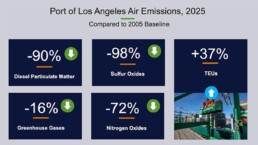
Port of Los Angeles reports lowest emissions per Container on Record
The Port of Los Angeles continued to make clean air gains in 2025, recording its lowest emissions per container on record, according to the Port's…
Drewry World Container Index – 22 Oct
WCI increased for the second consecutive week, the highest in 15 weeks. See detailed commentary below. Drewry World Container Index…
Mammoet, Port of Argentia and Argentia Capital Partner to Advance Floating Dry Dock and Marine Repair Facility
Partnership builds on Mammoet’s established presence at Port of Argentia and shared confidence in the growing market for ship repair and marine…
Subscribe to our newsletter!
if you dont want to swim alone in the ocean of news, sign up for the newsletter, and you will receive daily all the important news of world shipping!
