New Study identifies opportunities for a sea of benefits along Green and Digital Shipping Corridor between Singapore, Los Angeles and Long Beach
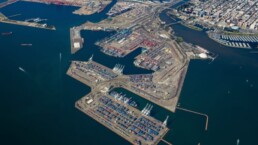

One year after the signing of the memorandum of understanding to establish a Green and Digital Shipping Corridor, the Maritime and Port Authority of Singapore, Port of Los Angeles and Port of Long Beach have completed a comprehensive baselining study. It forecasts more green jobs, health improvements for local communities and economic benefits for participating countries, emphasizing the future demand for zero- and near-zero emission fuels and the benefits from decarbonizing the shipping routes between the nations.
The study, commissioned by C40 Cities and the ports, and conducted by the American Bureau of Shipping, analyzed maritime trade flows between Singapore, Los Angeles and Long Beach, and provided a baseline of activities and energy demand requirements for vessels operating on the corridor through to 2050. The conclusion of the study follows the successful unveiling of the corridor’s Partnership Strategy at the 28th United Nations Climate Change Conference in December 2023, which outlined the corridor’s goals, partnership structure and governance mechanism. The study estimates the quantity of near-zero and zero-emission fuels required for this traffic by modelling the adoption of zero and near-zero carbon alternative fuels by vessels operating on the corridor through to 2050, considering various parameters such as fuel production costs and fuel availability, and in view of the targets in the 2023 International Maritime Organization’s Strategy on Reduction of Greenhouse Gas Emissions from Ships. The study can be found at c40.me/3xF60Yw.
“The Port of Long Beach and its partners have been very successful reducing emissions from cargo-handling equipment, trucks and other mobile sources moving cargo in our harbor,” said Port of Long Beach CEO Mario Cordero. “One of the most important parts of this partnership is it allows us to better understand and target a source of emissions that is hard for us to control as a local seaport authority – shipborne emissions. This work, vital to our net zero-emission quest, will result in economic and health benefits all along the trans-Pacific trade corridor.”
“This study provides a sense of scale and scope to inform our implementation of the Green and Digital Shipping Corridor,” said Port of Los Angeles Executive Director Gene Seroka. “Achieving the reductions of greenhouse gas emissions required will take coordination and commitment from public and private stakeholders across the maritime and goods movement industries. We’re proud to be collaborating with industry partners to make this corridor a reality.”
On a practical level, the study highlights the potential socioeconomic impact of transitioning to zero- and near-zero emission fuels and leveraging on digital solutions. Based on the study’s estimates, the corridor at full implementation could create over 700 new job opportunities in zero- and near-zero emission fuel production and improve local air quality. These estimates support findings by C40 and other organizations that activities undertaken through green shipping corridors can accelerate wider decarbonization across the maritime industry and unlock health benefits for local communities and green economy opportunities for participating countries.
As leading global ports, Singapore, Los Angeles and Long Beach are vital nodes on the trans-Pacific shipping lane and are key stakeholders in the maritime sector’s green and digital transition. Alongside 20 leading ports and port cities, MPA, POLA, and POLB are members of C40’s Green Ports Forum, a prominent global platform for collaborative climate action that actively champions ambitious green shipping corridors, acknowledging their central role in the ports and shipping sectors’ green transition.
The corridor partners underscore their dedication to a data-driven decision-making approach through the study, utilizing its insights to guide their actions in pursuing the partnership’s decarbonization objectives and aligning with the related goals of the shipping sector. Key findings of the study include:
- Vessels operating on the corridor represent 7% of the world’s container trade, which is about 1% of Singapore’s, 14.5% of Port of Long Beach’s, and 20% of Port of Los Angeles’ traffic.
- The projected annual energy demand of vessels on the corridor is estimated to be approximately 60,000 terajoules, equivalent to approximately two months of Singapore’s national electricity generation.
- Shipping demand on the corridor is estimated to be around 850,000 tons of methanol and 160,000 tons of ammonia annually by 2030, displacing the equivalent greenhouse gas emissions from almost 320,000 cars annually.
- The transition to zero- and near-zero emission fuels could potentially create approximately 700 jobs in the production and supply chain of such fuels by 2030.
The partnership convened the first in-person stakeholder meeting of the corridor together with industry value-chain representatives, as a prelude to onboarding stakeholders to the corridor. The meeting was held during Singapore Maritime Week 2024 on April 18.
The meeting and subsequent working groups will focus on developing green and digital solutions to address the following focus areas within the corridor:
- Enable the supply and adoption of zero and near-zero emissions fuels (e.g. green ammonia, green methanol) at scale, including safety, emergency response, mitigation and standards-setting.
- Develop and scale-up the adoption of energy efficiency solutions, including through digital tools (e.g. route optimization, remote monitoring) and technologies that reduce fuel consumption (e.g. wind-assisted propulsion).
- Develop and encourage the adoption of digital technologies to support the monitoring, reporting and verification of greenhouse gas emissions along the corridor.
All three ports will participate in the Accelerating Digitalization and Decarbonization Conference organized by MPA as part of Singapore Maritime Week 2024 and in a moderated discussion convened by C40 on the sidelines of the event entitled Navigating Collaboration: Governance of Green Shipping Corridor Partnerships, where C40 will unveil its new report and share insights into best practices for effective governance of the green corridor.
“Shipping is a new pillar in the multifaceted partnership with the U.S. The GDSC with the ports of Los Angeles and Long Beach highlights the importance of working with industry, researchers, government and society through innovation and capacity building,” said Teo Eng Dih, Chief Executive of MPA. “With traffic along the GDSC accounting for 7% of the world’s container trade, the initiatives by GDSC partners and stakeholders will help generate growth and new opportunities for maritime professionals.”
“Accelerating efforts to decarbonize the shipping sector is urgent if we are to limit global heating to 1.5 degrees Celsius,” said C40 Executive Director Mark Watts. “C40 is proud to support this first-mover initiative which has the potential not only to support the development and uptake of low- and zero-carbon fuels and vessels, but also create good green jobs and health benefits for local communities by doing so.”



Related News.

Crewing After 2026: How AI Will Take Over the Routine in 2027
The crewing market of late 2026 is not the market of 2025. Artificial intelligence has moved from presentations into daily crewing work, while the…

Dualog launches secure maritime AI service amid surge in seafarer AI use
The new service, Sparks lets crew and shore teams search company emails, documents and conversations without exposing sensitive fleet information to…

Time Ticking: Two weeks for Governments to Green-Light Framework for Cutting Shipping Emissions
As a crucial fortnight of meetings opens at the International Maritime Organization opens in London, the Clean Shipping Coalition calls on member…

“K” LINE signs contract for construction of two LPG dual-fuel VLGCs
Kawasaki Kisen Kaisha, announces today that it has signed agreements with South Korea-based HD Hyundai Samho regarding the construction of two LPG…

Equinor and VNG sign 18-year gas sales agreement for supplies to Germany
Equinor will supply natural gas to the German energy company VNG until the end of 2044. The 18-year agreement is the longest gas sales agreement…

Open letter to MEPs to reject the motion for a resolution and support the inclusion of Indian ship recycling yards on the European List
Dear Members of the European Parliament, Ahead of this week’s plenary vote, European Shipowners | ECSA, BIMCO, the Cruise Lines International…

ShipVet appoints James Stairmand as Chief Executive Officer
Founder Captain Fintan Cullen moves to a non-executive role as the company builds on investment in its vetting team and technology. ShipVet, the…

USD ≈7bn lost per year the hidden cost of how shipping trades
New Torvald Klaveness study quantifies around USD 7bn a year in potentially avoidable costs in dry bulk and product tanker shipping, with a possible…

APM Terminals Maasvlakte II and Port of Rotterdam Authority take next step in terminal development
APM Terminals Maasvlakte II and the Port of Rotterdam Authority are moving forward in terminal’s development with preparations for a new phase of…

ABP inspiring the next generation
ABP host 500 young people to explore maritime and transport careers More than 500 young people from across Hampshire and the Solent explored career…
Subscribe to our newsletter!
if you dont want to swim alone in the ocean of news, sign up for the newsletter, and you will receive daily all the important news of world shipping!
