Second cavitation tunnel tests confirm propeller boss cap efficiency as pilot installation planned
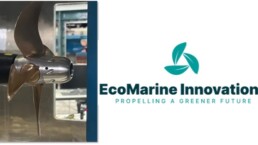

A second series of cavitation tests have confirmed EcoMarine Innovations’ Holy Boss Cap propeller hub improves fuel efficiency by up to 5% at full scale, as shipowners and propeller manufacturers vie for licensing agreements.
Full scale CFD simulation of a ship operating at a design speed of 16.46 knots and turning a controllable pitch propeller with four different boss-cap models, found the Holy Boss Cap the more efficient solution, outperforming existing hubs by a factor of 2.5 or more.
According to the trials report, researchers concluded propeller hub vortex “cavitation on the base boss cap was significantly eliminated by the holes on the calculations with the Holy Boss attached models. It is clearly seen that vortex [cavitation] is disappearing after it interacts with holes.”
Test results mean that the simple-to-manufacture and install propeller hub can be retrofitted to large ocean-going ships as a way of contributing to shipowner ESG goals to reduce carbon emissions.
Holy Boss Cap inventor Dr. Batuhan Aktas, a Chancellor’s Fellow in the Naval Architecture, Ocean and Marine Engineering Department at the University of Strathclyde, and future CEO of EcoMarine Innovations – a prospect spin out company of the University, said: “Our approach to improving propeller efficiency is unique in both design and application. It diverges from traditional methods that typically use propeller hub fins to achieve similar outcomes. We are receiving a tremendous amount of industry interest.”
According to Dr. Aktas, EcoMarine Innovations is currently in negotiations with several propeller manufacturers for licensing opportunities and has also held meetings with a Turkish ship operator. A pilot installation on a Kamsarmax vessel is planned in the second half of 2024.
A key differentiating aspect of the Holy Boss Cap is the emphasis on cost-effectiveness and ease of manufacturing. Unlike conventional propeller boss cap fins (PBCF) which are complex and expensive to produce, the Holy Boss Cap offers a simpler and more economical solution without compromising on efficiency or performance. Its design allows for significant reductions in fuel consumption and emissions, addressing urgent needs within the maritime industry for sustainability and compliance with international environmental regulations.
Ship maintenance costs can also be reduced as propeller hub vortex cavitation is the primary source of rudder cavitation and damage.
In addition to the reduced fuel consumption and carbon emissions, another positive environmental benefit of the HBC is that it reduces underwater radiated noise and vibration levels, which impacts the migratory, mating and feeding habits of marine mammals.
“Our most recent validation at one of Europe’s leading Hydrodynamic Research Centres demonstrates a vast improvement in propeller efficiency and recognises the fleet wide potential of the Holy Boss Cap in helping shipowners meet current and future emissions abatement legislation,” he said.



Related News.
Predicting the Future or Preparing for It? Cyprus Marine Club Explores the Power of Adaptability with Natasa Pilides
In a world where uncertainty has become the new normal, is predicting the future really the best strategy, or is the ability to adapt the greater…

Greece and Egypt in talks to extend EEZ Eastwards towards Cyprus following Libya’s move on Turkish Maritime Pact
Athens and Cairo have agreed to advance bilateral consultations aimed at extending the geographical scope of their 2020 Exclusive Economic Zone (EEZ)…
Seafarers face widening competency gap as digital shipping accelerates, recent research finds
Eighty two per cent of maritime professionals surveyed say current training does not adequately prepare crews for the realities of modern,…

Wärtsilä and WinGD sign new Service Framework Agreement to ensure long-term continuity and support for the global fleet
Technology groups Wärtsilä and WinGD have entered into a new long-term Service Framework Agreement, reaffirming their shared commitment to supporting…
Seatrium and Karpowership sign contract for a series of whale class Powership Conversion and Integration Projects
Seatrium and its strategic partner, floating power leader Karpowership, have strengthened their longstanding collaboration with the award of a…
ClassNK releases Handbook Supporting Consideration of Onboard Carbon Capture “Onboard Carbon Capture Systems Implementation Framework”
Bringing together technical, infrastructure, regulatory and emissions assessment considerations across the OCCS value chain - ClassNK has released a…

HHLA lowers earnings forecast for the 2026 financial year
Based on the business development to date and updated estimates for the fourth quarter of 2026, the Executive Board of Hamburger Hafen und…
Port of Los Angeles reports lowest emissions per Container on Record
The Port of Los Angeles continued to make clean air gains in 2025, recording its lowest emissions per container on record, according to the Port's…
Drewry World Container Index – 22 Oct
WCI increased for the second consecutive week, the highest in 15 weeks. See detailed commentary below. Drewry World Container Index…
Mammoet, Port of Argentia and Argentia Capital Partner to Advance Floating Dry Dock and Marine Repair Facility
Partnership builds on Mammoet’s established presence at Port of Argentia and shared confidence in the growing market for ship repair and marine…
Subscribe to our newsletter!
if you dont want to swim alone in the ocean of news, sign up for the newsletter, and you will receive daily all the important news of world shipping!
