German, Belgian and Dutch ports Europe, join forces to preserve the industry
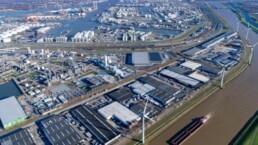

For years, the conversation between ports has been dominated by the question of who is the biggest. Nowadays, however, when the CEOs of Port of Antwerp-Bruges, North Sea Port, Duisburger Hafen AG and Port of Rotterdam sit around the table, we no longer talk about tonnes of cargo, but about how we can unite to secure a sustainable future for industry in Europe.
On the eve of the European industry summit on 17 and 18 April, we call on European government leaders to do the same and find a solution to the deteriorating position of our industry
Manufacturing industry
The manufacturing industry in the triangle between the Flemish-Dutch ports and the German Ruhr area is responsible for a large share of European production. Companies in the chemical and steel industries are located in the ports because of the supply of (still largely fossil) raw materials and energy. These are substantial emitters with a major responsibility to reduce their carbon emissions quickly. These companies also enable us to make electronics, medicine and mattresses in Europe. This is also the case for wind turbines, insulation materials and solar cells. The largely international head offices, however, are now wondering whether they still see a future in Europe. This is of huge concern to us as industry, in particular, can make a huge difference in making our society more sustainable.
As ports, we therefore want to take the lead in improving the investment climate for industry in Europe so that the relevant companies want to invest in sustainability. The companies in the triangle are, quite literally, connected by a network of pipelines. They cooperate, supply raw materials to each other and share expertise. The ports and industrial clusters are all adapting infrastructure to tomorrow’s raw materials and energy, such as hydrogen, so that even a sustainable industry can continue to cooperate efficiently. That also means planning and investing together. And, to be fair, we could do that more often and more effectively at times.
As the landlords of large industrial complexes, we aim to work on the basis of a shared vision. Space in ports is already scarce and processes such as more sustainable, circular production require much more space and may sometimes have a temporary, additional environmental impact. We therefore want to work together to figure out which activities we really need in Europe. Where is that space available, both physically and in terms of regulation? What will our ports and industry look like in 2050 when they have become climate neutral?
Common answer
A common answer to these questions will only be found and succeed if our governments also look at the industry from an international perspective.
So we ask that European government leaders, like us, stand alongside industry. Energy-intensive companies face much higher costs in Europe than in other parts of the world and have to cope with more complex laws and regulations. And, in the United States, the massive Inflation Reduction Act support package is making it more attractive for companies to invest in the necessary renewal there. If governments do nothing in return, investment in sustainability in Europe will stall and the industry will move outside Europe. Existing plants will then be kept operational for as long as possible as they age and will eventually shut down. That means more imports from outside Europe with negative consequences for the climate, our strategic autonomy and prosperity.
More and more people are suggesting that, if further money must be spent, we may be better off losing industry rather than retaining it. We understand their hesitation. Industry does not come without certain disadvantages and will not stop using fossil resources and emitting CO2 overnight. This requires a transition and maximum effort from everyone. We hope that industry will find this in Europe; after all, it provides crucial support for our ports, along with logistics and the energy sectors. The sectors represent about 63 billion euros in added value and over half a million jobs. That is why European government leaders need to merge climate and industrial policies in their five-year plan, as recently highlighted by European business in “The Antwerp Declaration for a European Industrial Deal”. Let’s maintain healthy competition and strengthen our cooperation on the energy transition.



Related News.

Crewing After 2026: How AI Will Take Over the Routine in 2027
The crewing market of late 2026 is not the market of 2025. Artificial intelligence has moved from presentations into daily crewing work, while the…

Dualog launches secure maritime AI service amid surge in seafarer AI use
The new service, Sparks lets crew and shore teams search company emails, documents and conversations without exposing sensitive fleet information to…

Time Ticking: Two weeks for Governments to Green-Light Framework for Cutting Shipping Emissions
As a crucial fortnight of meetings opens at the International Maritime Organization opens in London, the Clean Shipping Coalition calls on member…

“K” LINE signs contract for construction of two LPG dual-fuel VLGCs
Kawasaki Kisen Kaisha, announces today that it has signed agreements with South Korea-based HD Hyundai Samho regarding the construction of two LPG…

Equinor and VNG sign 18-year gas sales agreement for supplies to Germany
Equinor will supply natural gas to the German energy company VNG until the end of 2044. The 18-year agreement is the longest gas sales agreement…

Open letter to MEPs to reject the motion for a resolution and support the inclusion of Indian ship recycling yards on the European List
Dear Members of the European Parliament, Ahead of this week’s plenary vote, European Shipowners | ECSA, BIMCO, the Cruise Lines International…

ShipVet appoints James Stairmand as Chief Executive Officer
Founder Captain Fintan Cullen moves to a non-executive role as the company builds on investment in its vetting team and technology. ShipVet, the…

USD ≈7bn lost per year the hidden cost of how shipping trades
New Torvald Klaveness study quantifies around USD 7bn a year in potentially avoidable costs in dry bulk and product tanker shipping, with a possible…

APM Terminals Maasvlakte II and Port of Rotterdam Authority take next step in terminal development
APM Terminals Maasvlakte II and the Port of Rotterdam Authority are moving forward in terminal’s development with preparations for a new phase of…

ABP inspiring the next generation
ABP host 500 young people to explore maritime and transport careers More than 500 young people from across Hampshire and the Solent explored career…
Subscribe to our newsletter!
if you dont want to swim alone in the ocean of news, sign up for the newsletter, and you will receive daily all the important news of world shipping!
