Marine Pollution Clean Arctic Alliance welcomes Denmark’s banning of scrubber wastewater discharges
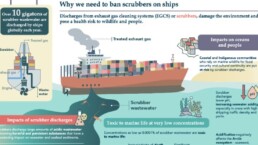

The Clean Arctic Alliance welcomed the Danish government’s announcement that it will prohibit the discharge of scrubber water from ships into the marine environment in its territorial waters (to 12nm), and called for all Arctic states to not only follow Denmark’s action, but to go beyond it by banning the use of scrubbers throughout Arctic waters.
“Denmark’s banning of the discharge of scrubber water from ships is welcome and exciting news and opens the door for Arctic countries to end the use of scrubbers in their waters ”, said Dr Sian Prior, Lead Advisor to the Clean Arctic Alliance. “Scrubbers discharge large amounts of acidic wastewater into the ocean; recent studies have shown that even very low concentrations of scrubber wastewater are toxic to marine life. Arctic governments must not only follow Denmark’s lead but go further – there is an urgent need to ensure that the strongest environmental protection – a ban on the use of scrubbers – is put in place to protect the ocean globally, but especially in Arctic waters, which supports highly productive ecosystems and wildlife, as well as Indigenous communities who rely on the ocean for food security.”
“The call for a scrubber discharge ban brought together Danish green NGOs to ask for a scrubber water discharge ban in Danish seas preventing ships from discharging high amounts of toxic persistent heavy metals and carcinogenic PAHs (polycyclic aromatic hydrocarbons) directly into nature. As a result, both our Environment Minister Magnus Heunicke and the Danish Parliament paid attention and have now banned the discharge of scrubber water to the benefit of marine ecosystems”, said Kåre Press-Kristensen, Senior Advisor, Head of Secretariat at Green Global Futures.
“As a growing number of coastal states take action against pollution by scrubbers, based on the scientific evidence, other countries must follow. The Clean Arctic Alliance calls on Canada, Greenland, Iceland, Norway, Russia and the State of Alaska to take action and ban the use of scrubbers in the Arctic. There is already an IMO resolution calling for ships in the Arctic to voluntarily move to distillate or other cleaner fuels or methods of propulsion which would make the installation and use of scrubbers redundant, and in July 2024 a ban on the use and carriage of heavy fuel oils (HFOs) in Arctic waters will come into effect. Since there is very limited opportunity and capacity for shipping to discharge scrubber waste to reception facilities in ports in the Arctic, a ban on the use of scrubbers is the most sensible approach”, said Eelco Leemans, Technical Advisor to the Clean Arctic Alliance.
About Scrubbers
Since January 2020, the allowable sulphur content on ships’ fuels has decreased from 4.5% to 0.5%. Ships burning high sulphur heavy fuel oils (HFO) can use exhaust gas cleaning systems (EGCS) or scrubbers to remove excess sulphur to comply with the new sulphur standard and allow ships to continue to use of heavy fuel oils, the most polluting type of marine fuel. However, scrubbers turn an air pollution problem into an ocean pollution problem. Read more.
In June 2021 the International Maritime Organization finally adopted a ban on the use and carriage of heavy fuel oil in the Arctic, with the first deadline coming into force in July 2024. The IMO ban however allows ships in the Arctic to continue to carry and burn significant quantities of HFO in the coming years if they have protected fuel tanks, or if they fly the flag of an Arctic coastal state and are issued with a waiver, resulting in ongoing HFO spill risks, continued high emissions of black carbon, and failure to achieve protection of a region that is rapidly changing due to climate warming. Exempt vessels, or those with waivers can continue to use heavy fuel oils by installing scrubbers, thus allowing the continued use of heavy fuel oils, as well as creating an ocean pollution problem.



Related News.

Crewing After 2026: How AI Will Take Over the Routine in 2027
The crewing market of late 2026 is not the market of 2025. Artificial intelligence has moved from presentations into daily crewing work, while the…

Dualog launches secure maritime AI service amid surge in seafarer AI use
The new service, Sparks lets crew and shore teams search company emails, documents and conversations without exposing sensitive fleet information to…

Time Ticking: Two weeks for Governments to Green-Light Framework for Cutting Shipping Emissions
As a crucial fortnight of meetings opens at the International Maritime Organization opens in London, the Clean Shipping Coalition calls on member…

“K” LINE signs contract for construction of two LPG dual-fuel VLGCs
Kawasaki Kisen Kaisha, announces today that it has signed agreements with South Korea-based HD Hyundai Samho regarding the construction of two LPG…

Equinor and VNG sign 18-year gas sales agreement for supplies to Germany
Equinor will supply natural gas to the German energy company VNG until the end of 2044. The 18-year agreement is the longest gas sales agreement…

Open letter to MEPs to reject the motion for a resolution and support the inclusion of Indian ship recycling yards on the European List
Dear Members of the European Parliament, Ahead of this week’s plenary vote, European Shipowners | ECSA, BIMCO, the Cruise Lines International…

ShipVet appoints James Stairmand as Chief Executive Officer
Founder Captain Fintan Cullen moves to a non-executive role as the company builds on investment in its vetting team and technology. ShipVet, the…

USD ≈7bn lost per year the hidden cost of how shipping trades
New Torvald Klaveness study quantifies around USD 7bn a year in potentially avoidable costs in dry bulk and product tanker shipping, with a possible…

APM Terminals Maasvlakte II and Port of Rotterdam Authority take next step in terminal development
APM Terminals Maasvlakte II and the Port of Rotterdam Authority are moving forward in terminal’s development with preparations for a new phase of…

ABP inspiring the next generation
ABP host 500 young people to explore maritime and transport careers More than 500 young people from across Hampshire and the Solent explored career…
Subscribe to our newsletter!
if you dont want to swim alone in the ocean of news, sign up for the newsletter, and you will receive daily all the important news of world shipping!
