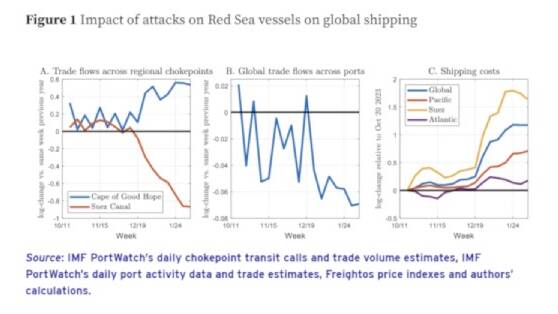

Recent attacks on ships navigating along the Red Sea have led vessels to reroute through the Cape of Good Hope, at the southern tip of Africa. This column studies the impact of these events on global shipping and introduces a multi-country general equilibrium model to study such events’ aggregate implications. The attacks have led to a decline in effective global shipping capacity, while global shipping costs have increased substantially. The model shows that lower global shipping capacity reduces the amount of goods that can be traded internationally, raises shipping costs and the relative price of tradable goods, and contracts global economic activity.
After the start of the latest Israel-Hamas war in October 2023, Yemen’s Houthi rebels began attacking vessels in the Red Sea. In response, shipping companies have altered their routes to avoid the Suez Canal and the Red Sea. Detouring around the Cape of Good Hope has extended voyages by approximately 3,500 nautical miles (6,482 kilometres) and increased shipping times by at least 14 days. Using daily automatic identification system data of the commercial fleet from the IMF PortWatch, Panel A of Figure 1 shows that trade flows around the Cape of Good Hope have increased in tandem with the rerouting from the Suez Canal, confirming that this has been the primary alternative route for much of the trade initially intended to ship through the Red Sea. 1 Trade flows between Europe and Asia, which ship primarily through the Suez Canal, have been particularly affected.
Impact on global shipping
While a nontrivial fraction of global trade – approximately 12% of the global value shipped – moves through the Suez Canal, most international trade flows are not directly affected by the events in the Red Sea. Yet, given the global nature of the shipping market, this regional shock has indirectly impacted other areas of the world, reducing global trade flows and increasing shipping costs.
Panel B of Figure 1 plots weekly estimates of global exports from PortWatch based on data across 1,378 major ports. We observe that global exports have been declining systematically (relative to the same week the year prior) since mid-December 2023, when major shipping companies began rerouting their voyages across the Red Sea. While global exports in the weeks prior to the rerouting had fluctuated around the -5% to 1% range relative to the year before, they had declined more than 7% by early February 2024 relative to last year.
Panel C of Figure 1 plots the dynamics of global and regional shipping costs using data from Freightos. 2 As expected, we observe that shipping prices for routes around the Suez Canal have increased substantially in recent months, exhibiting the greatest increase relative to other routes. More surprisingly, we observe that global shipping costs have also increased substantially over this period despite the regional nature of the shock. For instance, average global shipping costs have more than doubled since the onset of the Red Sea disruptions.
Quantifying the aggregate implications
To investigate the channels accounting for the global impact of shipping disruptions along with their implications, we study the multi-country general equilibrium model of international trade and global shipping dynamics that we developed in a recent working paper (Dunn and Leibovici 2024).
We examine the impact of a sequence of shocks to effective shipping capacity that reduce global trade flows (Figure 1, Panel B). To do so, we study a weekly version of the model that we estimate with data from before the onset of the Red Sea disruptions. We assume the economy is in a steady state before the week of 17-23 December, when shipping companies began rerouting their voyages across the Red Sea. Information on the rerouting of these voyages is revealed the week of 17-23 December, with shocks starting one week thereafter chosen for tracking global trade flows, as observed in the data. 3 Shocks are then assumed to revert gradually to the steady state over the next six months. Panel A of Figure 2 plots the effective shipping supply in the data and the model, showing we track the data closely up to the latest data available.

Panels B and C of Figure 2 show that the model’s estimates of shipping dynamics in response to the shocks are closely aligned with their empirical counterpart. Panel B shows that global shipping costs increase substantially, as in the data. In the model, global shipping supply is rigid in the short-run (blue line of Panel D) since global shipping firms typically operate at capacity and shipping investments are time-intensive. Thus, reductions in global shipping supply can be only partially offset through higher utilisation, leading to higher shipping prices and bringing imports to the level of the reduced shipping capacity.
Panel C shows that the value of shipping firms also increases in the model and the data. In particular, we compare the value of shipping firms implied by the model with their value in the data, as captured by the average changes in shipping stock prices. 4 Interestingly, we find that shipping firms increase in value despite the shipping disruptions. In the model, this increase is accounted for by the rigid nature of shipping supply in the short run and the relatively inelastic demand for shipping services. Note, however, that the increase in shipping costs and the value of shipping firms is somewhat higher in magnitude in the data than in the model.
These findings show that the model can account for salient features of shipping dynamics following the recent disruptions in the Red Sea. With a model equipped to capture recent developments, we then investigate their broader implications for economic activity and prices. Figure 2 Panel E shows that the shock to trade generates a decline in tradable absorption in our model, as the reduced effective shipping capacity has lowered the amount of tradables that countries can import from each other. Panels F and G show that the relative price of tradables increases, leading to a partial reallocation of absorption toward nontradable goods. However, despite this reallocation, the net impact of the shock is contractionary, as implied by the decline of aggregate investment and GDP in Panels H and I.
While the exact quantitative impact of the shocks on economic activity and prices depends on the details of our quantitative implementation, our findings point to key channels through which recent developments in the Red Sea may be heaving ripple effects on the global economy.
Concluding remarks
Our findings show that global shipping dynamics can be a key channel through which local shocks affect global economic outcomes. With growing geopolitical tensions, shipping disruptions may become more frequent, thus leading to greater global economic turbulence from these relatively local conflicts. These effects, however, may be transitory. As shipping companies adjust their fleets to these developments, they may find it optimal to operate with greater slack, which would act as a buffer to insure their operations against such shocks, thereby mitigating potential disruptions.
Source: CEPR



Related News.

Cyprus Maritime Innovation takes Centre Stage at SMM Hamburg 2026
Underscoring its expanding role as a premier international hub for cutting-edge maritime technology and sustainable shipping, the Republic of Cyprus…

Trump seeks to refill US oil reserve with Venezuela deal but faces long delay
U.S. President Donald Trump said on the 30th (local time) that he would refill the U.S. Strategic Petroleum Reserve, which has been depleted with…
US Navy Official visits South Korean Shipyards in private
With U.S. President Donald Trump pushing a plan to allow overseas construction of U.S. warships, attention is focusing on whether the building of…
SES and De Boer Marine expand collaboration with FlexMaritime deployment across Global Markets
SES, a leading space solutions company, and De Boer Marine, a leading provider of top-quality marine equipment and maritime connectivity services,…

New ESG guidance to help maritime industry turn sustainability into commercial advantage
New framework helps shipowners and ports align ESG strategy with access to capital, charterer expectations and long-term asset value. Maritime…

Britannia P&I Club analysis finds four in five crew deaths linked to illness rather than accidents
New report highlights cardiovascular disease as leading cause of fatalities and raises concerns over mental health risks among younger seafarers.…

The Swedish Club launches new Loss Prevention podcast, Knot Another Lesson
The Swedish Club has launched Knot Another Lesson, a new podcast exploring the practical lessons, emerging risks and operational challenges shaping…

Lloyd’s Register appoints Jens Grunenberg as Senior Representative for Germany
Lloyd’s Register has appointed Jens Grunenberg as its Senior Representative for Germany, effective 1 September. Based in Hamburg, Grunenberg will…

Indian Register of Shipping sets sights on Hamburg for European Expansion
Indian Register of Shipping, a leading international classification society and full member of the International Association of Classification…

MOL completes Merger of 6 Ship Management Companies
Unifying Management of Over 200 Vessels and Strengthening Safety Mitsui O.S.K. Lines, announced that it has completed the integration of the MOL…
Subscribe to our newsletter!
if you dont want to swim alone in the ocean of news, sign up for the newsletter, and you will receive daily all the important news of world shipping!
