Container traders anticipate rise in disruptions and increase in container prices in the Wake of Baltimore Bridge Collision

- US ports prepare for rising traffic amid growing freight volumes.
- xCPSI rises significantly from 26 to 61 points in one week, most supply chain professionals surveyed expect container price hikes in the coming weeks.
- Container traders in the US to prepare for potential disruptions, higher container prices and increased demand in the market
In the aftermath of the Baltimore bridge collision, supply chain professionals are anticipating price hikes, as indicated by a significant rise in sentiment for container price increases. A rebound of freight volumes into the US this year, coupled with the bridge incident and the ongoing challenges in the Red Sea as well as the Panama Canal is expected to strain key US ports in the short term. This is expected to lead to increased congestion, additional logistical and operational complexities, and short to midterm price increases.
The Container xChange’s Container Price Sentiment Index (xCPSI) unexpectedly surged from 26 to 61 points between March 18, 2024, and March 29, 2024. This marked increase suggests that the industry is anticipating container prices to increase in the coming weeks—while the suddenness of the index’s move highlights rising uncertainty in the market.
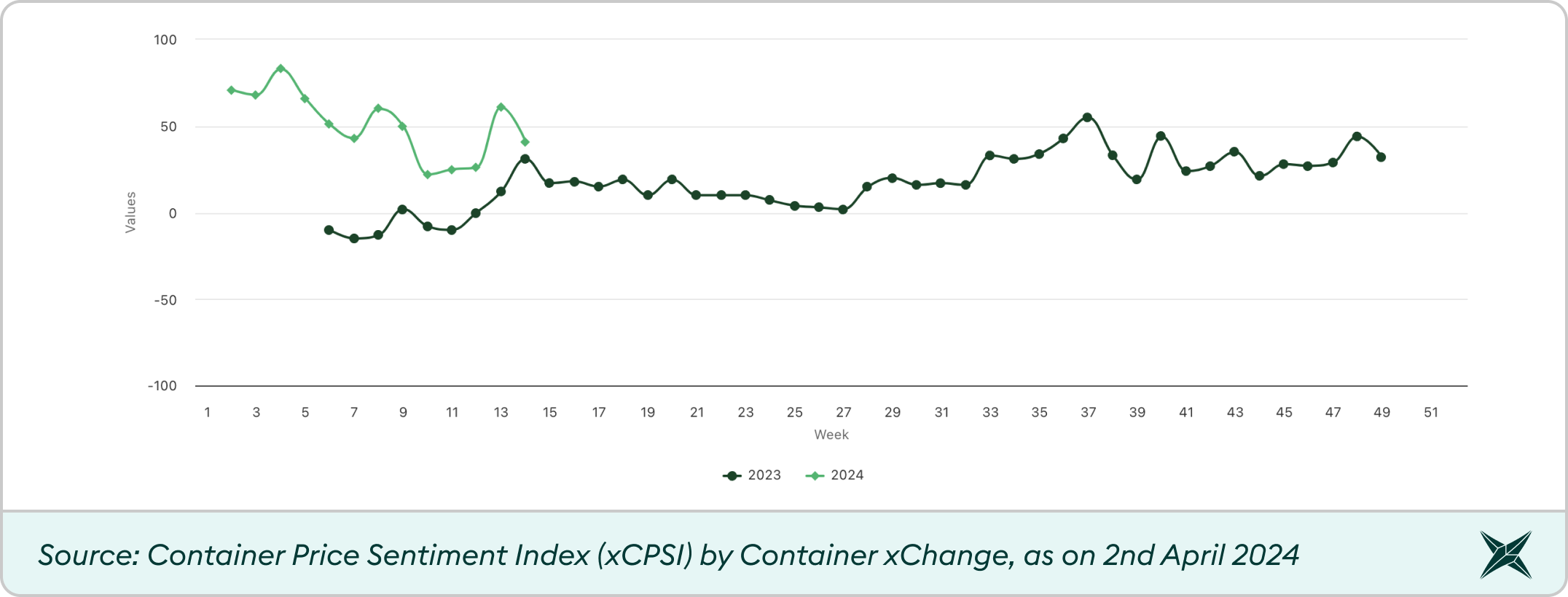
“The sharp rise in sentiment could be linked to ongoing market volatility, the perceived emergency on the US East Coast due to the Baltimore collision, and the resulting sustained pressure on the market.” commented Christian Roeloffs, cofounder and CEO of Container xChange.
We have received feedback from industry sources indicating an anticipated increase in container prices in the upcoming days/weeks, with projections ranging from 50-100 USD per TEU. This information suggests that customers looking to order new build units may encounter higher unit prices compared to previous weeks. One manufacturer, whom we used as a source in previous reports, anonymously shared this insight.
Additionally, another customer from Europe, who prefers to remain anonymous, is stocking up on various types of units in anticipation of future price hikes.
Based on these insights, it appears that the market is poised for price increases in the coming weeks.
Update on the Baltimore Incident
As of 29th March 2024, the Key Bridge Response 2024 Unified Command* reported that 56 total containers loaded on the vessel contained hazardous materials, with 14 impacted. These 14 containers were assessed by an industrial hygienist for potential hazards. The Unified Command and Joint Information Center were established in Baltimore on 26th March 2024 to coordinate the response and disseminate information regarding the Francis Scott Key Bridge collapse.
In the meantime, The Captain of the Port (COTP) Baltimore has established a temporary alternate channel on the northeast side of the main channel in the vicinity of the Francis Scott Key Bridge for commercially essential vessels, according to the official statement by Mayor Brandon M. Scott, on Sunday, 31st March 2024.
The temporary channel will be marked with government lighted aids to navigation and will have a controlling depth of 11 feet, a 264-foot horizontal clearance, and vertical clearance 96 feet. The Unified Command is working to establish a second, temporary alternate channel on the southwest side of the main channel. This second channel will allow for deeper draft vessels with an anticipated draft restriction of 15 to 16 feet.
Container vessels will need to adjust their routes to utilize this temporary channel, which has specific dimensions and markings to ensure safe passage. This temporary solution will enable commercially essential vessels, including container ships, to continue their operations with minimal disruption despite the bridge collapse.
Shippers to brace for cost escalations and mounting responsibilities
Furthermore, shippers whose routes include Baltimore are expected to face significant challenges in the coming days. One major issue is the increased shipping costs and associated expenses due to rerouting, which are expected to rise. Additionally, the responsibility for picking up cargo at diverted ports has been shifted to the shippers, as MSC and several other ocean carriers have informed their clients. This shift requires shippers to coordinate closely with freight forwarders, trucking companies, and other logistics providers to ensure safe and efficient transportation of the cargo to its final destination.
“In the short term, the bridge collapse will lead to localized disruptions in container availability and transportation. The incident has also led to increased delivery times and fuel costs which could indirectly impact container prices and leasing rates in the coming times.” added Roeloffs.
US ports under pressure?
Container xChange’s analysis of loaded imports at the top 10 ports in the US reveals a significant increase in container throughput compared to the previous year. This indicates improved port utilization and suggests a strong start to the year in terms of freight demand and activity.
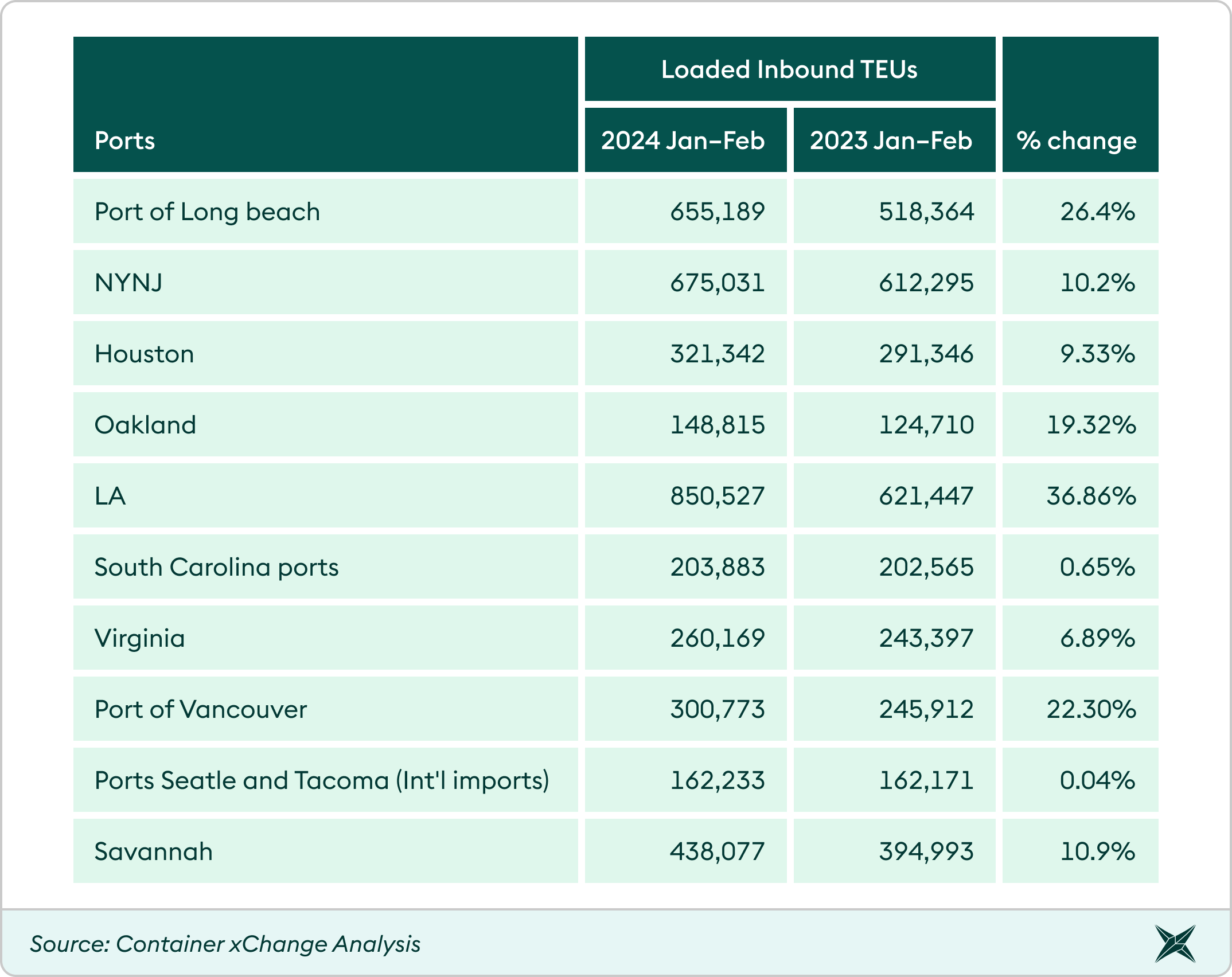
Ports such as the Port of Long Beach, LA, and Port of Vancouver have shown significant increases in loaded inbound TEUs, indicating strong growth in maritime freight traffic
Now with these diversions, it remains to be seen how well the ports will handle the rise in traffic. As more cargo gets diverted to these ports, we will see an increased throughput pressure on these ports. This could lead to higher congestion and longer wait times for vessels, trucks, and trains at the port.
Given this situation, we would expect container prices at these ports to rise in the month of April and beyond, depending on the intensity of the diversions and its aftermath.
The aftermaths of the Baltimore collision are being felt nationwide. The New York Gov. Kathy Hochul and New Jersey Gov. Phil Murphy directed their ports Thursday, 28th March 2024, to accept additional cargo to alleviate supply chain pressures from the shutdown in Baltimore. Being the only water route into and out of the port, the shipping channel will be closed for weeks, at a minimum, and possibly for months.
“By February 2024, most US ports experienced a resurgence in loaded cargo imports compared to the same period last year (Jan-Feb volumes in 2023). While volumes have rebounded and port operations have improved, concerns linger due to the ongoing Red Sea crisis and the recent Baltimore bridge collision, which is expected to cause months-long disruptions. This is likely to increase pressure on nearby ports with similar capabilities and may lead shippers and carriers to consider diverting entirely to the West Coast, potentially resulting in additional challenges or even closures for carriers,” commented Christian Roeloffs, co-founder, and CEO of Container xChange, an online global container logistics platform.
“As we move forward, we anticipate increased wait times and processing fees at the ports where traffic is diverted in the US. The most striking impact, nonetheless, is on the regional supply chain in Baltimore, where the effects on life, the economy, and businesses are severe,” Roeloffs emphasized.



Related News.

Crewing After 2026: How AI Will Take Over the Routine in 2027
The crewing market of late 2026 is not the market of 2025. Artificial intelligence has moved from presentations into daily crewing work, while the…

Dualog launches secure maritime AI service amid surge in seafarer AI use
The new service, Sparks lets crew and shore teams search company emails, documents and conversations without exposing sensitive fleet information to…

Time Ticking: Two weeks for Governments to Green-Light Framework for Cutting Shipping Emissions
As a crucial fortnight of meetings opens at the International Maritime Organization opens in London, the Clean Shipping Coalition calls on member…

“K” LINE signs contract for construction of two LPG dual-fuel VLGCs
Kawasaki Kisen Kaisha, announces today that it has signed agreements with South Korea-based HD Hyundai Samho regarding the construction of two LPG…

Equinor and VNG sign 18-year gas sales agreement for supplies to Germany
Equinor will supply natural gas to the German energy company VNG until the end of 2044. The 18-year agreement is the longest gas sales agreement…

Open letter to MEPs to reject the motion for a resolution and support the inclusion of Indian ship recycling yards on the European List
Dear Members of the European Parliament, Ahead of this week’s plenary vote, European Shipowners | ECSA, BIMCO, the Cruise Lines International…

ShipVet appoints James Stairmand as Chief Executive Officer
Founder Captain Fintan Cullen moves to a non-executive role as the company builds on investment in its vetting team and technology. ShipVet, the…

USD ≈7bn lost per year the hidden cost of how shipping trades
New Torvald Klaveness study quantifies around USD 7bn a year in potentially avoidable costs in dry bulk and product tanker shipping, with a possible…

APM Terminals Maasvlakte II and Port of Rotterdam Authority take next step in terminal development
APM Terminals Maasvlakte II and the Port of Rotterdam Authority are moving forward in terminal’s development with preparations for a new phase of…

ABP inspiring the next generation
ABP host 500 young people to explore maritime and transport careers More than 500 young people from across Hampshire and the Solent explored career…
Subscribe to our newsletter!
if you dont want to swim alone in the ocean of news, sign up for the newsletter, and you will receive daily all the important news of world shipping!
