Weighing up energy saving technology options

Horizons analyses how the growing use of energy saving devices and technology is helping the current fleet manage increasing emissions-related penalties in the sector.
Across the maritime industry, stakeholders are faced with a step change in emissions-related financial exposure and this will only increase over the next few years. EU Emissions Trading System (EU ETS) is now in effect, FuelEU Maritime is on the horizon and there is a very real possibility that IMO’s greenhouse gas fuel intensity (GFI) reduction will be introduced in the not too-distant future.
To put this into perspective, for a large handy-size bulk carrier using fossil fuel and trading to and from the EU and within the EU, the cost of EU Allowances (EUAs) in 2026 will be around €0.58 million, while the FuelEU Maritime penalty will be around €0.20 million. By 2035, the FuelEU Maritime penalty will be €0.71 million, while the EUA price would stay similar. But looking to 2050, the FuelEU Maritime penalty reaches €3.60 million.
These costs will drive shipowners to consider switching to alternative fuels, but also to consider less expensive options: retrofitting energy saving devices/technologies (ESDs/ESTs) to reduce their financial exposure.
“Whilst there is much uncertainty on future fuels, the one clarity is that the less fuel used, benefits us today and beyond 2050. We need to explore every possible efficiency gain from the current fleet that we can. Energy saving technologies and operational practices will play the primary role in delivering the 30% reduction of emissions targeted by the IMO in just six years from now. So, we need to make every upcoming drydocking count.”
Market trends
In the last year, the number of in-service ships (above 100 GT) with ESDs/ESTs onboard increased 11.9% to 7,613 at the start of January 2024. Some 31% of total in-service tonnage is now equipped with innovative emissions reducing and fuel saving technologies. The volume of ESD/EST installations, including onshore power supply facilities but excluding engine-based ESTs, has grown every year since 2018, up 163% from 2018 to 2023. Currently scheduled plans for 2024 suggest that activity will rise by a further 22%.
Where are these installations happening?
The majority of ESD/EST installations are occurring in China, which accounts for 62% of 2022 to 2024 actual and scheduled yard ‘events’. Japan accounts for only 12% of installations by event, which has been dropping steadily from a figure of 30% in 2018. Korea accounts for just 10% of installations, with other areas around the world all less than 5%.
What is being fitted to ships?
There are around 30 different types of ESDs/ESTs that are currently being used, falling into hull, propeller, solar, wind or engine-based categories. The most popular ESDs/ESTs being fitted or pending fall into the hull and propeller categories (existing fleet and orderbook).
Under the hull category, air lubrication (440 ships), bow enhancement (2,311 ships) and hull fins (795 ships) are the most popular.
Under the propeller category, propeller boss cap fins (1,483 ships), propeller ducts (2,778 ships), rudder bulbs (3,434 ships), stator fins (2,407 ships) and wake ducts (430 ships) are the most popular.
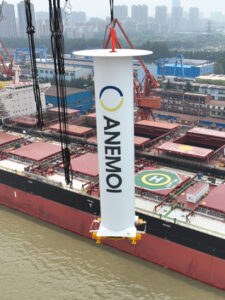
By comparison, under the wind category, Flettner rotors (40 ships), rigid sails (16 ships) and suction wings (44 ships) are the most popular, while 144 ships have been fitted with waste heat recovery systems. 170 ships have been fitted with solar panels.
The distribution of ESDs/ESTs across the different main ship segments is quite marked:
Bulk carriers
- Hull: 1,349 ships, of which 1,032 are bow enhancements
- Propeller: 3,321 ships, of which 1,404 are propeller ducts
Container ships
- Hull: 664 ships, of which 483 are bow enhancements
- Propeller: 1,823 ships of which 1,067 are rudder bulbs
Gas carriers
- Hull: 282 ships, of which 189 are air lubrication systems
- Propeller: 372 ships, of which 237 are rudder bulbs
Cruise ships
- Hull: 47 ships, of which 36 are air lubrication systems
- Propeller: 26 ships, of which 19 are rudder bulbs
Tankers
- Hull: 259 ships, of which 191 are bow enhancements
- Propeller: 1,892 ships, of which1,042 are propeller ducts
Newbuilding phenomenon
The adoption of ESDs/ESTs in the Container and Bulk Carrier segments over other segments is very noticeable. While there are many reasons for this, one key reason is considered to be the fact that ESTs (including Onshore Power Supply installations) have predominantly been on newbuilds. From 2018 to 2023, ESD/EST installations on newbuilds range from 69% to 90% of all ESD/EST installations. Given the container ship building boom, along with a spike in bulk carriers newbuilding during this time period, this could well be what is driving the numbers.
What about retrofits?
It begs the question – what about retrofits on existing ships? Is it a supply issue, where not enough yards are interested in retrofitting existing ships? Or is it a demand issue, where shipping companies are either not yet fully aware of their potential financial exposure under the regulations or, perhaps, even with this financial exposure, the economics of retrofitting existing tonnage still doesn’t add up in many cases, once CAPEX, OPEX and time off hire during the retrofitting itself is taken into account.
There are other factors that shipping companies need to consider as well, such as whether ESDs/ESTs actually deliver the energy/emissions savings expected under the conditions their ships operate, or whether multiple types of ESDs/ESTs are needed to achieve the emissions reduction/energy savings needed to make the investment worthwhile. Installations of multiple technologies do not necessarily deliver additive efficiencies. And there are also some practical considerations, such as system integration, life-cycle maintenance/management and other operational impacts such as accessibility to berths.
However, as emissions penalties increase over time, retrofitting will become an increasingly attractive path for many shipping companies and charterers, especially as options are limited on the newbuilding front from a scarcity of yard slots over the next few years.



Related News.
Columbia Group calls for greater focus on retaining women at sea as second She Beyond Conference takes place
Columbia Group has called on the maritime industry to create a future where women can thrive, progress and lead at sea, as it celebrated the second…
Neptune Group Welcomes “NIKOS TRAVLOS”
The new vessel proudly bears the name of Neptune's founder, who laid the foundation for the creation and enduring evolution of the Group. Her…

Wildcat Defense enters into exclusive agreement to acquire Fraser Shipyards
American family firm takes the next step in its strategy to rebuild U.S. shipbuilding and repair capacity, following its offer for Austal USA.…

Kawasaki signs strategic partnership MOU with Romania’s Transgaz for Onshore Hydrogen Gas Transport
Establishing a model for large-scale hydrogen supply and transport via pipelines Kawasaki Heavy Industries, announced at the Romania–Japan…

UK P&I Club and TT Club secure regulatory approval for Thomas Miller acquisition
The UK P&I Club and TT Club announce the successful completion of their joint acquisition of the Thomas Miller Holdings group, marking a major…

Valenciaport presents its Sandbox at PEIC’26 as a tool to bridge the gap between innovation and implementation
The opening session featured a discussion between Valenciaport President Mar Chao and Valenciaport Foundation Director Antonio Torregrosa. The…

Major investments strengthen Gothenburg RoRo Terminal
Expanded terminal areas, new rail connections and modernised quays are among the investments that have strengthened Gothenburg RoRo Terminal in…

ABP appoints key roles in the Humber
Associated British Ports has made two key appointments at its container terminals strengthening its unitised operations at the ports of Immingham…

Xinhua Silk Road 2026 North Bund Forum unveils 20 shipping-related achievements
The 2026 North Bund Forum opened in Shanghai on October 20 with 20 key shipping-related achievements spanning international cooperation, green…
Ports encouraged to prepare now for advanced nuclear in maritime and clean energy
New joint Lloyd’s Register and British Ports Association paper sets out a practical readiness pathway for ports considering nuclear-powered vessels,…
Subscribe to our newsletter!
if you dont want to swim alone in the ocean of news, sign up for the newsletter, and you will receive daily all the important news of world shipping!
