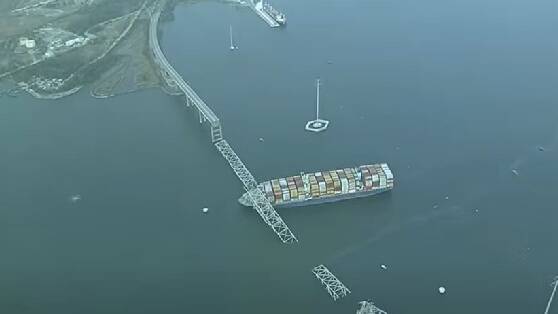

The catastrophic bridge collapse that closed the Port of Baltimore to ship traffic is unlikely to trigger a major new U.S. supply chain crisis or spike goods prices, due to ample and growing spare capacity at competing East Coast ports, economists and logistics experts say.
With six people still missing after a container ship collision destroyed the Francis Scott Key Bridge, it remained unclear how long the span’s twisted superstructure would block the harbor’s mouth.
But port officials from New York to Georgia were busy on Tuesday fielding queries from shippers about diverting Baltimore-bound cargo from containers to vehicles and bulk material.
“We’re ready to help. We have ample capacity to absorb any surge in container traffic,” Port of Virginia spokesperson Joe Harris told Reuters.
The Norfolk-based port is seen as a major beneficiary, due to its close proximity to Baltimore, but ports in Savannah and Brunswick, Georgia, also were poised to absorb some traffic, a spokesperson for the Georgia Ports Authority said.
The situation is a marked shift from the clogged, understaffed ports and supply chain chaos of 2021 and 2022 that spiked prices and fueled inflation as Americans binged on imported goods purchases coming out of the COVID-19 pandemic.
East Coast ports have invested billions of dollars over the past decade to expand capacity and while the temporary closure at Baltimore may add time and cost for some companies, economists do not expect a significant macroeconomic impact.
“The collapse of the Francis Scott Key Bridge in Maryland is another reminder of the U.S. vulnerability to supply-chain shocks, but this event will have greater economic implications for the Baltimore economy than nationally,” Ryan Sweet, chief U.S. economist at Oxford Economics, wrote in a note.
“We don’t anticipate that the disruptions to trade or transportation will be visible in U.S. GDP, and the implications for inflation are minimal,” he added.
NO SHIPS, NO WORK
The impact on the Port of Baltimore’s more than 2,000 workers who load and unload cargo vessels could be significant if the closure lasts more than a few days.
The dockworkers are day laborers, said Scott Cowan, head of the International Longshoreman’s Association Local 333 in Baltimore, meaning they only work when there is cargo to be moved. He estimated there might be about a week’s work clearing the existing inventory at the port.
“After that,” he said, “we’re dead in the water” with a collective $2 million a day in lost wages at stake.
The port directly generates over 15,000 jobs, with an additional 140,000 jobs dependent on port activity, according to Maryland Governor Wes Moore’s office.
VEHICLE PORT
One area of concern is higher shipment costs for imported cars and trucks and for exports of farm tractors and construction equipment as Baltimore is the largest U.S. port for “roll-on, roll-off” vehicle shipments, with over 750,000 cars and light trucks handled by state-owned terminals in 2023, according to Maryland Port Administration data.
Ford Motor Co F.N and General Motors GM.N said they would reroute some affected shipments but the impact would be minimal, while Volkswagen VOWG_p.DE is unaffected because its new Sparrows Point vehicles terminal is located at a former steel mill site on the bridge’s Chesapeake Bay side.
The risk of car price spikes is further dampened by a recovery in automotive inventories to their highest level since May 2020, after being drawn down sharply during the pandemic. The industry’s inventory-to-sales ratio is near its 32-year-average of 1.96 to 1 according to Census Bureau data, and sales incentives have risen in recent months as high interest rates dampen demand.
COASTAL SHIFT
Ryan Peterson, founder and CEO of logistics platform Flexport, said that with Baltimore handling only 1.1 million twenty-foot equivalent containers last year – ranking 12th in the U.S., any impact on container rates and shipping costs from the disruption would be far less than increases caused by cargoes diverted from the Suez Canal because of attacks on Red Sea shipping by the Houthi militant group in Yemen.
But the port outage could contribute to a shift of container traffic to West Coast U.S. ports that was already underway over the past several months because of the lack Asian shippers’ access to the Suez route and reduced capacity in the Panama Canal due to low water levels. Peterson said the potential for an East Coast longshoreman strike in late September – at the height of Christmas-season imports – also has some shippers considering West Coast shipments.
“East Coast volumes are down and there is the ability for those ports to flex up to handle this,” he said of the Baltimore disruption, adding that it’s “one more reason to think to start shifting volumes to the West Coast instead of the East.”
Source: Reuters reported by David Lawder, additional reporting by Daniel Burns and David Shepardson in New York. Edited by Stephen Coates



Related News.
Cyprus Maritime Innovation takes Centre Stage at SMM Hamburg 2026
Underscoring its expanding role as a premier international hub for cutting-edge maritime technology and sustainable shipping, the Republic of Cyprus…
Trump seeks to refill US oil reserve with Venezuela deal but faces long delay
U.S. President Donald Trump said on the 30th (local time) that he would refill the U.S. Strategic Petroleum Reserve, which has been depleted with…
US Navy Official visits South Korean Shipyards in private
With U.S. President Donald Trump pushing a plan to allow overseas construction of U.S. warships, attention is focusing on whether the building of…
SES and De Boer Marine expand collaboration with FlexMaritime deployment across Global Markets
SES, a leading space solutions company, and De Boer Marine, a leading provider of top-quality marine equipment and maritime connectivity services,…

New ESG guidance to help maritime industry turn sustainability into commercial advantage
New framework helps shipowners and ports align ESG strategy with access to capital, charterer expectations and long-term asset value. Maritime…

Britannia P&I Club analysis finds four in five crew deaths linked to illness rather than accidents
New report highlights cardiovascular disease as leading cause of fatalities and raises concerns over mental health risks among younger seafarers.…
The Swedish Club launches new Loss Prevention podcast, Knot Another Lesson
The Swedish Club has launched Knot Another Lesson, a new podcast exploring the practical lessons, emerging risks and operational challenges shaping…

Lloyd’s Register appoints Jens Grunenberg as Senior Representative for Germany
Lloyd’s Register has appointed Jens Grunenberg as its Senior Representative for Germany, effective 1 September. Based in Hamburg, Grunenberg will…

Indian Register of Shipping sets sights on Hamburg for European Expansion
Indian Register of Shipping, a leading international classification society and full member of the International Association of Classification…
MOL completes Merger of 6 Ship Management Companies
Unifying Management of Over 200 Vessels and Strengthening Safety Mitsui O.S.K. Lines, announced that it has completed the integration of the MOL…
Subscribe to our newsletter!
if you dont want to swim alone in the ocean of news, sign up for the newsletter, and you will receive daily all the important news of world shipping!
