Sustainable shipping fuels can reach cost parity with fossil fuels by 2035 with decisive policy, says new Wärtsilä report

New Wärtsilä analysis shows EU ETS and FuelEU Maritime will close price gap, creating policy blueprint to accelerate the global transition to sustainable fuels
Sustainable shipping fuels could reach cost parity with fossil fuels as early as 2035 with the help of decisive emissions policy such as carbon taxes and emissions limits, according to a new report launched today by technology group Wärtsilä.
The report, titled ‘Sustainable fuels for shipping by 2050 – the 3 key elements of success’, reveals that the EU Emissions Trading Scheme (ETS) and FuelEU Maritime Initiative (FEUM) will see the cost of using fossil fuels more than double by 2030. By 2035, they will close the price gap between fossil fuels and sustainable fuels for the very first time.
Transporting 80% of world trade, shipping is the engine room of the global economy. However, despite being the most efficient and environmental way to transport goods, it emits 2% of global emissions, equivalent to the annual emissions of Japan. Without action, this could increase by more than 45% by 2050.
In 2023, the International Maritime Organization (IMO) set a target of achieving net zero emissions by 2050. Existing decarbonisation solutions, such as fuel efficiency measures, could cut up to 27% of emissions. Wärtsilä’s report argues that sustainable fuels will be a critical step in eliminating the remaining 73% but radical action is needed to scale them. The industry suffers from a “chicken and egg” challenge – ship owners won’t commit to a fuel today that is expensive, only produced in small quantities, and may be usurped by another fuel that scales faster and more affordably. Meanwhile, it is difficult for suppliers to scale production without clear demand signals.
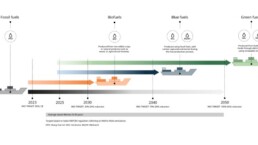
Wärtsilä has produced new modelling that shows a timeline of which fuels are likely to become widely available on a global scale, when and at what cost. To accelerate this timeline, the report argues that decisive policy implementation, industry collaboration, and individual operator action must coalesce to scale the production of these fuels.
Roger Holm, President of Wärtsilä Marine & Executive Vice President at Wärtsilä Corporation says: “Achieving net zero in shipping by 2050 will require all the tools in the toolbox, including sustainable fuels. As an industry, we must focus on coordinating action across policymakers, industry and individual operators to bring about the broad system change required to quickly and affordably produce a mix of sustainable fuels. Policy in Europe is showing just how impactful action at the international level can be, closing the cost gap between fossil- and low-carbon fuels for the first time.”
Decisive Policy: Wärtsilä’s modelling shows sustainable fuels will be 3-5 times more expensive than today’s fossil fuels in 2030. As ETS and FEUM show, policy is key to closing the price gap. The report argues that policymakers should:
- Maximise certainty: Set an internationally agreed science-based pathway for phasing out fossil fuels from the marine sector, in line with IMO targets.
- Boost cost competitiveness: Adopt a global industry standard for marine fuel carbon pricing.
- Collaborate: Increase global collaboration between governments on the innovation and infrastructure necessary to deliver sustainable fuels at scale worldwide.
Industry collaboration: The sector must collaborate with stakeholders from inside and outside shipping. The report calls on industry to:
- Pool buying power: Initiate sector-wide procurement agreements to pool demand from multiple shipping operators.
- Collaborate with other sectors: Convene with leaders in aviation, heavy transport, and industry to establish a globally recognised framework for the production and allocation of sustainable fuels.
- Share skills: Establish an industry-wide knowledge hub for the purpose of sharing expertise, skills and insights.
Individual actions: Every euro an operator saves in fuel costs at today’s prices, could be worth 3-5 times that by 2030. That means companies such as Carnival Corporation, which made a 5-10% efficiency gain through its Service Power Upgrade Program, could cut its fleetwide fuel costs by as much as $750 million per year in 2030. All operators can benefit from improving the efficiency of their vessels – the technology is readily available today.
Holm adds: “If there is one take away from our report, it is that smaller operators need not feel powerless. They have a major role in accelerating towards net-zero emissions shipping. Taking steps to improve fuel efficiency and invest in fuel flexibility can deliver immediate returns, reducing both emissions and operating costs. But action must be swift – we have the lifecycle of just a single vessel to get this right.”
Investing in fuel flexibility is the most financially viable way to avoid the risk of stranded assets. Wärtsilä has been developing multiple fuel options. Most recently, Wärtsilä launched the first commercially available 4-stroke engine for ammonia fuel, which can immediately reduce emissions by over 70%, compared to diesel.



Related News.

Predicting the Future or Preparing for It? Cyprus Marine Club Explores the Power of Adaptability with Natasa Pilides
In a world where uncertainty has become the new normal, is predicting the future really the best strategy, or is the ability to adapt the greater…

Greece and Egypt in talks to extend EEZ Eastwards towards Cyprus following Libya’s move on Turkish Maritime Pact
Athens and Cairo have agreed to advance bilateral consultations aimed at extending the geographical scope of their 2020 Exclusive Economic Zone (EEZ)…
Seafarers face widening competency gap as digital shipping accelerates, recent research finds
Eighty two per cent of maritime professionals surveyed say current training does not adequately prepare crews for the realities of modern,…

Wärtsilä and WinGD sign new Service Framework Agreement to ensure long-term continuity and support for the global fleet
Technology groups Wärtsilä and WinGD have entered into a new long-term Service Framework Agreement, reaffirming their shared commitment to supporting…
Seatrium and Karpowership sign contract for a series of whale class Powership Conversion and Integration Projects
Seatrium and its strategic partner, floating power leader Karpowership, have strengthened their longstanding collaboration with the award of a…
ClassNK releases Handbook Supporting Consideration of Onboard Carbon Capture “Onboard Carbon Capture Systems Implementation Framework”
Bringing together technical, infrastructure, regulatory and emissions assessment considerations across the OCCS value chain - ClassNK has released a…

HHLA lowers earnings forecast for the 2026 financial year
Based on the business development to date and updated estimates for the fourth quarter of 2026, the Executive Board of Hamburger Hafen und…
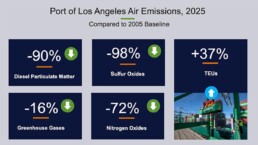
Port of Los Angeles reports lowest emissions per Container on Record
The Port of Los Angeles continued to make clean air gains in 2025, recording its lowest emissions per container on record, according to the Port's…
Drewry World Container Index – 22 Oct
WCI increased for the second consecutive week, the highest in 15 weeks. See detailed commentary below. Drewry World Container Index…
Mammoet, Port of Argentia and Argentia Capital Partner to Advance Floating Dry Dock and Marine Repair Facility
Partnership builds on Mammoet’s established presence at Port of Argentia and shared confidence in the growing market for ship repair and marine…
Subscribe to our newsletter!
if you dont want to swim alone in the ocean of news, sign up for the newsletter, and you will receive daily all the important news of world shipping!
