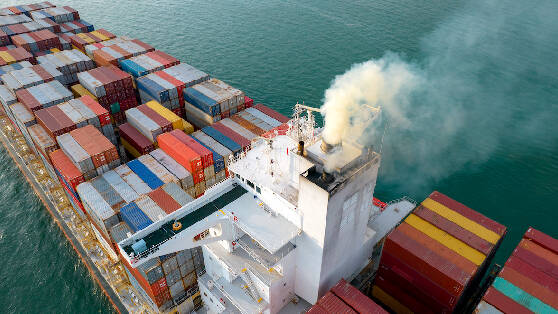

The European Union, Canada, Japan and climate-vulnerable Pacific Island states are among 47 countries rallying support for a charge on the international shipping sector’s greenhouse gas emissions, documents reviewed by Reuters showed.
The documents, being discussed at an International Maritime Organization (IMO) meeting now entering a second week, outline four proposals with a combined 47 backers for imposing a fee on each tonne of greenhouse gas the industry produces.
Support for the idea has more than doubled from the 20 nations that publicly supported a carbon levy at a French climate finance summit last year.
Backers argue the policy could raise more than $80 billion a year in funding which could be reinvested to develop low-carbon shipping fuels and support poorer countries to transition. Opponents, including China and Brazil, say it would penalise trade-reliant emerging economies.
Those countries are competing to win over the dozens of others – including most African nations – that diplomats say have yet to take a firm stance on the issue. The IMO takes decisions by consensus, but can also do so by majority support.
The U.N. agency last year agreed to target a 20% emissions cut by 2030, and net zero emissions around 2050. While countries agreed in talks last week to continue negotiations on the emissions price, an official meeting summary noted they were “split on several issues” regarding the idea.
Albon Ishoda, IMO delegate for the low-lying Marshall Islands, said a levy was the only credible route to meet the IMO’s goals.
“If this does not get passed, what are the alternatives? Because we’ve already agreed to certain targets,” he said. “Are we going back to the drawing board?”
Shipping, which transports around 90% of world trade, accounts for nearly 3% of the world’s carbon dioxide emissions – a share expected to expand in the coming decades without tougher anti-pollution measures.
A proposal tabled by the Marshall Islands, Vanuatu and others – which despite their high reliance on shipping for transport and trade have demanded an emissions levy for years – proposes a charge of $150 per tonne of CO2.
Researchers have said a $150 carbon price could make investments in low-carbon ammonia-fuelled systems economic compared with conventional ships.
“We need a transition of unprecedented scale and speed,” Vanuatu’s climate minister Ralph Regenvanu said. “Low-cost solutions, hybrid proposals aren’t going to do the job.”
Another submission, from the 27-country EU, Japan, Namibia, South Korea, industry group the International Chamber of Shipping and others, advocates combining a price on shipping emissions with a global emissions standard for maritime fuel.
An IMO meeting in September serves as a deadline for countries to decide whether to take forward both the fuel standard and an emissions price. A senior EU official said the bloc believes “only the two together can suffice” to meet the IMO’s targets.
Diplomats said a fuel standard, at least, is likely to be taken forward.
DISAGREEMENT
China, Brazil and Argentina pushed back on the idea of a CO2 levy in IMO talks last year. A study by Brazil’s University of Sao Paulo found a carbon tax on shipping would cut GDP across developing countries by 0.13%, with Africa and South America among the hardest-hit regions.
A Brazilian negotiator said Brazil and other developing countries were seeking a swift energy transition with the least disruptive effects on their economies, especially for countries that rely on sea-borne trade.
A proposal by Argentina, Brazil, China, Norway, South Africa, the United Arab Emirates and Uruguay advocates a global fuel emissions intensity limit, with a financial penalty for breaches, as an alternative to a levy on all shipping emissions.
That would mean if countries fully complied with the fuel standard, no emissions would face the fee.
“We will not be in favour of a flat levy likely to hurt developing countries, but we would be in favour of a good levy only applied to the emissions over a certain benchmark,” the Brazilian negotiator said.
WIGGLE ROOM
Despite differences of opinion, member states are still attempting to agree on global measures to avoid more countries targeting the industry on a national level. That would fragment the market with varying local standards, and cause a headache for firms shipping goods globally.
The EU for one has said it may bring more international shipping emissions into its local CO2 market if the IMO does not agree a global emissions price by 2028.
Questions over who would administer a charge, and how its proceeds would be reinvested, are also still open.
Diplomats have suggested a compromise could lie in the IMO deciding on a carbon price designed to ensure it would not need to be accounted for as a tax – for example, by designing the policy for the principal aim of cutting emissions, rather than raising revenues.
A proposal by Canada suggests the IMO agree the core design of an emissions price, but delay a decision on how its revenues would be spent – a politically divisive issue that scuppered previous talks.
The Marshall Islands’ Ishoda said he hoped disputes over the details would not prevent a deal.
“If we were able to move a mile, we end up moving an inch, because we argue about everything under the sun,” he said.
Source: Reuters



Related News.

Cyprus Maritime Innovation takes Centre Stage at SMM Hamburg 2026
Underscoring its expanding role as a premier international hub for cutting-edge maritime technology and sustainable shipping, the Republic of Cyprus…

Trump seeks to refill US oil reserve with Venezuela deal but faces long delay
U.S. President Donald Trump said on the 30th (local time) that he would refill the U.S. Strategic Petroleum Reserve, which has been depleted with…
US Navy Official visits South Korean Shipyards in private
With U.S. President Donald Trump pushing a plan to allow overseas construction of U.S. warships, attention is focusing on whether the building of…
SES and De Boer Marine expand collaboration with FlexMaritime deployment across Global Markets
SES, a leading space solutions company, and De Boer Marine, a leading provider of top-quality marine equipment and maritime connectivity services,…

New ESG guidance to help maritime industry turn sustainability into commercial advantage
New framework helps shipowners and ports align ESG strategy with access to capital, charterer expectations and long-term asset value. Maritime…

Britannia P&I Club analysis finds four in five crew deaths linked to illness rather than accidents
New report highlights cardiovascular disease as leading cause of fatalities and raises concerns over mental health risks among younger seafarers.…

The Swedish Club launches new Loss Prevention podcast, Knot Another Lesson
The Swedish Club has launched Knot Another Lesson, a new podcast exploring the practical lessons, emerging risks and operational challenges shaping…

Lloyd’s Register appoints Jens Grunenberg as Senior Representative for Germany
Lloyd’s Register has appointed Jens Grunenberg as its Senior Representative for Germany, effective 1 September. Based in Hamburg, Grunenberg will…
Indian Register of Shipping sets sights on Hamburg for European Expansion
Indian Register of Shipping, a leading international classification society and full member of the International Association of Classification…
MOL completes Merger of 6 Ship Management Companies
Unifying Management of Over 200 Vessels and Strengthening Safety Mitsui O.S.K. Lines, announced that it has completed the integration of the MOL…
Subscribe to our newsletter!
if you dont want to swim alone in the ocean of news, sign up for the newsletter, and you will receive daily all the important news of world shipping!
