Landmark study on offloading onboard captured carbon dioxide identifies low port readiness as key barrier to large-scale commercialisation
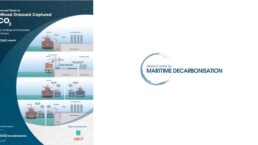

- Infrastructure and procedures for handling captured carbon dioxide at ports are currently inadequate.
- Defining clear pathways to offload, utilise, and/ or sequester CO2, is crucial for large-scale commercialisation of onboard carbon capture and storage
A recent study commissioned by the Global Centre for Maritime Decarbonisation, in collaboration with Lloyd’s Register and ARUP, has identified low port readiness as a major hurdle bottlenecking the adoption of Onboard Carbon Capture and Storage system as a practicable decarbonisation solution. Whilst the technologies required for offloading onboard captured CO2 exist at high levels of maturity, safe operationalisation of captured CO2 transfer by trained personnel has not been demonstrated.
The report, titled “Concept study to offload onboard captured CO₂,” found that while a limited number of ports possess the infrastructure to offload liquefied CO2 (LCO2), they are primarily designed to handle food-grade CO2. The higher purity standards that accompany this use limits the interoperability of facilities to handle onboard captured CO2.
The study examined over ten planned LCO2 related infrastructure projects worldwide. Located near, or with transport links from, CO2-emitting industrial clusters, these projects are likely to handle much larger volumes of captured CO2 than that from OCCS systems; port infrastructure needed for offloading, storing and transporting onboard captured CO2 will likely need to be integrated with these projects for economies of scale. However, as many of such projects remain in concept phase and have not reached Final Investment Decision (FID), ports have not proceeded with offloading infrastructure investments. This chicken-and-egg dilemma highlights the overall infancy of the carbon value chain.
Furthermore, introducing LCO2 offloading into already complex port operations will likely impact port efficiency and operational performance. The need for additional buffer zones to address the safety concerns of LCO2 handling and storage will also add to existing space constraints at ports and terminals.
About the study: Addressing the gap in the carbon capture value chain
This 9-month long study aims to address a gap in the onboard carbon capture value chain. OCCS has recently gained traction as a potential interim solution to help international shipping meet IMO’s emissions reduction targets, with potential deliberations at future Marine Environment Protection Committee (MEPC) sessions. While achieving emissions reductions through OCCS hinges on successfully integrating a shipboard-compatible system within space constraints, equally important is addressing the fate of captured CO2 by establishing its utilisation or sequestration pathways.
This study complements GCMD’s Project REMARCCABLE (Realising Maritime Carbon Capture to demonstrate the Ability to Lower Emissions) by addressing the feasibility of OCCS as a practicable, end-to-end solution at scale. For OCCS systems to be operationally feasible, the industry needs to develop a collaborative ecosystem to enable the value chain for managing captured CO2.
By systematically considering the needs of the entire value chain, this study evaluated four concept configurations of offloading infrastructure from a possible 162 scenarios, identified the operational standards and safety guidelines for handling LCO2, developed models for the quantification of costs for scaled-up infrastructure, articulated manpower competency frameworks for offloading operations, and analysed the potential regulatory scenarios needed to address the current uncertainties surrounding LCO2 offloading from OCCS.
Concepts for safe offloading of LCO2
One of the key considerations is to examine how LCO2 can be offloaded safely to the appropriate infrastructure.
The study determined that captured CO2 in its liquefied form is likely the most efficient and cost-effective option for onboard storage and transport. Based on this, the study shortlisted four concepts covering key offloading modalities, such as Ship-to-Ship and Ship-to-Shore, serving as building blocks that can be combined to cover a wider range of offloading concepts. (Please refer to Appendix I for the infographics on these four concepts).
In ranking the operability of these concepts, the study identified Ship-to-Ship and Ship-to-Shore transfers using an intermediate LCO2 receiving vessel as the most promising modalities for offloading at scale, with captured CO2 eventually sequestered or used as feedstock for manufacturing synthetic fuels.
Ship-to-Terminal transfer of captured CO2 stored in ISO tank containers was identified to be more compatible at smaller scales and for end uses that require higher grades of CO2. This modality of transfer is also most compatible with existing port infrastructure and therefore easier to pilot today.
Safety considerations handling LCO2
Handling LCO2 onboard presents a unique set of safety challenges not commonly encountered when handling fuels in shipping. The study offers an in-depth examination of hazards, such as asphyxiation and toxicity, if a leak or a loss of containment takes place.
Unique to CO2 is evaluation of its storage at conditions near its triple point, where the gaseous, liquid and solid phases of CO2 co-exist. Storage at or near the triple point is sensitive to impurities, and minor changes in temperature and pressure can lead to a phase change from liquid to solid CO2, leading to hazardous situations, such as blockage in pipes and build-up of pressure.
To address these hazards, a series of safety studies, including a Hazard Identification (HAZID) of offloading, Simultaneous Operations (SIMOPS) and a coarse Quantitative Risk Analysis (QRA), were conducted and mitigation measures and emergency response procedures articulated for handling LCO2.

Professor Lynn Loo, CEO of GCMD, said, “While pilots have successfully demonstrated numerous capture technologies onboard ships, it is still uncertain how captured carbon on merchant ships can be safely offloaded, and what the rest of the value chain looks like. This study sheds light on these challenges, and highlights recommendations to holistically address these concerns for parties interested in advancing OCCS / LCO2 offloading concepts.”

Nick Brown, LR CEO said: “The maritime industry requires a comprehensive understanding of the safety and operational challenges posed by all emission reduction technologies. This study, which focused on port readiness and considerations for the safe handling and offloading of LCO2, addresses some of the gaps that exist in the carbon capture value chain and will support industry stakeholders in making informed investment decisions around carbon capture solutions and the creation of regulatory and operational guidelines.”

Robert Cooke, Design Lead of Arup said, “As a result of the study, it has been promising to see how transferable existing CO2 industrial knowledge is to an offloading application. Arup brought together energy and maritime capabilities to outline the concepts for onboard captured CO2offloading and develop how this new process can practically and safely integrate into busy port environments. We look forward to seeing the technologies and implementation develop into effective marine decarbonisation solutions.”



Related News.
Columbia Group calls for greater focus on retaining women at sea as second She Beyond Conference takes place
Columbia Group has called on the maritime industry to create a future where women can thrive, progress and lead at sea, as it celebrated the second…
Neptune Group Welcomes “NIKOS TRAVLOS”
The new vessel proudly bears the name of Neptune's founder, who laid the foundation for the creation and enduring evolution of the Group. Her…

Wildcat Defense enters into exclusive agreement to acquire Fraser Shipyards
American family firm takes the next step in its strategy to rebuild U.S. shipbuilding and repair capacity, following its offer for Austal USA.…

Kawasaki signs strategic partnership MOU with Romania’s Transgaz for Onshore Hydrogen Gas Transport
Establishing a model for large-scale hydrogen supply and transport via pipelines Kawasaki Heavy Industries, announced at the Romania–Japan…

UK P&I Club and TT Club secure regulatory approval for Thomas Miller acquisition
The UK P&I Club and TT Club announce the successful completion of their joint acquisition of the Thomas Miller Holdings group, marking a major…

Valenciaport presents its Sandbox at PEIC’26 as a tool to bridge the gap between innovation and implementation
The opening session featured a discussion between Valenciaport President Mar Chao and Valenciaport Foundation Director Antonio Torregrosa. The…

Major investments strengthen Gothenburg RoRo Terminal
Expanded terminal areas, new rail connections and modernised quays are among the investments that have strengthened Gothenburg RoRo Terminal in…
ABP appoints key roles in the Humber
Associated British Ports has made two key appointments at its container terminals strengthening its unitised operations at the ports of Immingham…
Xinhua Silk Road 2026 North Bund Forum unveils 20 shipping-related achievements
The 2026 North Bund Forum opened in Shanghai on October 20 with 20 key shipping-related achievements spanning international cooperation, green…
Ports encouraged to prepare now for advanced nuclear in maritime and clean energy
New joint Lloyd’s Register and British Ports Association paper sets out a practical readiness pathway for ports considering nuclear-powered vessels,…
Subscribe to our newsletter!
if you dont want to swim alone in the ocean of news, sign up for the newsletter, and you will receive daily all the important news of world shipping!
