thyssenkrupp Veerhaven is planning the climate-friendly pusher tug of the future
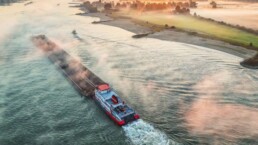

- Dutch logistics subsidiary of thyssenkrupp Steel Europe commissions individual designs for an innovative pusher tug with environmentally friendly propulsion
- thyssenkrupp Veerhaven sets course for efficiency and sustainability in its future fleet renewal
- The use of alternative fuels such as methanol is aimed to reduce the fleet’s CO2 emissions at a stroke – a first in this specific area of inland waterway shipping
- Another building block in the decarbonization of thyssenkrupp Steel’s supply chai
thyssenkrupp Veerhaven’s plans for the pusher tug of the future are taking shape: The logistics subsidiary of thyssenkrupp Steel Europe, based in Rotterdam, has commissioned two specialized design offices to draw up designs for a climate-friendly pusher tug. For the pusher tug shipping company thyssenkrupp Veerhaven, this is the next port of call on its voyage to the sustainable fleet of the future. Following the evaluation, the current seven pusher boats are to be gradually superseded by environmentally and climate-friendly models at the end of their technical service life, as far as possible.
Sustainable pusher tug: thyssenkrupp Veerhaven plans to use methanol and optimize low-water capabilities
thyssenkrupp Veerhaven wants to make its fleet climate-friendly with the new generation of pusher boats. The seven pusher tugs operated by thyssenkrupp Veerhaven ply a route between Europoort Rotterdam and the Ruhr area throughout the year, transporting around 18 million metric tons of raw materials for the iron and steel plants. The plans to use methanol as a fuel could save around 80 percent of current CO2 emissions, compared to the fossil fuel diesel. The level of the River Rhine will tend to dip below critical levels more and more frequently during the summer months due to the progression of climate change, which means the planned ship will also be optimized for lower water levels.
Overall, thyssenkrupp Veerhaven is venturing into uncharted waters with these plans. Replacing diesel by environmentally friendly fuels remains a dream of the future in this class of large pusher tugs, and has not yet been implemented by any company. “In this challenging area of inland waterway shipping, there are currently no vessels that run on environmentally friendly fuels such as methanol. We intend to play a pioneering role and, with our planned fleet modernization, we are laying the foundation for innovative technologies that will significantly reduce our carbon footprint,” says thyssenkrupp Veerhaven CEO Frank Tazelaar.
CO2 reduction along the entire supply chain
For thyssenkrupp Veerhaven, the CO2 reduction would contribute to its own Scope 1 emissions and, as a service provider, to the Scope 3 emissions of its customers. The parent company thyssenkrupp Steel will also benefit from this. In an effort to minimize Scope 3 emissions, the steelmaker is focusing on decarbonizing its entire supply chain. One example of a project in this respect is the collaboration with lime manufacturer Lhoist Germany. Lhoist plans to save around one million metric tons of CO2 in the coming years to support the production of green steel with carbon-neutral lime.
Another example for reducing climate-damaging gases in the supply chain is the use of climate-friendly services offered by DB Cargo. Although thyssenkrupp Steel has been relying on environmentally friendly rail transport between its sites for some time, the switch to DBeco solutions for train connections between the various locations will cut down CO2 emissions even further. This is because thyssenkrupp Steel relies on DBeco plus, i.e. 100 percent green electricity, for the electrified lines, whereas DBeco fuel, i.e. hydrotreated vegetable oils (HVO), is used on the diesel routes.
Design diversity for the next generation of pusher tugs
thyssenkrupp Veerhaven takes an innovative approach in its planning process. Normally, thyssenkrupp Veerhaven directly commissions the shipyards to build a new vessel. “For the uncharted waters of sustainable fuels, however, we took an innovative approach and arranged for specialist design offices to prepare offers for three separate designs,” says Tazelaar. These include reference vessels as well as low-water push boats with Stage V propulsion and dual-fuel/methanol-capable variants. After the selection process, thyssenkrupp Veerhaven commissioned the design offices C-Job Naval Architects and Kooiman Marine Group to design the next generation of pusher tugs.
After receiving the designs, thyssenkrupp Veerhaven will evaluate their technological and economic feasibility. As the oldest ship in the fleet will soon reach the end of its technical service life, thyssenkrupp Veerhaven is planning to order the first “pusher tug of the future” in the near term, assuming the investment decision is positive.



Related News.
Columbia Group calls for greater focus on retaining women at sea as second She Beyond Conference takes place
Columbia Group has called on the maritime industry to create a future where women can thrive, progress and lead at sea, as it celebrated the second…
Neptune Group Welcomes “NIKOS TRAVLOS”
The new vessel proudly bears the name of Neptune's founder, who laid the foundation for the creation and enduring evolution of the Group. Her…

Wildcat Defense enters into exclusive agreement to acquire Fraser Shipyards
American family firm takes the next step in its strategy to rebuild U.S. shipbuilding and repair capacity, following its offer for Austal USA.…
Kawasaki signs strategic partnership MOU with Romania’s Transgaz for Onshore Hydrogen Gas Transport
Establishing a model for large-scale hydrogen supply and transport via pipelines Kawasaki Heavy Industries, announced at the Romania–Japan…

UK P&I Club and TT Club secure regulatory approval for Thomas Miller acquisition
The UK P&I Club and TT Club announce the successful completion of their joint acquisition of the Thomas Miller Holdings group, marking a major…
Valenciaport presents its Sandbox at PEIC’26 as a tool to bridge the gap between innovation and implementation
The opening session featured a discussion between Valenciaport President Mar Chao and Valenciaport Foundation Director Antonio Torregrosa. The…
Major investments strengthen Gothenburg RoRo Terminal
Expanded terminal areas, new rail connections and modernised quays are among the investments that have strengthened Gothenburg RoRo Terminal in…
ABP appoints key roles in the Humber
Associated British Ports has made two key appointments at its container terminals strengthening its unitised operations at the ports of Immingham…
Xinhua Silk Road 2026 North Bund Forum unveils 20 shipping-related achievements
The 2026 North Bund Forum opened in Shanghai on October 20 with 20 key shipping-related achievements spanning international cooperation, green…
Ports encouraged to prepare now for advanced nuclear in maritime and clean energy
New joint Lloyd’s Register and British Ports Association paper sets out a practical readiness pathway for ports considering nuclear-powered vessels,…
Subscribe to our newsletter!
if you dont want to swim alone in the ocean of news, sign up for the newsletter, and you will receive daily all the important news of world shipping!
