Asian oil demand growth in focus as OPEC+ move carves out supply roadmap

Asian crude buyers are unlikely to face a supply squeeze following extended production cuts by OPEC+ and Russia’s move to slash output by an extra round, as plentiful non-OPEC supplies are set to fill the potential void, trade sources and analysts told S&P Global Commodity Insights.
While the recent developments have largely laid out a clear near-term supply roadmap for global crude oil for the next few months, a feeble market reaction to those decisions suggests that demand growth, mainly in Asia, may fall short of pick up in overseas supply on the back of rising production in countries such as the United States and Brazil.
“Non-OPEC production growth continues to outstrip OPEC growth despite higher expected year-on-year increase in OPEC oil production in Q3 and Q4 2024,” analysts at S&P Global said in a note.
Saudi Arabia, Iraq, the UAE and several other OPEC+ countries said March 3 they planned to maintain some 1.7 million b/d in output curbs through the end of June. The quotas were originally scheduled to expire at the end of March, but the alliance decided to keep a tighter grip on supplies.
Russia, on the other hand, said it would implement a new formula that would gradually convert its previous export cuts into crude production cuts over that span. Moscow plans to reduce crude output by 350,000 b/d and cut exports by 121,000 b/d in April; drop production by 400,000 b/d and exports by 71,000 b/d in May; and reduce production by 471,000 b/d in June.
“Even as OPEC+ continues to curtail production level in an effort to prop up crude prices, non-OPEC production is set to increase. The US production is one of key significance as it is now competing with the OPEC exporter as a swing producer and effectively managing prices,” said Rajat Kapoor, managing director for oil and gas at Synergy Consulting.
Supply balance
The International Energy Agency said earlier in February that with stronger-than-expected output from key American producers this year, it expected global oil supplies to average a record 103.8 million b/d in 2024.
Combined, the US, Brazil, Guyana, and Canada are forecast to add 1.4 million b/d of new oil production. Non-OPEC+ producers together are set to add 1.6 million b/d, according to the IEA.
“All this new oil is finding ready markets which used to traditionally rely in Middle Eastern suppliers, leading to what we see an oversupply in the market, leading to price weakness,” Kapoor said.
OPEC+ production cuts are no longer a concern for crude importers in the Far East as refiners across South Korea, Japan, Taiwan, Thailand, Vietnam are not facing any major issues securing their staple Middle Eastern sour crude, thanks largely to India’s strong preference for Russian barrels.
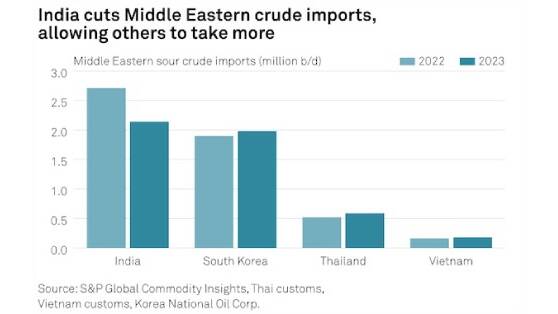
India sharply increased Russian crude imports to 1.2 million b/d in 2023, up over 900,000 b/d from 2022, but slashed Middle Eastern crude purchases by around 550,000 b/d to 2.14 million b/d last year, S&P Global data showed.
India’s sharp reduction in Persian Gulf crude imports last year allowed many other key regional buyers to access ample sour crude supplies with Asia’s third-biggest crude importer South Korea picking up additional 100,000 b/d of Middle Eastern crude in 2023, while Thailand and Vietnam combined managed to import 80,000 b/d more last year, according to S&P Global’s calculation and analysis of Asia-wide official government trade data.
“Supply security remains firmly intact regardless of the OPEC+ cuts,” said a feedstock manager at Japan’s biggest refiner ENEOS.
Asian commitments
Abu Dhabi National Oil Co. has likely allocated full term supplies to its Asian buyers for May-loading crude, according to market participants surveyed by S&P Global Feb. 29.
“We are seeing on average 3-5 more VLCCs per month of US crude offered to Asian buyers compared to previous few years,” said a feedstock and logistics manager at a major South Korean refiner.
South Korea, the top Asian buyer of US crude, picked up 14.21 million barrels, or more than seven VLCCs in January, latest data from Korea National Oil Corp. showed.
Taiwan’s US crude imports rose 27.9% on the year to 252,113 b/d in January, while Japan almost doubled its US crude intake to 130,578 b/d in the same month from 71,142 b/d a year earlier, data from Taiwan’s Ministry of Economic Affairs and Japan’s Ministry of Economy, Trade and Industry showed.
According to S&P Global, the Asian macroeconomic outlook remains stable on moderate recovery in China and resilient growth in India. As a result, it revised its regional oil demand higher for the first quarter on stronger-than-expected transport demand in China during the Lunar New Year holidays and firmer bunker demand in Singapore amid the Red Sea diversions.
Asia’s total liquids demand will likely grow 353,000 b/d on the quarter in Q1 2024 on the back of positive demand growth in China and Southeast Asia, according to S&P Global. However, a seasonal lull will return in the second quarter when total regional liquids demand is set to contract by a total of 583,000 b/d in the majority of the markets in Asia, except China.
Source: Platts



Related News.

Cyprus Maritime Innovation takes Centre Stage at SMM Hamburg 2026
Underscoring its expanding role as a premier international hub for cutting-edge maritime technology and sustainable shipping, the Republic of Cyprus…

Trump seeks to refill US oil reserve with Venezuela deal but faces long delay
U.S. President Donald Trump said on the 30th (local time) that he would refill the U.S. Strategic Petroleum Reserve, which has been depleted with…
US Navy Official visits South Korean Shipyards in private
With U.S. President Donald Trump pushing a plan to allow overseas construction of U.S. warships, attention is focusing on whether the building of…

SES and De Boer Marine expand collaboration with FlexMaritime deployment across Global Markets
SES, a leading space solutions company, and De Boer Marine, a leading provider of top-quality marine equipment and maritime connectivity services,…

New ESG guidance to help maritime industry turn sustainability into commercial advantage
New framework helps shipowners and ports align ESG strategy with access to capital, charterer expectations and long-term asset value. Maritime…

Britannia P&I Club analysis finds four in five crew deaths linked to illness rather than accidents
New report highlights cardiovascular disease as leading cause of fatalities and raises concerns over mental health risks among younger seafarers.…

The Swedish Club launches new Loss Prevention podcast, Knot Another Lesson
The Swedish Club has launched Knot Another Lesson, a new podcast exploring the practical lessons, emerging risks and operational challenges shaping…

Lloyd’s Register appoints Jens Grunenberg as Senior Representative for Germany
Lloyd’s Register has appointed Jens Grunenberg as its Senior Representative for Germany, effective 1 September. Based in Hamburg, Grunenberg will…

Indian Register of Shipping sets sights on Hamburg for European Expansion
Indian Register of Shipping, a leading international classification society and full member of the International Association of Classification…

MOL completes Merger of 6 Ship Management Companies
Unifying Management of Over 200 Vessels and Strengthening Safety Mitsui O.S.K. Lines, announced that it has completed the integration of the MOL…
Subscribe to our newsletter!
if you dont want to swim alone in the ocean of news, sign up for the newsletter, and you will receive daily all the important news of world shipping!
