BV research confirms central role of operational and energy efficiency in meeting shipping’s 2050 carbon budget


Decarbonisation simulations reveal the cumulative impact of operational and technical efficiency measures and showcase the importance of energy insetting in bridging the price gap between conventional and new fuels
Bureau Veritas, a world leader in testing, inspection and certification, has unveiled the results of new modeling research which confirmed the potential hefty cumulative impact of operational and technical efficiency measures in keeping shipping within its “carbon budget” to 2050.
Titled Decarbonization Trajectories, the report examines possible decarbonization pathways for the shipping industry through five distinct scenarios. Each scenario considers several parameters such as socio-economic forecasts for the evolution of demand for maritime transport, the possible speed for the uptake of green fuels and technical efficiency improvements in shipping. Using a bottom-up model that accounts for the particularities of each shipping segment and ship types, the study calculates the resulting GHG emissions for the industry as a whole, providing realistic insight into what decarbonization could look like under different variables.
The research highlights the cumulative impact of immediate actions in keeping shipping within its GHG emissions “budget” to 2050, a concept which accounts for all emissions released into the atmosphere before reaching the carbon neutrality threshold.
The simulations show that under a “central progressive” scenario, which would see moderate growth in maritime transport and a large uptake of bio and synthetic fuels, implementing measures such as reducing speed and waiting times could reduce total GHG emitted in the atmosphere by 44% for the period between 2020 and 2050.
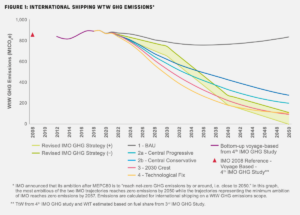
The BV study emphasizes that waiting for low-emission fuels and new propulsion technologies to mature will not be sufficient to keep shipping within its carbon budget without taking other immediate actions. In addition to reducing speed and waiting times, it identifies voyage optimization, weather routing, energy saving devices and wind assisted propulsion as practical solutions that the industry can implement today.
The report also highlights the potentially critical role of energy insetting to bridge the price gap between conventional and very-low carbon fuels, which are predicted to be significantly more costly than fossil fuels under all projections. With clear signals traveling all along the value chain, energy insetting could prove a promising pathway to stimulating the at-scale production of renewable and low-carbon fuels.

Paul Delouche, Strategy, Acquisitions and Advanced Services Director, Bureau Veritas Marine & Offshore and lead author of the report, said: “The starting point for this study was to ask what measures can bring the most impact through the right lens, using a GHG budget approach. To have a realistic understanding of shipping’s energy transition, we need to consider that the overall decarbonization of the sector will be made up of multiple overlapping trajectories. The bottom-up model developed by BV M&O captures this complexity, accounting for the huge diversity in vessel types, segments and technologies, but also taking into account wider market and supply chain dynamics.
“Our findings highlight the potential hefty impact on total GHG emissions to 2050 that shipping can achieve through the immediate adoption of available solutions. As well as the benefits of operational measures and energy-saving technologies, our study helps us better understand the potential and urgent need for solutions like energy insetting to bridge the cost gap and provide pathways for the earliest possible adoption of new fuels. This will require an approach to decarbonization that reaches across value and supply chains, emphasizing traceability.”



Related News.
Columbia Group calls for greater focus on retaining women at sea as second She Beyond Conference takes place
Columbia Group has called on the maritime industry to create a future where women can thrive, progress and lead at sea, as it celebrated the second…
Neptune Group Welcomes “NIKOS TRAVLOS”
The new vessel proudly bears the name of Neptune's founder, who laid the foundation for the creation and enduring evolution of the Group. Her…

Wildcat Defense enters into exclusive agreement to acquire Fraser Shipyards
American family firm takes the next step in its strategy to rebuild U.S. shipbuilding and repair capacity, following its offer for Austal USA.…
Kawasaki signs strategic partnership MOU with Romania’s Transgaz for Onshore Hydrogen Gas Transport
Establishing a model for large-scale hydrogen supply and transport via pipelines Kawasaki Heavy Industries, announced at the Romania–Japan…

UK P&I Club and TT Club secure regulatory approval for Thomas Miller acquisition
The UK P&I Club and TT Club announce the successful completion of their joint acquisition of the Thomas Miller Holdings group, marking a major…

Valenciaport presents its Sandbox at PEIC’26 as a tool to bridge the gap between innovation and implementation
The opening session featured a discussion between Valenciaport President Mar Chao and Valenciaport Foundation Director Antonio Torregrosa. The…

Major investments strengthen Gothenburg RoRo Terminal
Expanded terminal areas, new rail connections and modernised quays are among the investments that have strengthened Gothenburg RoRo Terminal in…

ABP appoints key roles in the Humber
Associated British Ports has made two key appointments at its container terminals strengthening its unitised operations at the ports of Immingham…

Xinhua Silk Road 2026 North Bund Forum unveils 20 shipping-related achievements
The 2026 North Bund Forum opened in Shanghai on October 20 with 20 key shipping-related achievements spanning international cooperation, green…

Ports encouraged to prepare now for advanced nuclear in maritime and clean energy
New joint Lloyd’s Register and British Ports Association paper sets out a practical readiness pathway for ports considering nuclear-powered vessels,…
Subscribe to our newsletter!
if you dont want to swim alone in the ocean of news, sign up for the newsletter, and you will receive daily all the important news of world shipping!
