Biofuel reduces the climate impact from a Green Sea Conference by 90 per cent
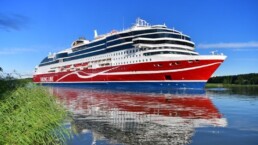

Viking Line’s latest sustainability innovation, the Green Sea Conference, reduces greenhouse gas emissions from a conference trip by an average of 90 per cent and satisfies the desires of environmentally conscious corporate customers. Each year about 600,000 passengers travel with groups or conferences on Viking Line’s vessels, and all aspects involved in a sea conference have now been subject to a comprehensive sustainability assessment.
Sea conferences have regained their previous popularity after several years of the COVID pandemic. This year, Viking Line’s conference capacity on its Helsinki route is being further expanded, when Viking Cinderella returns to Finland, working in tandem with Gabriella. Sea conferences on Viking Line’s vessels are usually arranged for groups with fewer than 30 people, but meetings for 300–500 people are also held frequently. Sometimes major sea seminars can host up to one thousand participants.
Viking Line is now launching its Green Sea Conferences, a new sustainable alternative for conference planners. Greenhouse gas emissions per participant are on average 90 per cent lower for a Green Sea Conference than for the normal conference product. Green Sea Conferences are offered on all departures on the two climate-smart vessels, Viking Glory and Viking Grace, in service on the Turku route.
“Our customers choose sea conferences above all to combine work and pleasure in a cost-effective way, keep the group together and at the same time meet people’s need for physical meetings, a need that has become stronger in recent years. With our new conference product, we can provide all this in such a way that the carbon footprint of their conference trip is small,” says Philip Sjöstrand, Head of Sales at Viking Line.
“Emissions from a Green Sea Conference are lower because customers who have opted for such a journey travel using renewable biofuel. We have also carried out a detailed sustainability assessment of the other components that are part of a conference trip. Each year more than 19,000 group and conference events with a total of some 600,000 participants are held on our vessels. This means every choice that increases sustainability makes a big difference,” says Marika Immonen, Head of Customer Experience at Viking Line.
Everyone who takes part in Viking Line’s conferences can see the sustainable choices that are made, including the organic coffee served in the conference facilities, the preference for information provided digitally rather than in printed form, the restaurants’ use of locally sourced ingredients based on seasonal availability, and an ambitious focus on reducing food waste. All waste generated on Viking Line’s vessels is recycled, and food waste is recirculated as raw material for biogas on most of the company’s vessels.
Viking Line’s corporate customers were involved from the very start in the work to develop the company’s Green Sea Conferences. Conference planners who opt for this package get a carbon footprint report for their trip if they wish.
“Each year, companies set increasingly ambitious sustainability goals, and it has also become more and more important to employees that their employer’s business is sustainable. By choosing a Green Sea Conference, such conference planners are pioneers and can be certain that the emissions from their conference have been minimized. As early as last summer, we started giving our leisure travellers the option of choosing biofuel,” says Viking Line’s Sustainability Manager, Dani Lindberg.
Viking Line’s environmental journey
1980s
• Viking Line stops using toxic paint for the bottoms of its vessels, and divers start cleaning vessel bottoms.
• Recycling waste on board the vessels begins.
• First land-based power supply is placed in service in Stockholm. Today a land-based power supply is also used in Helsinki, Mariehamn and Tallinn.
1990s
• The switch to fuel with a low sulphur content reduces sulphur dioxide emissions.
• The wastewater on board the company’s vessels starts being pumped ashore for treatment.
• Cold seawater is used to cool the ventilation air on board the vessels, and the air on board is heated using energy recovered from flue gases.
2000s
• Viking Line is the first shipping company in the world to use Humid Air Motor technology to reduce nitrogen oxide emissions. By using seawater for cooling, the combustion temperature of the vessel’s engines is lowered.
• Nitrogen oxide emissions on Viking Cinderella are reduced when catalytic converters are installed on the vessel.
• Recycling of organic waste starts on board Viking XPRS.
2010s
• The new vessel Viking Grace uses 100% sulphur-free liquefied natural gas (LNG) as a fuel. The climate-smart vessel reduces nitrogen emissions by 85% and greenhouse gas emissions by 15% compared to a vessel that runs on oil. With LNG, there are essentially zero particulate matter emissions.
• Viking Grace tests a rotor sail, thus becoming the world’s first hybrid vessel to use both LNG and wind power. The vessel is equipped with an energy recovery system that converts surplus heat into electricity.
2020s
• Flow regulators are installed on Viking Gabriella and Viking XPRS, which reduces fuel consumption and carbon dioxide emissions.
• The new vessel Viking Glory is placed in service in March 2022. The vessel’s engines enable optimal fuel utilization and do not produce any sulphur emissions.
• Thanks to Viking Glory’s Azipod steerable propeller-mounted propulsion system, the vessel is easy to manoeuvre in port, which saves time and fuel. The shape of the vessel’s hull reduces the formation of waves as well as fuel consumption.
• Viking Glory is also a pioneer in utilizing waste cooling from LNG. The energy recovery system generates up to 40% of the electricity the vessel needs for passenger functions.
• Viking Line starts offering passengers on Viking Glory and Viking Grace the option to purchase biogas equivalent to the amount used for their own travel and thus reduce emissions generated by their travel by an average of 90%. Starting in early 2024, climate offset is also included in the company’s Green Sea Conference package, which can be purchased for conference trips on the Turku route.



Related News.

Crewing After 2026: How AI Will Take Over the Routine in 2027
The crewing market of late 2026 is not the market of 2025. Artificial intelligence has moved from presentations into daily crewing work, while the…

Dualog launches secure maritime AI service amid surge in seafarer AI use
The new service, Sparks lets crew and shore teams search company emails, documents and conversations without exposing sensitive fleet information to…

Time Ticking: Two weeks for Governments to Green-Light Framework for Cutting Shipping Emissions
As a crucial fortnight of meetings opens at the International Maritime Organization opens in London, the Clean Shipping Coalition calls on member…

“K” LINE signs contract for construction of two LPG dual-fuel VLGCs
Kawasaki Kisen Kaisha, announces today that it has signed agreements with South Korea-based HD Hyundai Samho regarding the construction of two LPG…

Equinor and VNG sign 18-year gas sales agreement for supplies to Germany
Equinor will supply natural gas to the German energy company VNG until the end of 2044. The 18-year agreement is the longest gas sales agreement…

Open letter to MEPs to reject the motion for a resolution and support the inclusion of Indian ship recycling yards on the European List
Dear Members of the European Parliament, Ahead of this week’s plenary vote, European Shipowners | ECSA, BIMCO, the Cruise Lines International…

ShipVet appoints James Stairmand as Chief Executive Officer
Founder Captain Fintan Cullen moves to a non-executive role as the company builds on investment in its vetting team and technology. ShipVet, the…

USD ≈7bn lost per year the hidden cost of how shipping trades
New Torvald Klaveness study quantifies around USD 7bn a year in potentially avoidable costs in dry bulk and product tanker shipping, with a possible…

APM Terminals Maasvlakte II and Port of Rotterdam Authority take next step in terminal development
APM Terminals Maasvlakte II and the Port of Rotterdam Authority are moving forward in terminal’s development with preparations for a new phase of…

ABP inspiring the next generation
ABP host 500 young people to explore maritime and transport careers More than 500 young people from across Hampshire and the Solent explored career…
Subscribe to our newsletter!
if you dont want to swim alone in the ocean of news, sign up for the newsletter, and you will receive daily all the important news of world shipping!
