Red Sea chokepoints are critical for international oil and natural gas flows
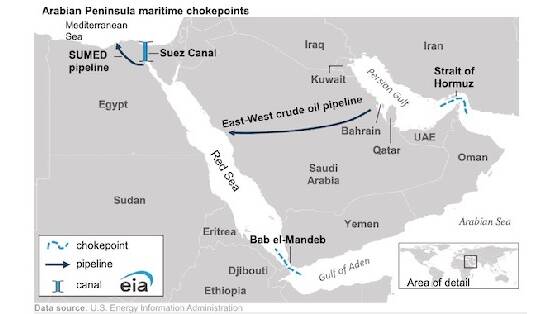


Oil shipments
Northbound oil flows toward Europe via the Suez Canal and SUMED pipeline fell between 2018 and 2020. Renewed U.S. sanctions on Iran reduced all exports from Iran, including those through the Suez Canal. In addition, less crude oil and oil products from Middle East producers moved through the Suez Canal because Europe imported less oil from the Middle East and more from the United States. The COVID-19 pandemic further reduced flows through the Suez Canal because of slowing global oil demand.

In the first half of 2023, northbound crude oil flowing through the Suez Canal and SUMED pipeline had increased by more than 60% from 2020, as demand in Europe and the United States rose from pandemic-induced lows. Also, Western sanctions on Russia’s oil beginning in early 2022 shifted global trade patterns, leading Europe to import more oil from the Middle East via the Suez Canal and SUMED pipeline and less from Russia.

Southbound shipments through the Suez Canal rose significantly between 2021 and 2023, largely because of Western sanctions on Russia’s oil exports. Oil exports from Russia accounted for 74% of Suez southbound oil traffic in the first half of 2023, up from 30% in 2021. Most of those export volumes were destined for India and China, which imported mostly crude oil from Russia. The Middle East, primarily Saudi Arabia and the United Arab Emirates, increased imports of refined oil products from Russia in 2022 and the first half of 2023 in order to generate electric power or to store or re-export.
LNG shipments
LNG flows through the Suez Canal in both directions rose to a combined peak in 2021 and 2022 of 4.5 billion cubic feet per day (Bcf/d) before total flows declined in the first half of 2023 to 4.1 Bcf/d. Southbound LNG flows more than doubled from 2020 to 2021, mainly driven by growing exports from the United States and Egypt heading to Asia. In 2022 and the first half of 2023, southbound LNG volumes via the Suez Canal declined as U.S. and Egyptian LNG exports both favored European destinations over Asian markets, supplanting some of the natural gas exports that Russia historically sent to Europe. Most of the variation in northbound volumes reflects changes in Qatar’s exports to Europe (via the Suez Canal) compared with Asia. Qatar also sent more LNG to Europe in 2022 to replace some volumes from Russia, increasing northbound flows.

Although oil flow trends through the Bab al-Mandeb Strait are similar to those of the Suez Canal, more oil exits the Red Sea (northbound via the Suez Canal and southbound via the Bab el-Mandeb Strait) than enters the Red Sea through these chokepoints. Saudi Arabia transports some crude oil from the Persian Gulf via pipeline to the Red Sea for export mostly to Europe. LNG flows through the Bab el-Mandeb Strait have matched those in the Suez Canal over the last few years because the few LNG import terminals in the Red Sea have been used less.
Source: EIA



Related News.

Cyprus Maritime Innovation takes Centre Stage at SMM Hamburg 2026
Underscoring its expanding role as a premier international hub for cutting-edge maritime technology and sustainable shipping, the Republic of Cyprus…

Trump seeks to refill US oil reserve with Venezuela deal but faces long delay
U.S. President Donald Trump said on the 30th (local time) that he would refill the U.S. Strategic Petroleum Reserve, which has been depleted with…
US Navy Official visits South Korean Shipyards in private
With U.S. President Donald Trump pushing a plan to allow overseas construction of U.S. warships, attention is focusing on whether the building of…
SES and De Boer Marine expand collaboration with FlexMaritime deployment across Global Markets
SES, a leading space solutions company, and De Boer Marine, a leading provider of top-quality marine equipment and maritime connectivity services,…

New ESG guidance to help maritime industry turn sustainability into commercial advantage
New framework helps shipowners and ports align ESG strategy with access to capital, charterer expectations and long-term asset value. Maritime…

Britannia P&I Club analysis finds four in five crew deaths linked to illness rather than accidents
New report highlights cardiovascular disease as leading cause of fatalities and raises concerns over mental health risks among younger seafarers.…

The Swedish Club launches new Loss Prevention podcast, Knot Another Lesson
The Swedish Club has launched Knot Another Lesson, a new podcast exploring the practical lessons, emerging risks and operational challenges shaping…

Lloyd’s Register appoints Jens Grunenberg as Senior Representative for Germany
Lloyd’s Register has appointed Jens Grunenberg as its Senior Representative for Germany, effective 1 September. Based in Hamburg, Grunenberg will…
Indian Register of Shipping sets sights on Hamburg for European Expansion
Indian Register of Shipping, a leading international classification society and full member of the International Association of Classification…
MOL completes Merger of 6 Ship Management Companies
Unifying Management of Over 200 Vessels and Strengthening Safety Mitsui O.S.K. Lines, announced that it has completed the integration of the MOL…
Subscribe to our newsletter!
if you dont want to swim alone in the ocean of news, sign up for the newsletter, and you will receive daily all the important news of world shipping!
