The Port of Riga renews technical fleet boosting military mobility
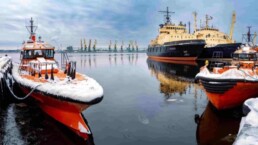

The capital company “LVR Flote” of the Freeport of Riga Authority concluded a contract with Baltic Workboats AS on the purchase of a new multifunctional hybrid ice class vessel. 50% of the vessel purchase costs will be covered by co-financing from the European Climate, Infrastructure and Environment Agency CINEA, and it is expected that the vessel will be commissioned by the end of 2024. In addition to the vessel’s basic functions it can provide support to the services of the Latvian Border Guard, Navy and Coast Guard, thus boosting the military capacity of Latvia.
The purchase of the new vessel equipped with a hybrid engine will contribute to the achievement of the strategic goals of the Freeport of Riga – to maintain a safe and sustainable shipping infrastructure, as well as to reduce the impact of the port operation on the environment. At the same time, the project is an important step towards the commitment of “LVR Flote” to conduct the modernization of the port’s technical fleet by 2026, gradually introducing technologies for the use of renewable energy resources. Hybrid vessels in their day-to-day operations substantially reduce fossil fuel emissions and contribute to climate neutrality and decarbonization goals.
Ansis Zeltiņš, the Freeport of Riga CEO: “The sustainability of the ports of Europe and the Baltic region goes hand in hand with the development of innovative environmental technologies and the positioning of ports’ activities in the development of new energy resources. The key words for success are collaboration, knowledge and best practices. For several years, the Freeport of Riga, both in cooperation with Latvian innovative companies and by exchanging experience with the EU port industry leaders (Rotterdam, Trieste, Stockholm, Plymouth, etc.), has been investing its resources and efforts to maintain sustainable development of Riga in these geopolitically difficult conditions. This is the beginning of the modernization of the port’s auxiliary fleet in order to test zero-emission technologies and to use them in the port’s daily life, thus facilitating the integration of Riga into the network of the so-called “green” transport corridors of the future Europe.”
The modern and multifunctional vessel of the technical fleet can be useful not only for breaking ice in the port water area and the Gulf of Riga, but also for performing various tasks necessary for the port’s operation, including buoy recovery, hydrographic measurements, as well as support for pollution collection, rescue and evacuation works, which are already provided by “LVR Flote”.
“Looking ahead, we assume that the performance of this vessel will open up opportunities for our company both to establish new collaborations and to launch new services, such as offshore wind farm services. Considering that the vessel is deployable for military mobility, we also see a prospect in providing services to the defense industry,” commented Kaspars Ozoliņš, member of the “LVR Flote” Board.
The new vessel is going to be more efficient and maneuverable than the current large icebreakers operated by “LVR Flote”. Due to the vessel’s small draught, which will not exceed 3 meters, it will be possible to use it in shallow areas of the Port of Riga and on the coast for the needs of the Navy and the Harbour Master.
The project will be implemented by the Estonian shipbuilding company Baltic Workboats AS, which won the contract following an open tender. The new vessel will be built by one of the leading European shipbuilding companies – Damen Shipyards Hardinxveld in the Netherlands and adapted to the specific requirements of “LVR Flote” at the Baltic Workboats AS shipyard in Saaremaa, Estonia.
“Developing the vessel’s technical specification, “LVR Flote” has conducted a comprehensive survey of the interested parties, consulting with the authorities of Latvian large ports, the Maritime Administration of Latvia, the National Armed Forces and others. Valuable comments were received from the parties, facilitating performance of various functions by the vessel”, explained K.Ozoliņš. The main technical characteristics of the vessel: length – 27 m, width – 9.1 m, draught – 2.9 m, compliance with requirements of Finnish-Swedish ice class 1C. Hybrid propulsion system (diesel and electric) includes 2 diesel engines with a total power of 1940 kW, as well as a 160 kW electric motor and battery system, which provides one-hour navigation autonomy in electric mode. The project will also provide the necessary electric charging infrastructure in the Port of Riga.
The project “Acquisition of a modern and efficient icebreaker for ice breaking operations in the Gulf of Riga” is implemented with the CINEA co-funding within the Transport Military Mobility Program. The contractual investment for the acquisition of the new vessel amounts to EUR 10.498 million and the CINEA co-financing represents EUR 5.076 million of the eligible project costs.



Related News.

Columbia Group calls for greater focus on retaining women at sea as second She Beyond Conference takes place
Columbia Group has called on the maritime industry to create a future where women can thrive, progress and lead at sea, as it celebrated the second…
Neptune Group Welcomes “NIKOS TRAVLOS”
The new vessel proudly bears the name of Neptune's founder, who laid the foundation for the creation and enduring evolution of the Group. Her…

Wildcat Defense enters into exclusive agreement to acquire Fraser Shipyards
American family firm takes the next step in its strategy to rebuild U.S. shipbuilding and repair capacity, following its offer for Austal USA.…
Kawasaki signs strategic partnership MOU with Romania’s Transgaz for Onshore Hydrogen Gas Transport
Establishing a model for large-scale hydrogen supply and transport via pipelines Kawasaki Heavy Industries, announced at the Romania–Japan…

UK P&I Club and TT Club secure regulatory approval for Thomas Miller acquisition
The UK P&I Club and TT Club announce the successful completion of their joint acquisition of the Thomas Miller Holdings group, marking a major…

Valenciaport presents its Sandbox at PEIC’26 as a tool to bridge the gap between innovation and implementation
The opening session featured a discussion between Valenciaport President Mar Chao and Valenciaport Foundation Director Antonio Torregrosa. The…

Major investments strengthen Gothenburg RoRo Terminal
Expanded terminal areas, new rail connections and modernised quays are among the investments that have strengthened Gothenburg RoRo Terminal in…

ABP appoints key roles in the Humber
Associated British Ports has made two key appointments at its container terminals strengthening its unitised operations at the ports of Immingham…

Xinhua Silk Road 2026 North Bund Forum unveils 20 shipping-related achievements
The 2026 North Bund Forum opened in Shanghai on October 20 with 20 key shipping-related achievements spanning international cooperation, green…
Ports encouraged to prepare now for advanced nuclear in maritime and clean energy
New joint Lloyd’s Register and British Ports Association paper sets out a practical readiness pathway for ports considering nuclear-powered vessels,…
Subscribe to our newsletter!
if you dont want to swim alone in the ocean of news, sign up for the newsletter, and you will receive daily all the important news of world shipping!
