Emissions several hundred tonnes lower as Viking Line’s vessels now use green land-based power supply
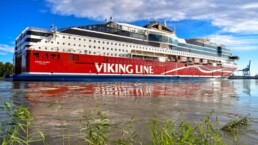

Starting in 2030, it will be a legal requirement for vessels to use a land-based power supply when they are in port. For Viking Line, this is already an everyday reality, and now the company has also switched to using only green electricity from renewable energy sources. Altogether, this will reduce the company’s annual greenhouse gas emissions by up to 780 tonnes.
As early as the 1980s, Viking Line connected its vessels for the first time to a land-based power supply in the Stockholm city harbour of Stadsgårdshamnen. Since then, links to a land-based power supply have been built in the ports of Mariehamn, Helsinki and Tallinn. In all of these ports, Viking Line has now switched to green electricity produced from renewable energy sources such as wind power, solar energy or biogas.
“Annual carbon dioxide emissions from our vessels are up to 780 tonnes less compared to if the vessels produced electricity using their own engines when in port. Thanks to the land-based power supply, vessel emissions of particulate matter are also reduced significantly, and no noise in the area is produced from their engines,” says Sustainability Manager Dani Lindberg at Viking Line.
Viking Line’s vessels use a land-based power supply on every route except for the Turku route, since the harbour times in Turku, Mariehamn and Stockholm are so short that there is not enough time to connect the vessel to a land-based power supply.
Establishing a land-based power supply is a concerted effort involving the shipping companies and ports since it requires substantial investments from both sides. Over the years, Viking Line has installed facilities to connect to the onshore power supply on all of its vessels that sail from Helsinki to Stockholm or Tallinn, most recently on Viking XPRS in 2021.
“It is gratifying that the ports provide a land-based power supply since the law does not require vessels to use an onshore power supply until 2030. After that time, all vessels in port for more than two hours will have to use a land-based power supply instead of fuel, and the ports will have to make certain that the necessary infrastructure for using such power is in place.”
Large passenger vessels use a great deal of electricity, and an average of 25 per cent of fuel consumed is for producing electricity. Viking Line is therefore investing to reduce electricity consumption on its vessels as part of its drive to systematically reduce total emissions from its vessel fleet.
“Thanks to technological innovations, the energy efficiency of our newest vessels is already top-class based on global measurements. For example, Viking Glory has an energy recovery system that converts waste heat from its engines into electricity and uses waste cooling from LNG fuel to cool cooling facilities and cooling spaces. We improve the energy efficiency of all of our vessels over the course of their life cycle by updating and renewing technological solutions, including ventilation systems, in conjunction with routine dry-dockings,” says Dani Lindberg.



Related News.
Columbia Group calls for greater focus on retaining women at sea as second She Beyond Conference takes place
Columbia Group has called on the maritime industry to create a future where women can thrive, progress and lead at sea, as it celebrated the second…
Neptune Group Welcomes “NIKOS TRAVLOS”
The new vessel proudly bears the name of Neptune's founder, who laid the foundation for the creation and enduring evolution of the Group. Her…

Wildcat Defense enters into exclusive agreement to acquire Fraser Shipyards
American family firm takes the next step in its strategy to rebuild U.S. shipbuilding and repair capacity, following its offer for Austal USA.…

Kawasaki signs strategic partnership MOU with Romania’s Transgaz for Onshore Hydrogen Gas Transport
Establishing a model for large-scale hydrogen supply and transport via pipelines Kawasaki Heavy Industries, announced at the Romania–Japan…

UK P&I Club and TT Club secure regulatory approval for Thomas Miller acquisition
The UK P&I Club and TT Club announce the successful completion of their joint acquisition of the Thomas Miller Holdings group, marking a major…
Valenciaport presents its Sandbox at PEIC’26 as a tool to bridge the gap between innovation and implementation
The opening session featured a discussion between Valenciaport President Mar Chao and Valenciaport Foundation Director Antonio Torregrosa. The…

Major investments strengthen Gothenburg RoRo Terminal
Expanded terminal areas, new rail connections and modernised quays are among the investments that have strengthened Gothenburg RoRo Terminal in…

ABP appoints key roles in the Humber
Associated British Ports has made two key appointments at its container terminals strengthening its unitised operations at the ports of Immingham…

Xinhua Silk Road 2026 North Bund Forum unveils 20 shipping-related achievements
The 2026 North Bund Forum opened in Shanghai on October 20 with 20 key shipping-related achievements spanning international cooperation, green…
Ports encouraged to prepare now for advanced nuclear in maritime and clean energy
New joint Lloyd’s Register and British Ports Association paper sets out a practical readiness pathway for ports considering nuclear-powered vessels,…
Subscribe to our newsletter!
if you dont want to swim alone in the ocean of news, sign up for the newsletter, and you will receive daily all the important news of world shipping!
