China’s Belt and Road Initiative turns away from coal

Ambitious, contentious and big spending, China’s Belt and Road Initiative (BRI) is 10 years old. In that time, China has splashed more than US$1 trillion on overseas infrastructure projects.
Power markets in developing economies have been major beneficiaries. But the rapid growth in much-needed generation capacity has also shone the spotlight on the initiative’s environmental impact and raised critics’ hackles over levels of indebtedness among poorer nations.
Can BRI power sector projects be judged a success? Does its record on sustainability conflict with decarbonisation goals? Can Western efforts to counter China’s influence succeed? Yanqi Cao in our APAC Power & Renewables research team takes a closer look.
What impact has the BRI had on power sector investment?
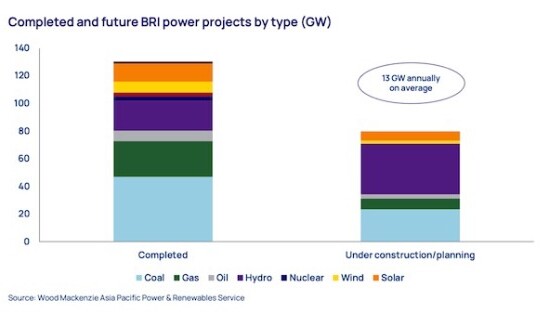
The numbers are undeniably impressive. Over the last 10 years, Chinese companies have installed 128 GW of overseas power projects – greater than the total generation capacity of the United Kingdom – with around 70% of this across South and Southeast Asia. We estimate China has financed and provided EPC services worth US$200 billion for power generation capacity worldwide, including countries that are not directly a part of the BRI, since 2013.
There is no doubt that BRI capital, technical expertise and supply chains have provided a major boost to power capacity across the developing world. But many countries have also seen debt levels soar as dollar-linked interest rates on Chinese bilateral lending have increased. In addition, massive levels of BRI lending and investment have gone into coal-fired projects, raising concerns over carbon emissions and whether these plants might be retired even while debt repayments to China continue.
Is criticism of the BRI’s environmental record justified?
Coal projects dominated in the early years. Two-thirds of Vietnam’s BRI power projects are coal-fired, while virtually all of Indonesia’s 14 GW of BRI capacity is coal.
But this has changed since China announced a ‘No new overseas coal power’ policy in 2021. Today, almost 200 BRI renewables projects are operational, accounting for 37% of total capacity – roughly equal to coal.
We estimate almost three-quarters of BRI new build projects under construction are renewables compared to less than 20% a decade ago. This is positive, but while renewables account for a growing share of projects, they remain more limited in terms of total capacity due to their smaller project size.
Has the BRI abandoned coal?
Accessing BRI finance for coal-fired projects is clearly getting tougher. Almost 90% of proposed coal-fired projects have already been cancelled due to policy changes and increased opposition to coal since 2021. This shift could impact a further 21 coal projects and we expect 13 projects at the planning stage to be shelved. China hasn’t, however, completely abandoned coal, continuing to allow coal plant equipment sales and the completion of ongoing projects.
How have Western nations responded to the BRI?
Concerned by China’s growing influence, the US, Europe and Japan have announced alternatives to the BRI. In 2021, the Biden administration, along with its G7 partners, launched Build Back Better World, which was quickly repurposed – along with more modest financial goals – as the Partnership for Global Infrastructure and Investment (PGII). The PGII aims to invest US$600 billion to support developing economies, including climate and energy security. The EU has branded its efforts as the Global Gateway to provide up to €300 billion, with a key focus on clean energy projects across Asia Pacific.
These initiatives to counter China’s BRI are long on rhetoric but short on action. Western-backed investments are not only fewer, smaller and slower to market than BRI projects but must adhere to far stricter rules on sustainability and transparency. With an almost decade-long head start, the BRI’s track record of quickly delivering generation capacity matters: for cash-strapped developing economies caught between China and the West, time is money.
Where next for the BRI?
The BRI’s influence on power markets is set to grow, with a further 80 GW already under construction or at the planning stage. Adjusting its overall strategy, we expect China to place a greater emphasis on direct investment rather than the bilateral lending which dominated the BRI’s early years. Like any lender, China is attuned to the risks of debt defaults as recipients struggle to repay loans at higher interest rates.
We also expect a far greater focus on renewables. This shift is positive for emissions but not entirely altruistic. A key part of the BRI has long been to provide markets for Chinese manufacturers and equipment suppliers. With China’s solar manufacturing capacity now enough supply five times its domestic solar panel demand, that leaves a lot of hardware looking for a home.
Source: Wood Mackenzie



Related News.
Cyprus Maritime Innovation takes Centre Stage at SMM Hamburg 2026
Underscoring its expanding role as a premier international hub for cutting-edge maritime technology and sustainable shipping, the Republic of Cyprus…
Trump seeks to refill US oil reserve with Venezuela deal but faces long delay
U.S. President Donald Trump said on the 30th (local time) that he would refill the U.S. Strategic Petroleum Reserve, which has been depleted with…
US Navy Official visits South Korean Shipyards in private
With U.S. President Donald Trump pushing a plan to allow overseas construction of U.S. warships, attention is focusing on whether the building of…

SES and De Boer Marine expand collaboration with FlexMaritime deployment across Global Markets
SES, a leading space solutions company, and De Boer Marine, a leading provider of top-quality marine equipment and maritime connectivity services,…

New ESG guidance to help maritime industry turn sustainability into commercial advantage
New framework helps shipowners and ports align ESG strategy with access to capital, charterer expectations and long-term asset value. Maritime…

Britannia P&I Club analysis finds four in five crew deaths linked to illness rather than accidents
New report highlights cardiovascular disease as leading cause of fatalities and raises concerns over mental health risks among younger seafarers.…

The Swedish Club launches new Loss Prevention podcast, Knot Another Lesson
The Swedish Club has launched Knot Another Lesson, a new podcast exploring the practical lessons, emerging risks and operational challenges shaping…

Lloyd’s Register appoints Jens Grunenberg as Senior Representative for Germany
Lloyd’s Register has appointed Jens Grunenberg as its Senior Representative for Germany, effective 1 September. Based in Hamburg, Grunenberg will…

Indian Register of Shipping sets sights on Hamburg for European Expansion
Indian Register of Shipping, a leading international classification society and full member of the International Association of Classification…
MOL completes Merger of 6 Ship Management Companies
Unifying Management of Over 200 Vessels and Strengthening Safety Mitsui O.S.K. Lines, announced that it has completed the integration of the MOL…
Subscribe to our newsletter!
if you dont want to swim alone in the ocean of news, sign up for the newsletter, and you will receive daily all the important news of world shipping!
