The role of resilience in satellite networks


In 2019, a major satellite suffered an in-orbit failure, eventually becoming a total loss. As the anchor client, Panasonic Avionics and our airline clients could have taken a major hit when that satellite went offline. But we didn’t—because our satellite network has built-in redundancy. That means when one, or even several, satellites encounter a problem, the rest of the network fills in the gaps.
Redundancy is essential to maintaining a resilient satellite network. Redundant, or overlapping, coverage means that when one satellite fails, a neighboring satellite can pick up the slack.
In an industry becoming increasingly dependent on connectivity for operations and for passenger satisfaction, having reliable, consistent in-flight connectivity is increasingly critical. When a major satellite fails, it can have serious and long-lasting consequences that endanger an airline’s ability to offer those critical connections.
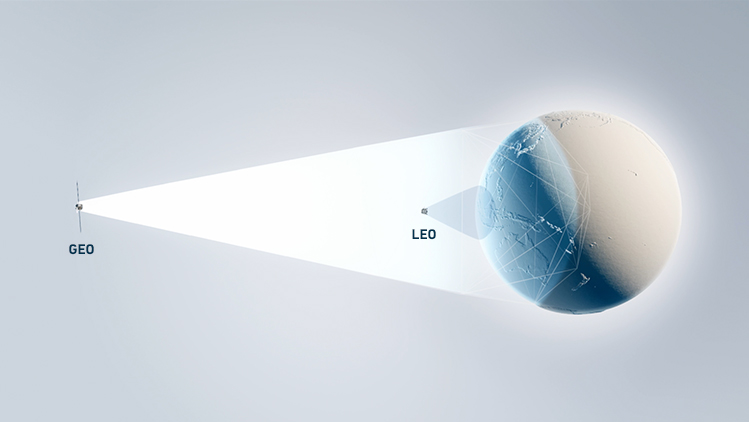
Multi-orbit satellite constellations
Currently, most constellations are comprised of Geostationary Equatorial Orbit (GEO) satellites. GEO satellites travel at the same pace as Earth’s rotation, meaning they appear to stay in a fixed position. Being further away, at an altitude of 35,786 kilometers, GEO satellites cover a large area so as few as three equally spaced satellites can provide near global coverage, and a lifespan of around 15 years.
Low Earth Orbit (LEO) constellations are made up of hundreds of satellites circumnavigating the Earth. The OneWeb constellation is built with robustness and resilience top of mind. It has over 600 individual LEO satellites and dozens of in-orbit spares linking to 42 ground stations around the world. The network is spread out across 12 orbital planes, each at about 1,200 kilometers above Earth’s surface. They can also be designed to be smaller and lighter, making them more cost-effective to launch and easier to replace.
LEO and GEO satellite networks are complementary, not competitive. Each can provide connectivity, with some degrees of difference in coverage and latency. Combined, they increase the capacity, reliability, and speed of connectivity bringing airlines, and passengers, truly global coverage in-flight.
Risks of satellite failures
For any satellite, whether LEO or GEO, the point of launch represents the highest potential for risk. When in service, satellites may also be subject to failures, such as mechanical faults, electrical issues, or space debris.
When a GEO satellite fails, coverage is lost, and in most cases, satellites cannot be fixed, such as in recent industry developments over summer of 2023. Replacement of a GEO satellite can take years between developing, building, and launching.
One of the most compelling examples of Panasonic’s operational agility was our response to the GEO satellite malfunction in 2019 previously mentioned. When this satellite experienced a catastrophic fuel leak, leading to its loss, many service providers were left scrambling.
However, Panasonic’s satellite-agnostic approach allowed us to quickly transition our services to an alternative satellite from another supplier. This rapid switchover minimized downtime and ensured a consistent and reliable service experience for our airline clients and their passengers.
Built-in redundancy and continuous evolution
OneWeb LEO satellites travel at 27,000 kilometers per hour, orbiting the Earth in just 109 minutes, with frequent satellite handovers occurring every 2min40sec. This means that in case a LEO satellite experiences a fault, the impact on the final user won’t be felt for very long. To rectify any failed satellites, in-orbit spares can be re-positioned to replace the failed satellite within hours—rather than months or even years, should a GEO satellite suffer an outage.
Additionally, OneWeb satellites have a relatively short seven-year in-orbit life compared to GEO satellites. This enables OneWeb to evolve the constellation to harness the latest and greatest technologies. In May 2023, OneWeb launched JoeySat to trial its next generation technology. This satellite will test beam-hopping capability which will allow satellites to switch between different places on Earth and adjust the strength of the communications signals based on customer needs or demands. This means that, in case of adversity, remaining satellites can focus capacity where needed.

Meeting today’s demands—and future ones
Network resilience isn’t only about meeting today’s connectivity demands. It’s also about being able to scale up quickly as needed, such as in the event of a satellite failure or a global event that impacts communication networks.
We’re also continually evolving our network. Last month, Panasonic announced a 50% global increase to our GEO network capacity.
While service providers across the aviation industry have access to both GEO and LEO satellite networks, one of Panasonic’s key differentiator lies in our satellite-agnostic approach. This allows us to objectively select the best satellite technology—be it LEO for lower latency and better data throughput, or GEO for additional coverage—for each specific airline need.
We don’t use proprietary satellite technology, because it can introduce risks that can make it harder to recover from an outage or failure. Instead, we take the best of what the market has to offer, building a diversity of compatible equipment that enables us to quickly recover when confronted by any adverse events. The result is a wide range of different, industry leading satellites providing a multi-layered, multi-orbit network.
This flexibility is not limited to GEO or LEO networks — it extends to MEO and potentially even ATG networks. Our approach allows us to efficiently integrate new technologies and providers, thereby ensuring that we can continually offer the most effective and efficient solutions to meet the evolving needs of our airline clients and their passengers.
Our approach to satellite networks substantially cuts down risk and ensures our customers—more than 70 of the world’s leading airlines— can rely on our network.



Related News.
Global Flag State Ranking 2026 who is up, who is down
Lorrendraaier publishes Global Flag State Ranking 2026: 148 flags measured on objective data, Singapore leads, Pakistan falls 35 places, the Dutch…

Will Germany have enough gas this winter?
As of mid-September 2026, Germany had stored just about 141 terawatt-hours of gas, accounting for around 57% of the country’s total storage…

Record diesel prices put US policy options in focus
Record-high diesel prices and tight inventories have put US exports under scrutiny, but keeping more barrels at home may offer only temporary…

IUMI elects Sean M. Dalton as President and says farewell to Frédéric Denèfle
The International Union of Marine Insurance (IUMI) has elected Sean M. Dalton as its new President. The election took place today at a meeting of the…

F/V MISTRESS Shipwreck ‘Lost’ Near Block Island Located After Seven Years
Green Oceans’ Underwater Investigation Reveals a Shipwreck Presumed to be the F/V Mistress found at the Base of Block Island Turbine #1 - Asks…

OCEAN at 50 celebrating a proud past and Maritime Future
OCEAN, the European sub-committee of ISSA, celebrated half a century of service to Europe’s ship supply sector with a landmark anniversary conference…

DORIC MONTHLY BRAZIL BAROMETER SEPTEMBER 2026
Pls find below the DORIC MONTHLY - BRAZIL BAROMETER SEPTEMBER 2026 BRAZIL_BAROMETER_SEPTEMBER_2026

Steel flows face fresh challenges in the final quarter of 2026
Steel flows slip into negative growth in July 2026 Global steel flows fall 1% y/y in July 2026 to reach 22.2 Mt. China’s share of global steel…

Insurance must shift “from repair to prevention”, says IUMI
Marine insurers will need to place greater emphasis on loss prevention as risks become more complex and costly to insure, according to Pascal Dubois,…

BIMCO’s Container Shipping Market Overview & Outlook September 2026 is out
Container Shipping Market Overview & Outlook Supply pressure is mounting "Disruptions and strong growth in head-haul trades continue to support…
Subscribe to our newsletter!
if you dont want to swim alone in the ocean of news, sign up for the newsletter, and you will receive daily all the important news of world shipping!
