MSC Cruises and Gasum partner for LNG and renewable e-LNG to achieve 2050 Net Zero Greenhouse gas emissions goal
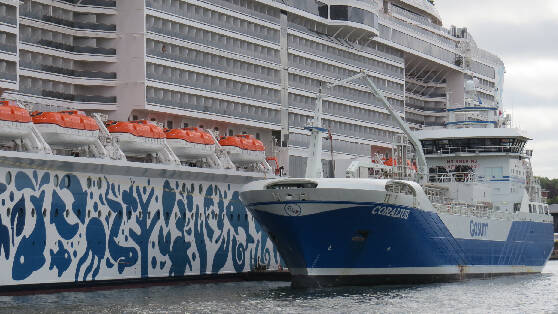

The Cruise Division of MSC Group and Gasum have signed a long-term agreement for the supply of LNG to the new flagship of its MSC Cruises brand, MSC Euribia, as well as a Letter of Intent with the goal of cooperating on the supply of synthetic e-LNG made with renewable energy. All this as part of the Cruise Division’s strategy to achieve net zero greenhouse gas emissions from its marine operations by 2050.
MSC Cruises, the world’s third-largest cruise operator, and Nordic energy company Gasum and have executed a Letter of Intent (LOI) engaging in a landmark cooperation that aims at securing MSC access to liquefied synthetic gas, or e-LNG, which is produced using hydrogen, created by hydrolysis with renewable energy and captured CO2. Gasum and MSC Cruises are together creating an actionable roadmap for cutting emissions in MSC’s cruise operations with sizeable volumes of several thousand tons of e-LNG starting in 2026.
The companies also signed a long-term agreement on the delivery of liquefied natural gas, LNG, to MSC’s new flagship MSC Euribia. With this agreement Gasum supports MSC Cruises in cutting emissions with the immediate use of LNG.
Using LNG removes nearly all sulfur oxide and particle emissions, greatly reduces nitrogen oxide emissions and significantly lowers greenhouse gas emissions. In addition, LNG technology on board enables MSC Cruises to switch at any time to fully renewable liquefied biogas (bio-LNG) or synthetic gas (e-LNG) in order to reach greenhouse gas emissions reductions of up to 100 per cent.
MSC Euribia recently demonstrated that emissions neutral cruising is possible already today by sailing the historical first ever net zero greenhouse gas emissions cruise voyage benefiting from the emissions reductions allowed by liquefied biogas procured by Gasum. The ship sailed for four days from Saint-Nazaire in France to Copenhagen, Denmark and utilised bio-LNG with a mass-balance approach, the most environmentally efficient method of delivering the benefits of renewable biogas. MSC Cruises purchased over 400 tonnes of bio-LNG from Gasum to show its commitment to the deployment of drop-in renewable fuels and energy transition measures towards the pioneering net zero gas emissions voyage. The line is the industry’s first deep sea ocean cruise operator to buy bio-LNG as a fuel source that proved to allow significant lifecycle emissions reductions.
Linden Coppell, Vice President of Sustainability and ESG for MSC Cruises, said: “We are delighted to be partnering with Gasum on our journey to net zero greenhouse gas emissions. Securing a reliable supply of LNG and e-LNG is of critical importance to our decarbonisation efforts, and the LOI and long-term agreement that we have announced today are significant steps on that journey. Partnering with Gasum will enable us to access new and cleaner fuels needed to make net zero cruising a reality. We need more suppliers like Gasum to step up and support our industry with its environmental targets. We are ready and waiting to buy more of these new fuels.”
Mika Wiljanen, CEO of Gasum, stated: “As an alternative fuel supplier dedicated to the energy transition, Gasum is proud to offer support to MSC Cruises, a major maritime player, in their quest to improve the environmental footprint of their operations. At the same time MSC Cruises is supporting the development of the most promising alternative fuel by proving a demand for it. This LOI on e-LNG is a landmark agreement for the shipping industry as it demonstrates that e-LNG will be available to the maritime transport sector within a short timeframe. We are also very happy about the long-term LNG supply agreement which we believe is the start of long-lasting cooperation.”
What is e-LNG or synthetic gas
E-LNG gas can be produced synthetically through the Power-to-Gas process. First hydrogen is produced from water using renewable electricity, for example wind or solar power. The produced hydrogen can then be further processed into methane by adding non-fossil carbon dioxide obtained from carbon capture.
This resulting synthetic renewable methane gas is fully interchangeable with natural gas and biogas. When it is liquefied it is likewise fully interchangeable with LNG and liquified biogas. This means that it can be transported through already existing infrastructure – trucks, ships, pipelines also using the existing gas grids.
It also means that synthetic gas can be directly used in the dual fuel engines fitted on board currently running on natural gas, biogas, LNG or liquefied biogas at any ratio. There is no need for any additional investments in new equipment or modifications.
Unlike alternative fuels such as ammonia or methanol which are still in the development stage both in terms of production and infrastructure, synthetic gas, or e-LNG, is a concrete pathway to decarbonizing maritime as well as land transportation in the next few years.
Gasum’s strategic goal is to bring seven terawatt hours (7 TWh) of renewable gas yearly to market by 2027. Achieving this goal would mean a yearly cumulative carbon dioxide reduction of 1.8 million tons for Gasum’s customers.



Related News.
ISLAND OIL: Unveiling of the Sculpture “Cyprus’s Journey Through the Ages” in Protaras – A Tribute and Landmark to Cyprus’s Historical Memory and Cultural Heritage
In a modest ceremony marked by a moving atmosphere, the sculpture “Cyprus’s Journey Through the Ages”, created by acclaimed Cypriot sculptor…
World Maritime Day 2026 from Policy to Practice – powering Maritime Excellence
Global regulations will deliver safer, more resilient shipping when they are implemented worldwide. The international maritime community marks…

Diana Shipping announces Time Charter Contract for m/v DSI Polaris with Dai An Ocean Shipping
Diana Shipping , a global shipping company specializing in the ownership and bareboat charter-in of dry bulk vessels, announced that, through a…

Chief Economists Expect Global Economy to Stabilize, but Fiscal Constraints, Rising Living Costs and AI Investment Uncertainty Threaten Growth
The global economy is stabilizing, but the fiscal support that cushioned successive shocks since 2020 is unlikely to play the same role in the year…
V. welcomes its new graduate cohort as programme expands across the group
Twelve graduates from nine nationalities join 11th year of V.’s expanded international management programme. V., the global ship manager and marine…
From Policy to Practice: Why Seafarers Are the Key to Maritime Excellence
The shipping industry is no stranger to regulation. Seafarers and ship operators work within a vast framework of international conventions, national…

Intermodal Report – Week 38 2026
Please find below the Intermodal market report for week 38 2026. Intermodal Report Week 38 2026 Market Insight By Nikos Tagoulis, Head of…

Allied – Weekly Market Review – Week 38
Please find below the Allied Weekly Report for Week 38 | 2026 ALLIED - Weekly Market Report- Week 38
Record year on the Northeast Passage but Arctic shipping remains very limited
In 2025, a record 103 transit voyages were made via the Northeast Passage. However, this is still equivalent to only around a day and a half of…

[xclusiv] S&P Report 21th September 2026
Please find below the [xclusiv] latest Weekly S&P Report [xclusiv] 2026_09_21 Market Commentary: VLCCs: Freight Boom Reprices the Fleet The VLCC…
Subscribe to our newsletter!
if you dont want to swim alone in the ocean of news, sign up for the newsletter, and you will receive daily all the important news of world shipping!
