Russia behind 225% spike in shadowy oil transfers at sea


As Russia seeks to up its game in circumventing Western sanctions, more oil tankers are turning off their location transponders in risky but lucrative cargo operations.
An analysis of data from S&P Global Market Intelligence, including Maritime Intelligence Risk Suite (MIRS) and Maritime Portal, has found a 225% increase globally in the shadowy practice of switching off the automatic identification system (AIS) designed to maintain maritime safety and more recently to help track shipments of oil.
The data show 215 tankers totaling 9.31 million dwt were engaged in 524 dark ship-to-ship (STS) transfers in the first quarter of this year, compared with 72 tankers with 2.40 million dwt in 161 transfers in the same period a year earlier before Russia was hit by sanctions and caps on the price of the oil it sells.
In Crimean waters, Russia’s exclusive economic zone and sea lanes near Kaliningrad, 312 dark STS were observed in January-March, according to data. This compares with just six a year earlier and shows Russia to be at the center of a growing global trend to use dark STS techniques as a way to evade international scrutiny when transporting oil.
The development has come amid a deep discount of Russia’s main crude export grade Urals to Date Brent since the Kremlin’s invasion of Ukraine. According to S&P Global Commodity Insights’ Platts assessments, the discount averaged $37.8/b in Q1 2023 versus $17.7/b in Q1 2022. It was $3.7/b in January 2022.

Buying Russian oil remains a highly profitable business despite price caps and sanctions. For tanker owners, there could be millions of dollars to make per voyage. S&P Global Commodities at Sea data shows 102.4 million barrels of crude and petroleum producers were potentially involved in dark STS during the first quarter, though information on their exact origins is unclear due to the opaque nature of these operations.
That said, once a ship turns off its AIS, seafarers on other vessels might not be able to recognize it without eye contact. Many shipping professionals, as well as government officials from Ukraine and some Western countries, have warned of increased collision and oil pollution risks due to more dark STS.
These ships are effectively operating in “no-man’s land” and “it’s going to very likely end in tears for many,” said Bjorn Hojgaard, CEO of ship-management group Anglo-Eastern. “But there will always be those that see the reward of a large upside outweigh that of excessive risk and willing to chance it.”

Adding to the risks is that ships in dark STS mode tend to be old, which means they could have ageing equipment and weaker hulls due to corrosion. For instance, the 1997-built Aframax Pablo — which has a history of dark activity — caught a fire off Malaysia in early May. Three crew members went missing and Maritime Portal data showed the ship was declared a total loss.
Regulatory power
Currently, the UN’s International Maritime Organization requires vessels involved in STS of all kinds to inform coastal states. The MIRS analysis suggests this is likely the reason for more dark STS in the Russian EEZ as Russia can conceal cargo origin without drawing attention from other countries, according to Byron McKinney, trade finance director at S&P Global Market Intelligence.
Seaborne oil from Russia faces an embargo by the EU and has limited access to G7 maritime services due to the price cap regime. In theory, through dark STS, disguised Russian oil could be transported to other ordinary STS hubs for a second transfer, further obscuring its origin.
Based on IMO rules, ships turning off AIS without legitimate reasons, such as staying off the radar screens of pirates, could be punished by flag states. But it could be hard to form consensus on enforceable punitive measures. Ships involved in dark STS during Q1 2023 were under the administration of 41 flag states, the data show.
“Ocean is a large space…it’s really hard for any flag state to do anything about it,” said Mike Salthouse, head of external affairs at mutual insurer NorthStandard, suggesting flag states outside of the West might also lack the incentives to regulate AIS transmission.
Separately, the IMO grants port states the power to review vessel AIS logbooks. This would allow the EU to exert some control. For example, banning ships engaged in dark activity from entering the bloc. In January-March, there were 55 port calls in Europe by ships having completed dark STS, the data show.
Financial constraints
Tom Midttun, head of production for global marine at insurance brokerage Lockton Edge, suggests the most effective way for the West to enforce sanctions would be via the insurance market. S&P Global analysis finds 46% of the ships in dark STS during Q1 were still covered by International Group of Protection and Indemnity Clubs, subject to the Russian oil price caps.
Marine insurers generally provide coverage denominated in US dollars and rely on reinsurers based in the EU and US, according to Midttun. Therefore, the authorities can extend the sanctions regime to cover ships turning off AIS, which would prevent their operators from receiving coverage everywhere, he said.
“It is all about the finance,” added Midttun, suggesting regulators could aim to choke off the finance to ships in dark operations. “Without insurance the banks have no security for their loan if something should happen to the vessel. Experience has shown this lack of security triggers immediate actions on the part of the banks,” he said.
But many ships in dark STS have simply opted to not receive robust coverage. The proportion of ships engaged in dark STS with IG coverage is far below the industry average of 90%.
“The reality is that it is fairly limited what we can do. It is up to each individual business owner where they want to buy their insurance,” mutual insurer Gard CEO Rolf Thore Roppestad said. “What we can do as an industry, however, is to continue to shine a spotlight on the problem, exposing the risk that this is posing to people and society.”
Source: Platts



Related News.

QatarEnergy extends LNG cancellations into November as Hormuz disruption drags on
QatarEnergy’s latest cancellations run into early November. Buyers in Europe and Asia are finding replacement cargoes, switching to other fuels or…
Shipping must pool demand to unlock alternative fuel investment, says EmissionLink
Shipping must move beyond individual fuel procurement strategies and aggregate demand for alternative fuels if it is to unlock the investment needed…
EuroHoldings announces Charter Contract Extensions for two of its Feeder Containerships, M/V Joanna and M/V Aegean Express
Euroholdings, an owner and operator of container carriers and tanker vessels and provider of container and tanker seaborne transportation…
Titan and Sogestran agree long-term partnership for new 6,000cbm LNG bunker vessel
Agreement covers the construction, charter and operation of the vessel in the Western Mediterranean. Titan Clean Fuels, part of Molgas Group, has…
Piraeus Port Authority provides practical support to the Municipality of Salamina for the restoration of recent wildfire affected areas
Immediate response by Piraeus Port Authority through the provision of an excavator to support the removal and collection of fire-damaged materials…
Trump vows US will take ‘all’ of Venezuela’s oil as deal details emerge
The White House has published the terms of its Venezuela oil deal, naming the private company at its centre and confirming Washington’s majority…
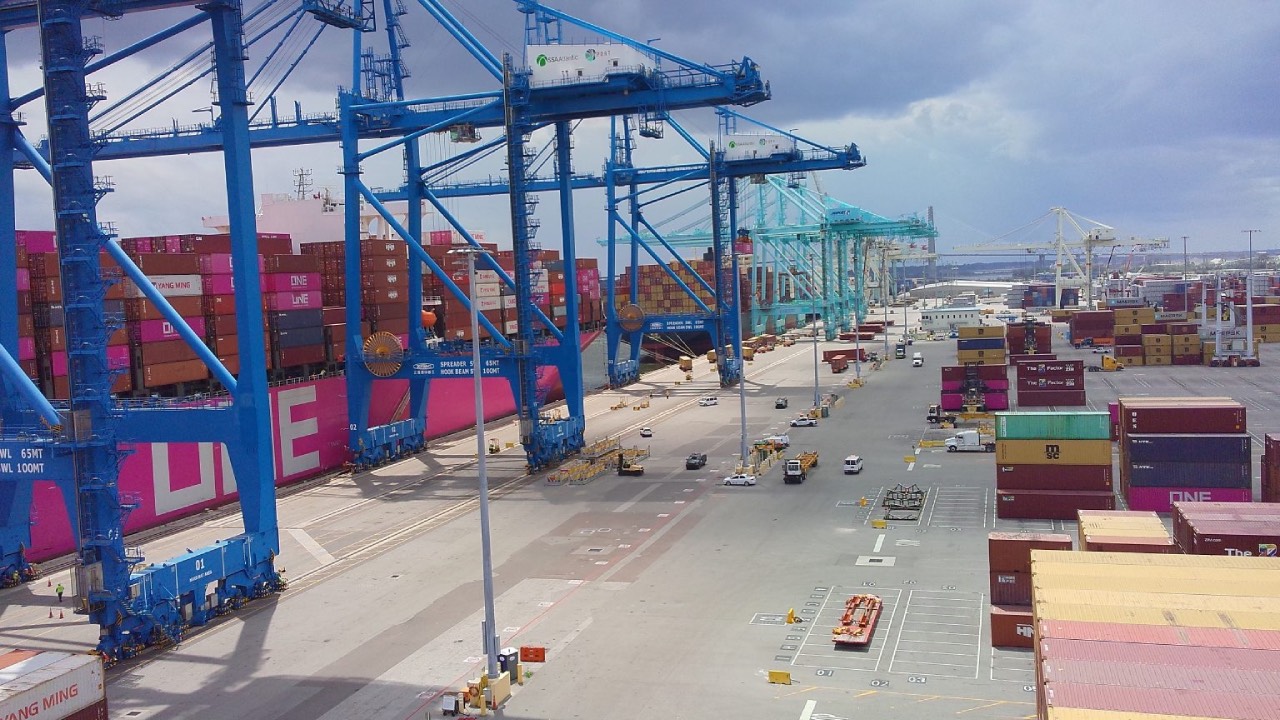
SSA Marine upgrades benefit shippers as air draft project enters final months
Following the completion of a more than $100 million modernization project, SSA Marine is expanding capacity and improving efficiency at its…
Lloyd’s Register launches RouteFlex to provide unprecedented stowage flexibility for container operators
New LR RouteFlex application leverages metocean data to empower operators with more flexible, dynamic, voyage-based stowage optimisation. Lloyd’s…
“Deeper Than It Seems”an awareness campaign revealing the regulatory work behind every coastal tourism experience
The Saudi Red Sea Authority has launched its awareness campaign "Deeper Than It Seems," introducing the regulatory system that underpins maritime and…

Intermodal Report Week 35 2026
Pls find below the Intermodal Report - Week 35 2026 Intermodal Report Week 35 2026
Subscribe to our newsletter!
if you dont want to swim alone in the ocean of news, sign up for the newsletter, and you will receive daily all the important news of world shipping!
