KONGSBERG successfully demonstrates autonomous vessel operations on Belgium’s inland waterway network
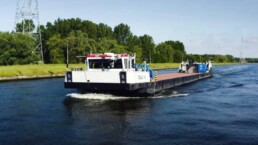

Kongsberg Maritime successfully completed a live trial of autonomous shipping technology in Bornem, Belgium, demonstrating the progress the company has made in fully autonomous systems.
The test vessel, Zulu 4, an inland waterway barge owned by Blue Line Logistics NV, is equipped for remote-operated and autonomous transport demonstrations for the AUTOSHIP project, which is part of Horizon 2020, an EU research programme.
As part of the test, Zulu 4 manoeuvred and navigated on unrestricted waterways, and it demonstrated berthing and unberthing capability. To achieve this, the vessel was upgraded with onboard control technology, while an onshore remote operation centre (ROC) provided support. A safety crew was onboard the vessel during the test.
The Zulu 4 completed a 16.5-kilometre circuit starting from a port in Niel on the Rupel River. The vessel entered a busy sea canal before traversing locks and passing several bridges as well as a yacht club and marina.
KONGSBERG technologies used in the trial included Autodocking, Autocrossing and automatic navigation systems. The company has also developed cloud-based communications systems and advanced simulations to test and ensure that the vessel operated safely and optimally.
Pål André Eriksen, Senior Vice President, Remote & Autonomous Solutions, Kongsberg Maritime, said: “We are delighted with the performance of the Zulu 4 on what is a challenging route through the busy Belgian waterways. The course that the ZULU 4 completed provided an opportunity to test our technology in a real-life situation, where numerous manoeuvres were performed successfully and safely.
“The test run provides all partners within AUTOSHIP with essential experience and data, which can help us advance the adoption of remote-controlled and autonomous technology in the maritime sector.”
“Together with last week’s successful demonstration of a coastal cargo ship in Norway, we have proved that these technologies are applicable across different vessel types and suited to a variety of operations”.
Antoon Van Coillie, CEO, ZULU Associates, which develops emission-free inland vessels, added: “The fitting out of Zulu 4with digital technology from Kongsberg Maritime and its testing is a major step forward to achieving autonomous operation of inland waterway barges. This will allow the industry to respond to the triple challenges of zero emission transport, real modal shift and the looming workers shortage crisis.
“Kongsberg Maritime is a very strong partner and their extensive maritime know-how benefits tremendously the development of digitalisation on inland waterways”.
Under remote monitoring from the ROC, the team and vessel had to show situational awareness, engine and machinery monitoring, berthing/unberthing and manoeuvring in port. The same tasks were demonstrated under autonomous control, as well as collision avoidance, grounding avoidance, transit sailing and automatic mooring. Zulu 4 also demonstrated the ability to switch between autonomous operation and remote-controlled operation.
This live trial of the technology follows from another demonstration of autonomous ship technology on May 25 in Alesund, Norway, in which a cargo vessel, Eidsvaag Pioneer, completed a range of tasks autonomously.
Both vessels are equipped with remote and fully autonomous operation technology as part of the AUTOSHIP project, part of the EU research programme Horizon 2020. AUTOSHIP is a collaboration between KONGSBERG and Norway’s leading research organisation, SINTEF, as well as several European partners.
The aim of the AUTOSHIP project is to test and develop fully autonomous navigation systems, intelligent machinery systems, self-diagnostics, prognostics and operation scheduling, as well as communication technology enabling a prominent level of cyber security and integrating the vessels into upgraded e-infrastructure.
The successful test of the Zulu 4 barge verifies the maturity of key enabling technologies and helps build the real-world data required to assure the safety and security of autonomous operations on European waterways to regulators and customers.
Europe’s inland waterways offer positive environmental impacts by using autonomous shipping technology. An autonomous barge in operation is expected to take around 7,500 trucks off the roads each year and will result in reductions in both traffic congestion and emissions.



Related News.

Connected Fleets under Siege: Navigating Geopolitical Cyber Threats and Modern Maritime IT
An exclusive CSN interview between Adonis Violaris and Dr Matthew Maheras As commercial shipping becomes ever more digitally integrated, the industry…
InterManager warns enclosed space deaths demand urgent industry action
InterManager has called for urgent industry action on enclosed space safety after its latest research highlighted persistent failures in procedures,…
ATPI Greece marks 50 years at the heart of global crew changes
Five decades supporting the Greek and global shipping community 35% of ATPI’s marine business now managed from Greece More than 130 professionals…
Euroseas announces a new time charter contract for its 2001-built 2,556 teu Feeder Containership, M/V EM Corfu, and the sale of its sister vessel, M/V Evridiki G
Euroseas an owner and operator of container carrier vessels and provider of seaborne transportation for containerized cargoes, announced a new…
Possible further delay to road transport’s inclusion in EU ETS causes serious concern
Interferry, the global trade association representing the ferry shipping industry, is raising serious concerns over the current state of EU Emissions…

ABP appoints new head of commercial for Humber
Associated British Ports, the UK’s largest port operator, has appointed Sandrine Lagrost as its new Head of Commercial for the Humber, joining the…
Commodity Radar | Spotlight: Bauxite – Week 43.2026
The final quarter of 2026 is expected to see softer bauxite flows Chinese front-loading is expected to have run its course, pointing to softer…
Japan IMO attempt to weaken the IMO Net-Zero Framework
Japan has put forward a proposal to the International Maritime Organization to remove the Net-Zero Fund and put shipping companies in control of…

xclusiv S&P Report 19th October 2026
Pls find below the [xclusiv] S&P Report 19th October 2026 [xclusiv] 2026_10_19

Glencore achieves land access for the Coroccohuayco project at Antapaccay
Antapaccay, a Peruvian entity controlled by Glencore, has completed the access agreements required for the last blocks of land to unlock the…
Subscribe to our newsletter!
if you dont want to swim alone in the ocean of news, sign up for the newsletter, and you will receive daily all the important news of world shipping!
