Methanol Institute publishes first complete guide to methanol as a marine fuel
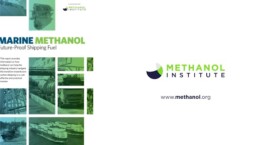

Tool to support decision-making on future fuel choices includes analysis and commentary on technical, commercial and operational aspects
The Methanol Institute has published the first comprehensive guide to methanol as a marine fuel. As the shipping industry continues its transition towards net carbon neutral operations, owners are increasingly choosing methanol as a fuel that can help them progressively reduce emissions in line with regulatory targets.
‘MARINE METHANOL Future-Proof Shipping Fuel’ has been produced to help stakeholders across the industry access the information they need to support decision-making on which alternative fuel is right for their fleet.
Sections of the report address regulatory drivers, environmental performance, engines and fuel systems, bunkering, handling and safety characteristics, costs and pricing, availability and feedstocks for conventional and renewable product. Also included are case studies on first movers including AP Moller-Maersk, Waterfront Shipping, Proman Stena Bulk and the conversion of ropax ferry Stena Germanica.
The orderbook for methanol fuelled ships has grown rapidly with owners and operators specifying the fuel for use on ships from the largest containerships to small pilot boats. In between is the growing fleet of methanol carriers, bunker tankers, bulk carriers, heavylift vessels, cruiseships, ferries and superyachts.
Approved for use as fuel under the IMO’s IGF Code, the momentum for methanol as fuel has increased as studies, analysis and guidance – much of it supported by the Methanol Institute – has been published. This includes early guidance for bunkering operations developed with Lloyd’s Register and subsequent work with the ports of Shanghai, Singapore and Rotterdam.
Propulsion systems include tried and tested two-stroke main engines, four stroke units, and fuel cells using methanol for conversion to hydrogen. Main engine manufacturers report considerable order backlogs and are developing ever larger, higher capacity units. Studies and pilots continue to prove the effectiveness of converting smaller main engines to methanol operations.
“Methanol has staked a significant claim to be among the serious fuel choices for vessel designers, owners and operators looking to make a start on their transition to sustainable operations,” said MI Chief Executive Officer Greg Dolan. “While there won’t be a single decarbonization solution, it is clear that methanol has advantages that combine to provide a pathway to lower carbon and ultimately carbon-neutral operations; This report provides a clear roadmap for this journey.”
“Shipowners have recognised that methanol provides them with huge flexibility in introducing a low-pollution, lower carbon fuel which is closest to a drop-in available in the market,” said MI Chief Operating Officer Chris Chatterton. “The decision by more and more leading shipping companies to adopt methanol as fuel signals that the industry recognises the need to start its transition to net carbon neutrality now; this publication can support their decision-making process.”



Related News.

Connected Fleets under Siege: Navigating Geopolitical Cyber Threats and Modern Maritime IT
An exclusive CSN interview between Adonis Violaris and Dr Matthew Maheras As commercial shipping becomes ever more digitally integrated, the industry…
InterManager warns enclosed space deaths demand urgent industry action
InterManager has called for urgent industry action on enclosed space safety after its latest research highlighted persistent failures in procedures,…

ATPI Greece marks 50 years at the heart of global crew changes
Five decades supporting the Greek and global shipping community 35% of ATPI’s marine business now managed from Greece More than 130 professionals…
Euroseas announces a new time charter contract for its 2001-built 2,556 teu Feeder Containership, M/V EM Corfu, and the sale of its sister vessel, M/V Evridiki G
Euroseas an owner and operator of container carrier vessels and provider of seaborne transportation for containerized cargoes, announced a new…
Possible further delay to road transport’s inclusion in EU ETS causes serious concern
Interferry, the global trade association representing the ferry shipping industry, is raising serious concerns over the current state of EU Emissions…

ABP appoints new head of commercial for Humber
Associated British Ports, the UK’s largest port operator, has appointed Sandrine Lagrost as its new Head of Commercial for the Humber, joining the…
Commodity Radar | Spotlight: Bauxite – Week 43.2026
The final quarter of 2026 is expected to see softer bauxite flows Chinese front-loading is expected to have run its course, pointing to softer…
Japan IMO attempt to weaken the IMO Net-Zero Framework
Japan has put forward a proposal to the International Maritime Organization to remove the Net-Zero Fund and put shipping companies in control of…

xclusiv S&P Report 19th October 2026
Pls find below the [xclusiv] S&P Report 19th October 2026 [xclusiv] 2026_10_19
Glencore achieves land access for the Coroccohuayco project at Antapaccay
Antapaccay, a Peruvian entity controlled by Glencore, has completed the access agreements required for the last blocks of land to unlock the…
Subscribe to our newsletter!
if you dont want to swim alone in the ocean of news, sign up for the newsletter, and you will receive daily all the important news of world shipping!
