DNV study shows high offshore hydrogen infrastructure potential for Europe
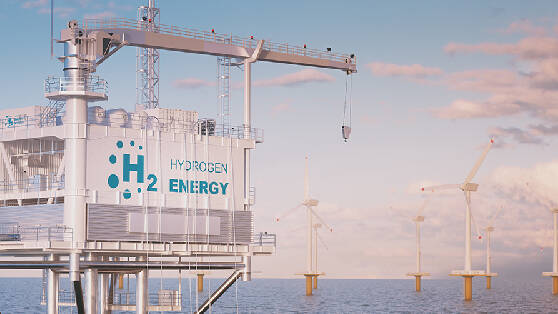

Increasing security of supply: DNV sees potential 300 TWh/a of green hydrogen
Offshore hydrogen production is paramount to meet the substantial increase expected in European hydrogen demand, as hydrogen is due to play a significant role as a low-carbon energy carrier – not only to decarbonize hard-to-abate sectors, but also to boost security of energy supply in Europe. The “Specification of a European Offshore Hydrogen Backbone” study, commissioned to DNV by infrastructure system operators GASCADE and Fluxys, highlights the significant advantages of an offshore hydrogen backbone in the North and Baltic Seas.
“The EU expects demand for climate-neutral hydrogen to reach 2,000 terawatt hours (TWh) by 2050, and DNV sees the potential to produce 300 TWh of hydrogen using electricity from offshore wind farms in the North Sea by 2050. This would make a significant contribution to reducing dependence on energy imports. This positive aspect for increasing supply security can hardly be valued highly enough after the experiences of the recent past,” says GASCADE Managing Director Ulrich Benterbusch.
Given the lower costs of hydrogen transmission compared to electricity and the possibility for large pipelines to aggregate offshore hydrogen production from several windfarms, the report assesses that offshore hydrogen production is an attractive option for offshore wind production, certainly at distances of more than 100km from shore. The potential energy generation from offshore wind in the North Sea and Baltic Sea is immense, and possible greater than what the electricity system alone can handle. The DNV study finds that offshore hydrogen production connected by pipeline is cheaper than onshore hydrogen production.
“What we see is that areas located over 100 km from the coastline offer lower levelized costs of production. At this distance, it costs more per energy unit to transport electricity than to carry hydrogen via pipeline”, explains Claas Hülsen, Regional Advisory Business Development Director for Energy Systems at DNV – one of the study’s authors.
With regards to transport infrastructure, the study draws two different pictures based on location:
- For the North Sea, a large area and production potential meet the 100 km criterion. To bring the hydrogen produced offshore to land, a meshed pipeline connection – a European backbone – could sensibly connect production sites to the existing onshore pipeline network.
- The situation is somewhat different in the Baltic Sea region, where fewer areas currently meet the 100-km criterion. However, if Sweden and Finland decide to produce hydrogen on a large scale and transport it to demand centers in southern Europe, a combined pipeline is likely to make sense there as well.
The spatial distribution of the potential offshore hydrogen production sites shows that the sea areas of different countries are involved. “This suggests that transnational coordination will be necessary to develop the full identified hydrogen generation potential”, says Christoph von dem Bussche, Managing Director of GASCADE. It will be equally important to strike the right balance between the potential use of wind for electricity generation and the potential generation of hydrogen across countries.
To further optimize this hydrogen supply chain, the study suggests storing up to 30% of the produced hydrogen in salt caverns to efficiently increase the flexibility of the system. To support the political discussion, the study also contains an initial cost estimate: In the North Sea, the cost of pipelines and compressors for the offshore hydrogen backbone is estimated to account for 10% of the total cost of hydrogen produced offshore. According to initial calculations, a hydrogen system costs for the North Sea of €4.69-4.97/kg can be achieved with an investment in offshore hydrogen transport infrastructure of €35-52 billion (including underground storage).
AquaDuctus project part of the contemplated offshore backbone
The study strengthens GASCADE and Fluxys in their conviction that the AquaDuctus project is a key building block to achieve a green transition and meet the decarbonization targets of the EU Green Deal and Repower EU package.
This large-scale offshore pipeline project, conceived to efficiently carry hydrogen produced from wind farms in the North Sea onto the German onshore hydrogen grid, is indeed designed as a backbone able to collect hydrogen from multiple production sites while also offering the potential to link up with other international hydrogen flows through the North Sea.
Pascal De Buck, CEO of Fluxys, says: “The AquaDuctus offshore pipeline, thought as a regulated open access infrastructure available to all future operators of hydrogen wind farms, will make a substantial contribution to security of supply by diversifying Europe’s hydrogen supply sources.”



Related News.
Cyprus Maritime Innovation takes Centre Stage at SMM Hamburg 2026
Underscoring its expanding role as a premier international hub for cutting-edge maritime technology and sustainable shipping, the Republic of Cyprus…

Trump seeks to refill US oil reserve with Venezuela deal but faces long delay
U.S. President Donald Trump said on the 30th (local time) that he would refill the U.S. Strategic Petroleum Reserve, which has been depleted with…
US Navy Official visits South Korean Shipyards in private
With U.S. President Donald Trump pushing a plan to allow overseas construction of U.S. warships, attention is focusing on whether the building of…
SES and De Boer Marine expand collaboration with FlexMaritime deployment across Global Markets
SES, a leading space solutions company, and De Boer Marine, a leading provider of top-quality marine equipment and maritime connectivity services,…
New ESG guidance to help maritime industry turn sustainability into commercial advantage
New framework helps shipowners and ports align ESG strategy with access to capital, charterer expectations and long-term asset value. Maritime…
Britannia P&I Club analysis finds four in five crew deaths linked to illness rather than accidents
New report highlights cardiovascular disease as leading cause of fatalities and raises concerns over mental health risks among younger seafarers.…

The Swedish Club launches new Loss Prevention podcast, Knot Another Lesson
The Swedish Club has launched Knot Another Lesson, a new podcast exploring the practical lessons, emerging risks and operational challenges shaping…
Lloyd’s Register appoints Jens Grunenberg as Senior Representative for Germany
Lloyd’s Register has appointed Jens Grunenberg as its Senior Representative for Germany, effective 1 September. Based in Hamburg, Grunenberg will…
Indian Register of Shipping sets sights on Hamburg for European Expansion
Indian Register of Shipping, a leading international classification society and full member of the International Association of Classification…
MOL completes Merger of 6 Ship Management Companies
Unifying Management of Over 200 Vessels and Strengthening Safety Mitsui O.S.K. Lines, announced that it has completed the integration of the MOL…
Subscribe to our newsletter!
if you dont want to swim alone in the ocean of news, sign up for the newsletter, and you will receive daily all the important news of world shipping!
