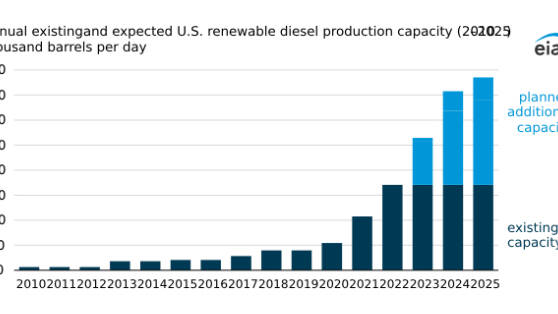

U.S. production capacity for renewable diesel could more than double from current levels by the end of 2025, based on several announcements for projects that are either under construction or could start development soon.
Two factors behind growing U.S. renewable diesel capacity are rising targets for state and federal renewable fuel programs and biomass-based diesel tax credits. The Inflation Reduction Act of 2022 extended the biomass-based diesel tax credits through 2024. We estimate U.S. renewable diesel production capacity was 170,000 barrels per day (b/d), or 2.6 billion gallons per year (gal/y), at the end of 2022. Although we expect some announced projects will be delayed or canceled, if all projects begin operations as scheduled, U.S. renewable diesel production capacity could reach 384,000 b/d, or 5.9 billion gal/y, by the end of 2025.
Renewable diesel is a fuel that is chemically equivalent to petroleum diesel and nearly identical in its performance characteristics. The same is not true of biodiesel, which is chemically different from petroleum diesel. Renewable diesel’s chemical equivalence to petroleum diesel gives it a couple of advantages over biodiesel. One advantage is that producers can distribute renewable diesel in petroleum diesel pipelines. A second advantage is that traditional diesel engines can consume any blend level of renewable diesel, including pure renewable diesel, with no significant side effects. In contrast, biodiesel can only be blended into petroleum diesel between 2% and 20% of the diesel fuel by volume.
Renewable diesel has some of the highest greenhouse gas (GHG) reduction scores among existing fuel pathways in programs such as the federal Renewable Fuel Standard (RFS), the California Low-Carbon Fuel Standard(LCFS), the Oregon Clean Fuels Program, and the Washington State Clean Fuels Program.
Investment in new renewable diesel production capacity has recently grown significantly in the United States because of renewable diesel’s interchangeability with petroleum diesel in existing petroleum infrastructure and because of government incentives. In 2022 and early 2023, the following eight new renewable diesel refineries began production:
- CVR Energy’s plant in Wynnewood, Oklahoma
- Diamond Green Diesel’s plant in Port Arthur, Texas
- HollyFrontier’s plant in Artesia, New Mexico
- HollyFrontier’s plant in Cheyenne, Wyoming
- Montana Renewables’ plant in Great Falls, Montana
- New Rise Renewables’ plant in Reno, Nevada
- Seaboard Energy’s plant in Hugoton, Kansas
- Shell’s plant in Norco, Louisiana
The production capacity currently scheduled to begin operation could allow renewable diesel to contribute to a greater share of West Coast diesel consumption. Most renewable diesel in the United States has historically been consumed on the West Coast, where producers can take advantage of both RIN credits from the RFS and state credits from one of the state renewable fuel programs. An average of 520,000 b/d of distillate fuel oil was consumed on the West Coast in 2021. The region, which is also the largest renewable diesel importing region in the United States, could soon meet the majority of its distillate fuel needs from renewable diesel by 2025 if domestic renewable diesel capacity does, in fact, increase as scheduled.
Source: EIA



Related News.

Cyprus Maritime Innovation takes Centre Stage at SMM Hamburg 2026
Underscoring its expanding role as a premier international hub for cutting-edge maritime technology and sustainable shipping, the Republic of Cyprus…

Trump seeks to refill US oil reserve with Venezuela deal but faces long delay
U.S. President Donald Trump said on the 30th (local time) that he would refill the U.S. Strategic Petroleum Reserve, which has been depleted with…

US Navy Official visits South Korean Shipyards in private
With U.S. President Donald Trump pushing a plan to allow overseas construction of U.S. warships, attention is focusing on whether the building of…

SES and De Boer Marine expand collaboration with FlexMaritime deployment across Global Markets
SES, a leading space solutions company, and De Boer Marine, a leading provider of top-quality marine equipment and maritime connectivity services,…

New ESG guidance to help maritime industry turn sustainability into commercial advantage
New framework helps shipowners and ports align ESG strategy with access to capital, charterer expectations and long-term asset value. Maritime…

Britannia P&I Club analysis finds four in five crew deaths linked to illness rather than accidents
New report highlights cardiovascular disease as leading cause of fatalities and raises concerns over mental health risks among younger seafarers.…

The Swedish Club launches new Loss Prevention podcast, Knot Another Lesson
The Swedish Club has launched Knot Another Lesson, a new podcast exploring the practical lessons, emerging risks and operational challenges shaping…

Lloyd’s Register appoints Jens Grunenberg as Senior Representative for Germany
Lloyd’s Register has appointed Jens Grunenberg as its Senior Representative for Germany, effective 1 September. Based in Hamburg, Grunenberg will…

Indian Register of Shipping sets sights on Hamburg for European Expansion
Indian Register of Shipping, a leading international classification society and full member of the International Association of Classification…
MOL completes Merger of 6 Ship Management Companies
Unifying Management of Over 200 Vessels and Strengthening Safety Mitsui O.S.K. Lines, announced that it has completed the integration of the MOL…
Subscribe to our newsletter!
if you dont want to swim alone in the ocean of news, sign up for the newsletter, and you will receive daily all the important news of world shipping!
