Launch of XMM on Ariane 5 two new kids on the block who changed history
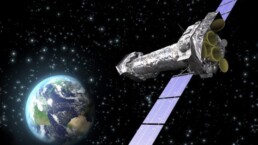

It is difficult to image a more inspiring way to usher out one millennium and herald the next – two new-generation pioneering examples of technology perfectly performing an extraordinary ambitious feat, and both going on to make history several times over in the decades to come.
On 10 December 1999, the new European heavy-lift launcher Ariane 5blasted off from the Kourou Spaceport exactly on schedule at 3.32 pm CET, carrying the European Space Agency’s most advanced science spacecraft at the time, the X-ray Multi Mirror space telescope XMM (full name High Throughput X-ray Spectroscopy Mission).
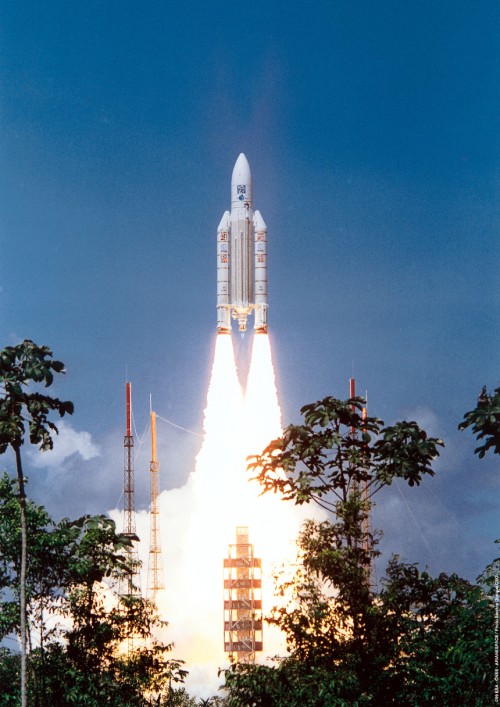
Twenty-nine minutes after lift-off, XMM was released into space with incredible accuracy – injected by Ariane 5 to within a minuscule 1.5 km of its target. Around a mere 20 seconds after separation, XMM’s first telemetry data was received by mission control, and within an hour of lift-off the space operations center confirmed that the spacecraft was under control with electrical power generated by the now-deployed solar arrays. Put on course by the best start possible, it was off on a mission to take science and our understanding of the universe to completely new levels.
Designed for the future
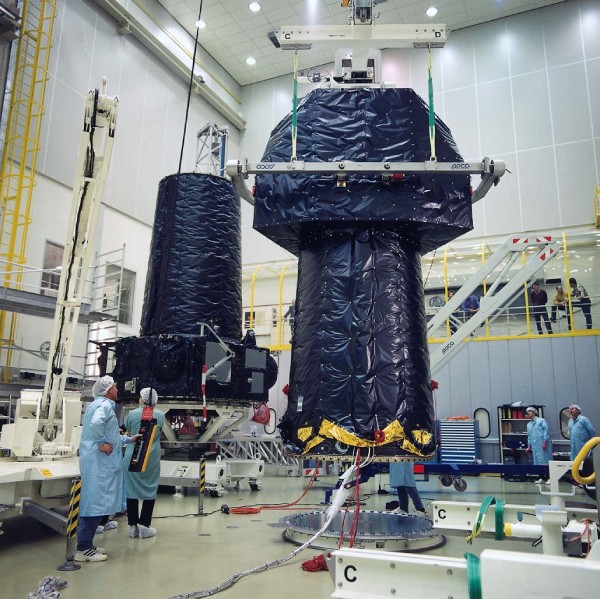
Europe had a lot riding on this mission. It was the first commercial mission of the all-new Ariane 5 rocket. Its passenger was no less than the largest and most sophisticated science satellite so far created in Europe.
Europe’s new rocket was not an incremental extension of its predecessors, but a radical conceptual departure, conceived to respond to a larger palette of mission demands as space activity and ambition expanded. Built to be more powerful, more flexible, Ariane 5 had much to prove on this flight.
Its passenger XMM, too, was pushing the boundaries. A scientific cornerstone project for ESA, not an extension or a follow-up of existing technology, its mission was to help scientists to solve the biggest cosmic questions by providing data of X-ray emissions in space.
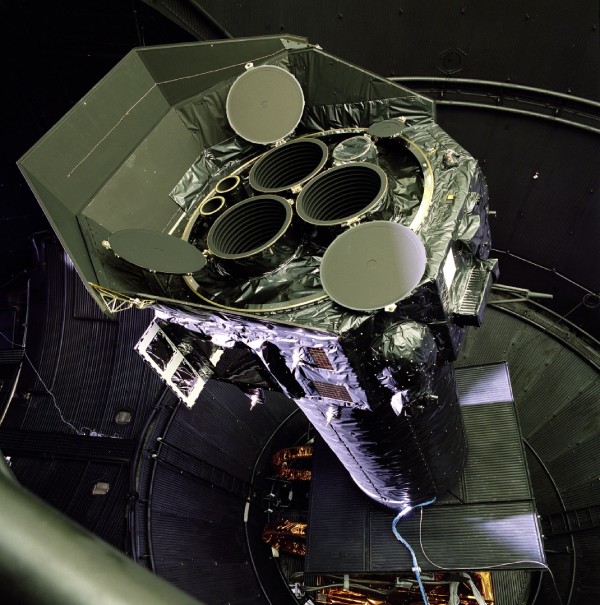
Getting to space to find out more
Many cosmic bodies – galaxies, quasars, stars (like our Sun) – generate X-rays, which provide chemical and physical information. But the Earth’s atmosphere blocks out these X-rays, which are messengers of what occurred in the distant past when stars were born or died, and can provide clues to our future. So we can only collect this information by a satellite placed in space outside the Earth’s atmosphere.
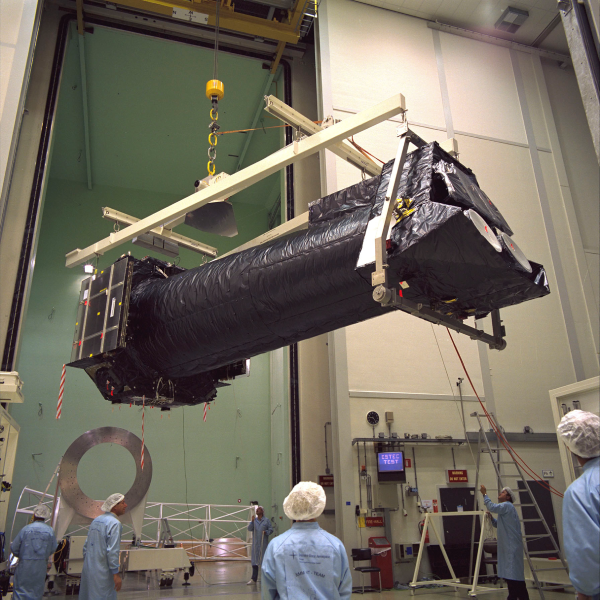
XMM, which weighs 3.8 tons and measures 10 meters in length, is equipped with three X-ray telescopes with 58 high-precision mirrors capable of detecting millions of sources, far more than any previous mission.
For a passenger of this size, for these orbit requirements, Ariane 5 was the obvious choice.
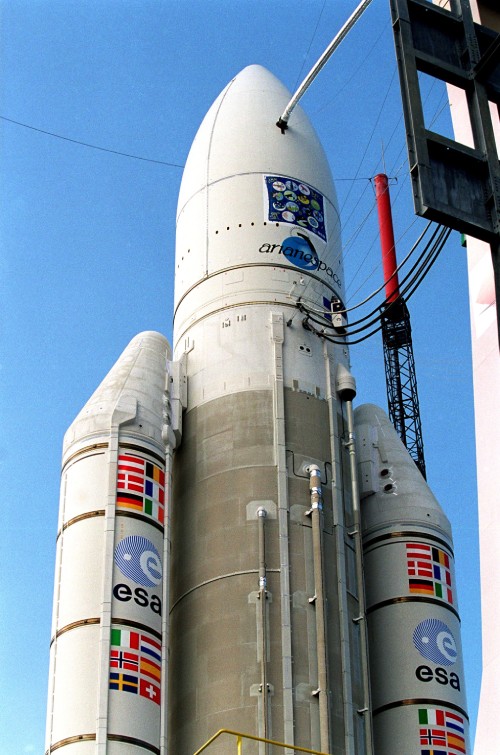
A textbook launch = a new playbook
XMM operates in an unusual highly elliptical orbit which takes it from 7,000 km at its nearest point to 140,000, its farthest point from Earth. This takes it out to almost a third of the way to the Moon passing by in a 48-hour loop, which means it can take long interrupted observations and is optimal for station ground contact.
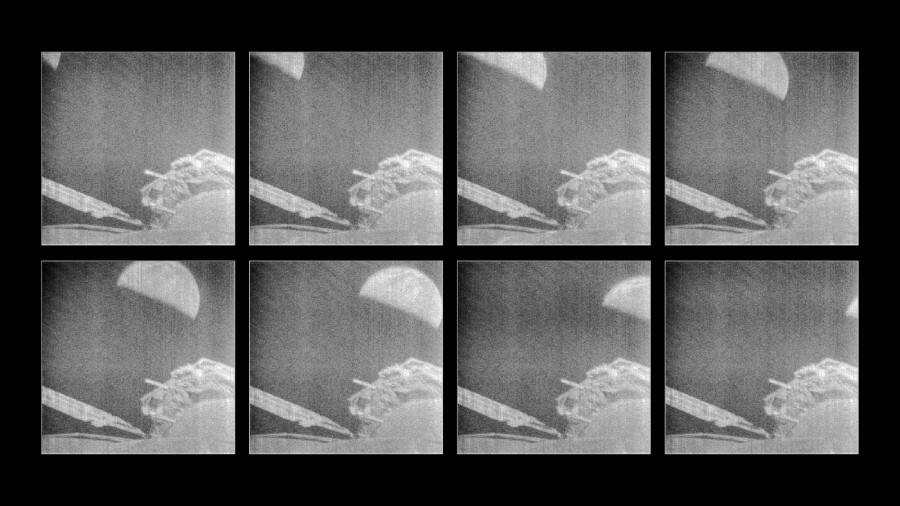
At the time of the launch, the XMM project manager went on record as saying that the reduction in the amount of propellant occasioned by the accuracy of the launch procedure by Ariane 5 could well extend XMM’s lifetime to 20 years, instead of the expected 10 years. Prophetic words…
Originally planned for a two-year mission, with a 10-year provision, XMM has proved to be so efficient that it has been extended again and again and is going strong today, in its third decade after its launch. It has provided and continues to provide the huge international science community with an outstanding source of information – and shows little sign of slowing down!
Since its launch, this X-ray observatory has delivered an incredible, invaluable quantity of new data, dramatically improving our understanding of the cosmos – black holes, neutron stars, supernovae, to name but a few.
There have also already been spin-offs back home on Earth in the areas such as miniaturisation and carbon fibre technology.
That day in 1999, Flight 504 was a moment full of heart-stopping emotion, no doubt. But it is also an eloquent testimony to Europe’s on-going vision, ambition, determination and confidence in its ability to push space exploration to its full potential.
That day in 1999, Flight 504 was a moment full of heart-stopping emotion, no doubt. But it is also an eloquent testimony to Europe’s on-going vision, ambition, determination and confidence in its ability to push space exploration to its full potential.
Did you know …?
XMM (standing for X-ray Multi Mirror) was the name of the spacecraft at its launch. It was renamed XMM-Newton in February 2000 to honour Sir Isaac Newton (1643– 1727), the father of spectroscopy, the science on which the mission is based
XMM-Newton was affectionately named the ‘Black Beauty’ by the engineers who built it on account of its black thermal protective film
After launch in December 1999, XMM was put into safe mode until 4 January 2000 to avoid any millennium bug problems
Among its many achievements, XMM-Newton can boast providing data which enabled scientists to solve one of the biggest mysteries in astrophysics – the “puzzle of the missing matter”
Photos: NASA, ESA, ArianeGroup



Related News.

Crewing After 2026: How AI Will Take Over the Routine in 2027
The crewing market of late 2026 is not the market of 2025. Artificial intelligence has moved from presentations into daily crewing work, while the…

Dualog launches secure maritime AI service amid surge in seafarer AI use
The new service, Sparks lets crew and shore teams search company emails, documents and conversations without exposing sensitive fleet information to…

Time Ticking: Two weeks for Governments to Green-Light Framework for Cutting Shipping Emissions
As a crucial fortnight of meetings opens at the International Maritime Organization opens in London, the Clean Shipping Coalition calls on member…

“K” LINE signs contract for construction of two LPG dual-fuel VLGCs
Kawasaki Kisen Kaisha, announces today that it has signed agreements with South Korea-based HD Hyundai Samho regarding the construction of two LPG…

Equinor and VNG sign 18-year gas sales agreement for supplies to Germany
Equinor will supply natural gas to the German energy company VNG until the end of 2044. The 18-year agreement is the longest gas sales agreement…

Open letter to MEPs to reject the motion for a resolution and support the inclusion of Indian ship recycling yards on the European List
Dear Members of the European Parliament, Ahead of this week’s plenary vote, European Shipowners | ECSA, BIMCO, the Cruise Lines International…

ShipVet appoints James Stairmand as Chief Executive Officer
Founder Captain Fintan Cullen moves to a non-executive role as the company builds on investment in its vetting team and technology. ShipVet, the…

USD ≈7bn lost per year the hidden cost of how shipping trades
New Torvald Klaveness study quantifies around USD 7bn a year in potentially avoidable costs in dry bulk and product tanker shipping, with a possible…

APM Terminals Maasvlakte II and Port of Rotterdam Authority take next step in terminal development
APM Terminals Maasvlakte II and the Port of Rotterdam Authority are moving forward in terminal’s development with preparations for a new phase of…

ABP inspiring the next generation
ABP host 500 young people to explore maritime and transport careers More than 500 young people from across Hampshire and the Solent explored career…
Subscribe to our newsletter!
if you dont want to swim alone in the ocean of news, sign up for the newsletter, and you will receive daily all the important news of world shipping!
