Emissions estimated as accurate as the real thing – nearly
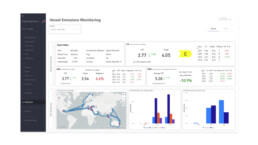

Signal Ocean’s Emissions estimation algorithm exceeds 90 per cent accuracy
Detailed back testing of actual CO2 emissions of circa 40 tankers that have been part of the Signal Maritime pool against Signal Ocean’s algorithm-based estimates has shown that real-time emission estimates are accurate within less than a 10% margin of error.
The power and simplicity of real-time emission estimates have been recently underlined in pretty much all of this year’s ESG fora, but accuracy is critical if owners, charterers and traders are to depend on them as a trustworthy indicator of a vessel’s CII (Carbon Intensity Indicator) rating in 2023 and beyond. The International Maritime Organization’s MARPOL Annex VI Carbon Intensity Indicator legislation takes effect from 1 January 2023.
With charterers now taking contractual responsibility for a vessel’s ship emissions under BIMCO’s new model CII clause, the need for real-time accurate CII assessments for any vessel based on its actual activity is critical. Whilst every vessel above 5000 GT will have a publicly available CII rating ranging from A to E, this rating will only describe a ship’s performance in the previous calendar year and not how it has performed so far this year, nor how it is likely to perform tomorrow or for the rest of the year.
The vessel emission features offered through the Signal Ocean platform, and the Vessel Emissions API allow shipping participants to see in a simple, systematic and consistent way emissions for any proposed voyage and enable meaningful benchmarking and comparisons.
Signal Ocean COO Dimitris Tsapoulis said:
“CII estimations for any vessel or voyage, past, current or future, allow Signal Ocean users to factor in environmental performance at the time they are weighing their chartering options. Anecdotally, traders using the service reported back accuracies that were very close to their own internal calculations, based on actual measurements; we were delighted to see yet another data point in Signal Maritime’s figures.”
He added:
“What is even more inspiring than seeing a system with high accuracy estimations is to see the Signal Maritime team producing top-of-class environmental performance by closely tracking and simulating it through data. Environmental performance will undoubtedly play an increasingly critical role in economic success as we approach 2030 and beyond.”
The Signal Ocean estimates vessel emissions, like CO2, from AIS data converted into voyages, where all stops for bunkering operations, idle times, repairs, loads and discharge operations are taken into account. At sea, ballast and laden legs and Sulphur Emission Control Area navigation times are clearly defined. Fuel consumption is mapped to different fuel types (VLSFO, MGO, HSFO) based on the area that vessels have been trading, as well as taking into consideration a rich set of vessel particulars, including dimensions, the country built, and year built, scrubber fitting, consumption curves, operational conditions and vessel speeds.
Earlier this year, the algorithm underpinning Signal Ocean’s estimates of vessel CO2 emissions was verified as meeting IMO guidelines by the independent classification society DNV. The service is available for tankers, dry bulk and LPG vessels.
Source: Signal



Related News.

OL Shipping Group in Tokyo: Capt. Eberhard Koch calls for realistic solutions to Maritime Decarbonisation
An intensive and engaging couple of days in Tokyo brought together leading figures from the international maritime community, providing a valuable…

Regatta for Peace one of the largest ever in Cyprus
Cyprus will host the first European stop on a global sailing journey leading up to the 2027 America’s Cup in Naples. More than 120 sailors…

The propulsion technology powering the marine energy transition
The marine industry is under increasing pressure to future-proof fleets, balancing the need to reduce emissions and improve efficiency. Propulsion…
Signal Ocean acquires Lgmar
Signal Ocean announced the acquisition of Lgmar, the Athens-based company behind Telix, a maritime email and communication platform in daily use…

Canada clean power push challenged by interprovincial grid limits, says GlobalData
Canada is entering a pivotal phase of power-sector expansion as federal tax credits, the phase-out of coal-fired generation, and accelerating…

Maritime safety depends on human factors and leadership, not procedures alone
Interim survey findings point to a gap between seafarers’ perceptions of risk and injury data Seafarers may misjudge when and where they are most at…

New BIMCO contracts tackle ship recycling and energy-saving retrofits
BIMCO adopted two new contractual solutions designed to help you manage important operational and regulatory challenges: the revised…
Stena Line to acquire vessel and make changes to its network
Stena Line has reached an agreement to acquire the RoRo vessel Somerset from CLdN. Subject to closure and transfer, the vessel would begin operating…

DORIC WEEKLY INSIGHT 16 OCTOBER 2026
Please find below the DORIC Market Insight for the week ending 16th October 2026. Weekly Report 16.10.2026

Important information for port clients and freight carriers effective November 1, a new traffic overpass and port checkpoint will open for traffic to the Port of Riga on Kundziņsala
Starting November 1 of this year, a new traffic overpass connecting Tvaika Street to Kundziņsala will open to facilitate traffic to and from the Port…
Subscribe to our newsletter!
if you dont want to swim alone in the ocean of news, sign up for the newsletter, and you will receive daily all the important news of world shipping!
