CII is not the answer for Oldendorff Carriers
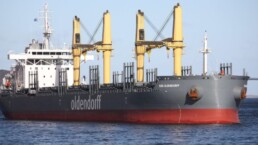

IMO’s new Carbon Intensity Indicator regulations will not help the environment and may in many cases actually lead to higher rather than lower emissions. Oldendorff Carriers have developed and herewith share a detailed presentation on this complex topic. This overview is intended to be both informal and educational. It serves to help their staff and partners understand the likely yet unintended consequences of the regulations and the difficulties with related contractual clauses.
Reducing the Greenhouse Gas emissions is one of the most significant challenges for this generation. We need to decarbonise to limit global warming. However, the shipping industry is one of the most difficult to abate sectors. While ocean shipping is the most efficient mode of transportation, it requires significant amounts of energy to power global trade. We must work collaboratively with all participants in the supply chain to achieve meaningful emission reductions.
Oldendorff Carriers presentation provides a variety of examples where the application of the CII regulations yield unfavorable results. Our argument is that the shipping industry should not rely solely on the formulas in the regulation, rather we need to take a holistic view and focus on reduction of absolute emissions. The CII formulas in the regulation are not holistic, can be gamed and there are many real-world instances where strict adherence and focus on the CII rating letter grades will do more damage than good.
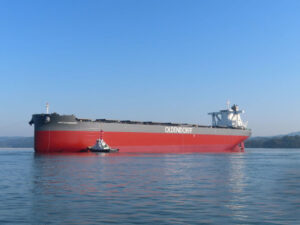
For example, ship owners and operators are already trying to increase fleet productivity by reducing empty legs, so they can carry more cargoes per year. Even though a ship consumes more fuel during laden voyages, the improved utilization decreases the emissions per ton carried, which is beneficial for the environment and should be the objective.
However, such improved efficiency is being penalized with a bad CII rating, whereas if an identical sister ship engages in inefficient trading and lower productivity, this leads to higher emissions per ton carried, but this vessel is being rewarded and encouraged by a good rating.
As the CII formula uses distance in the denominator, longer voyages are favored and shorter round voyages are penalized. The likely consequence will be that less efficient ships will trend toward long voyages, emitting more, while more efficient ships stay in the shorter trades. Meanwhile, there is no motivation to shorten trade lines in the name of reducing emissions.
Furthermore, the CII rating will be negatively affected by long waiting times or slow port operations, even though this is mostly beyond the carrier’s control. Some owners may resort to irresponsible steaming around in circles instead of waiting at anchor. This will improve their CII rating but will also increase annual GHG emissions.
The CII is an operational score card, but it does not accurately reflect the difference between a super eco ship and an inefficient ship on a trade route with an inherently bad CII variable. Even the most efficient vessels can receive bad CII ratings due to factors that have nothing to do with the actual technical efficiency of the vessel. On the other hand, the most inefficient vessel can achieve a good CII rating by simply ballasting with no cargo. This exemplifies why CII metrics should not be used in isolation for commercial contracts.
Neither charterers nor owners should take a hard stance on a specific CII letter rating. The D and E ratings are acceptable transitional ratings during the current phase of the IMO CII regulations, provided that the improvement plan requirements (SEEMP) are adhered to. Ships rated D or E that are following this SEEMP process are compliant and should be accepted by charterers for the execution of their cargoes. If charterers insist on a higher CII rating, then shipowners will need to ask for indemnification from charterers for damages to the vessels CII rating caused by long port stays. Similarly, owners should not worry about how their ships are traded if they are out on time charter. This approach will solve the problem with the BIMCO clause not being workable and end the vicious cycle where all parties seek to be indemnified for theoretical damages that can’t be quantified.
Please review our presentation if you would like to see the reasons behind our point of view. We believe that the review of the CII regulations, which is already intended by the IMO, should begin urgently to rectify the illustrated problems.
In the meantime, our advice is to focus on the emissions and not the CII rating.



Related News.

OL Shipping Group in Tokyo: Capt. Eberhard Koch calls for realistic solutions to Maritime Decarbonisation
An intensive and engaging couple of days in Tokyo brought together leading figures from the international maritime community, providing a valuable…

Regatta for Peace one of the largest ever in Cyprus
Cyprus will host the first European stop on a global sailing journey leading up to the 2027 America’s Cup in Naples. More than 120 sailors…
The propulsion technology powering the marine energy transition
The marine industry is under increasing pressure to future-proof fleets, balancing the need to reduce emissions and improve efficiency. Propulsion…
Signal Ocean acquires Lgmar
Signal Ocean announced the acquisition of Lgmar, the Athens-based company behind Telix, a maritime email and communication platform in daily use…

Canada clean power push challenged by interprovincial grid limits, says GlobalData
Canada is entering a pivotal phase of power-sector expansion as federal tax credits, the phase-out of coal-fired generation, and accelerating…

Maritime safety depends on human factors and leadership, not procedures alone
Interim survey findings point to a gap between seafarers’ perceptions of risk and injury data Seafarers may misjudge when and where they are most at…

New BIMCO contracts tackle ship recycling and energy-saving retrofits
BIMCO adopted two new contractual solutions designed to help you manage important operational and regulatory challenges: the revised…
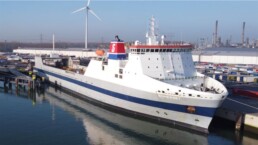
Stena Line to acquire vessel and make changes to its network
Stena Line has reached an agreement to acquire the RoRo vessel Somerset from CLdN. Subject to closure and transfer, the vessel would begin operating…
DORIC WEEKLY INSIGHT 16 OCTOBER 2026
Please find below the DORIC Market Insight for the week ending 16th October 2026. Weekly Report 16.10.2026

Important information for port clients and freight carriers effective November 1, a new traffic overpass and port checkpoint will open for traffic to the Port of Riga on Kundziņsala
Starting November 1 of this year, a new traffic overpass connecting Tvaika Street to Kundziņsala will open to facilitate traffic to and from the Port…
Subscribe to our newsletter!
if you dont want to swim alone in the ocean of news, sign up for the newsletter, and you will receive daily all the important news of world shipping!
