The Port of Gandia a unique case in Spain and possibly one of the few in the world
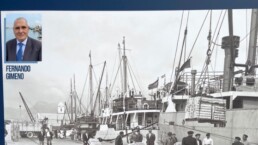

It was the only port in Spain built with private capital and destined for the public service of ships, goods and passengers
In 1892, after the execution of the works of the enclosure and the Gandia-Alcoi railway line, the Port, owned by the British company ‘The Alcoi-Gandia Railway & Habour Company Limited’ opened its doors
The port of Gandia was a forerunner, becoming one of the first ports in Spain to have true intermodal transport of goods, by connecting sea and rail transport on the same quay
Fernando Gimeno, former head of port services management at the Port of Gandia and author of the book ‘History of the Port of Gandia’, explained the origins of a centenary enclosure
In 1947, the Port of Gandia became State property, after acquiring the small Gibraltar from the British company
In 1892 the Port of Gandia received the authorisation to open the port to the public. This weekend it celebrated its 130th anniversary, a port area that is unique in Spain and possibly in the world, as it was built with private capital and intended for the public service of ships, goods and passengers. A project driven by the entrepreneurial nature of the people of La Safor and which served to promote the export of vegetables and oranges produced in the region and the promotion of the railway line that linked Gandia with Alcoy and served to develop the economy of the inland regions and give goods an outlet by sea, linking the railway with the port.
In 1883, commissioned by the then mayor of Gandia, José Rausell Rivas and his friend and leader of the liberal party in the city, Sinibaldo Gutiérrez Más, to the engineer Rafael Yagüe Buil Más, the original project of the port was drawn up. A necessary enclosure motivated by the large production of vegetables and oranges in Gandia that had to be taken to Valencia to export them, which meant, during the transfer, a deterioration of the goods, while the part that was shipped on the beach (30,000 tons), were carried out in difficult conditions and at a high economic cost. With the construction of the port, operations would be safer, costs would be lower and traffic would increase, both for the export of agricultural products (including areas of Xátiva, Alzira, etc.) and for imports (fertilisers and timber). The budget for the execution of the works was 1,083,369.33 pesetas and the annual maintenance and operation of 29,000 pesetas.
In addition to this need, the construction of the Gandia-Alcoi railway by the British company ‘The Alcoi-Gandia Railway & Habour Company Limited’, whose objectives were to import the coal needed by the textile industries of Alcoi, and to export the products of the regions of La Safor, L’Alcoiá and El Comtat, to overseas markets, added to the greater utility of the enclosure. A train that linked both towns for 53 kilometres. In fact, it was the British company that acquired the rights to build the coastal enclave.
The port of Gandia was a forerunner, becoming one of the first ports in Spain to have a true intermodal transport of goods, by connecting maritime and rail transport on the same quay.
State port. The state acquires ‘little Gibraltar’
After the war, the port went through its darkest and most precarious period, as the company had no economic resources to repair the damage to the port. So much so that the dredging had to be paid for by the exporters to allow the ships to dock and the oranges to be loaded. In view of the distressing situation, the Gandia Town Council demanded that the State declare the port of Gandia of national interest, “as the existence of this little Gibraltar could not be allowed”. Finally, the port passed to the State in 1947, after having been acquired by the State from the British company for 4,125,000 pesetas.
The importance of oranges and the opening up to other goods
Since its beginnings, the Gandia area has been a reference point for the export of Valencian oranges. As early as 1958, oranges were exported in all their varieties and presentation formats (boxes, trays, etc.) to 13 countries: Germany, Belgium, Denmark, Finland, France, Holland, Great Britain, England, Ireland, Italy, Norway, Poland, Sweden and Russia, through the Port of Odessa. This trend in orange exports would continue and increase over the next ten years. The ports of destination for the oranges included: Aarhus, Antwerp, Bremen, Copenhagen, Dover, Dublin, Stockholm, Genoa, Gdynia, Göteborg, Hamburg, Helsinki, Hull, Liverpool, London, Malmö, Marseille, Newcastle, Norkoping, Odessa, Oslo, Port Vendres, Rijeka, Rostock, Rotterdam, Sette.
In the 1960s-1970s, the northern quay was extended by 410 metres and goods began to diversify, thanks to the private initiative of companies such as Navarro and Boronad, which allowed the traffic of other products, especially paper and wood, when the massive introduction of the lorry was imposed for the distribution of fruit and vegetables to European countries.



Related News.

OL Shipping Group in Tokyo: Capt. Eberhard Koch calls for realistic solutions to Maritime Decarbonisation
An intensive and engaging couple of days in Tokyo brought together leading figures from the international maritime community, providing a valuable…
Regatta for Peace one of the largest ever in Cyprus
Cyprus will host the first European stop on a global sailing journey leading up to the 2027 America’s Cup in Naples. More than 120 sailors…
The propulsion technology powering the marine energy transition
The marine industry is under increasing pressure to future-proof fleets, balancing the need to reduce emissions and improve efficiency. Propulsion…
Signal Ocean acquires Lgmar
Signal Ocean announced the acquisition of Lgmar, the Athens-based company behind Telix, a maritime email and communication platform in daily use…

Canada clean power push challenged by interprovincial grid limits, says GlobalData
Canada is entering a pivotal phase of power-sector expansion as federal tax credits, the phase-out of coal-fired generation, and accelerating…

Maritime safety depends on human factors and leadership, not procedures alone
Interim survey findings point to a gap between seafarers’ perceptions of risk and injury data Seafarers may misjudge when and where they are most at…

New BIMCO contracts tackle ship recycling and energy-saving retrofits
BIMCO adopted two new contractual solutions designed to help you manage important operational and regulatory challenges: the revised…
Stena Line to acquire vessel and make changes to its network
Stena Line has reached an agreement to acquire the RoRo vessel Somerset from CLdN. Subject to closure and transfer, the vessel would begin operating…

DORIC WEEKLY INSIGHT 16 OCTOBER 2026
Please find below the DORIC Market Insight for the week ending 16th October 2026. Weekly Report 16.10.2026
Important information for port clients and freight carriers effective November 1, a new traffic overpass and port checkpoint will open for traffic to the Port of Riga on Kundziņsala
Starting November 1 of this year, a new traffic overpass connecting Tvaika Street to Kundziņsala will open to facilitate traffic to and from the Port…
Subscribe to our newsletter!
if you dont want to swim alone in the ocean of news, sign up for the newsletter, and you will receive daily all the important news of world shipping!
