Deltamarin participates in a project to demonstrate end-to-end shipboard carbon capture at scale
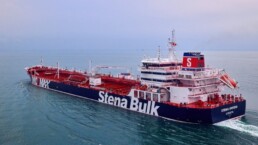

The Global Centre for Maritime Decarbonisation, the Oil and Gas Climate Initiative and Stena Bulk today initiated the first stage of a two-year, three-phase project to demonstrate shipboard carbon capture at scale.
Together with Alfa Laval, the American Bureau of Shipping, Deltamarin and TNO, the consortium of leading players from the energy and shipping industries will investigate on-board capture and storage, as well as offloading of captured carbon dioxide to address the challenges and opportunities of deploying carbon capture technology on ships.
Although a lot of effort is going into the development of low and zero-carbon fuels, that development alone may not be fast enough to allow international shipping to meet IMO’s greenhouse gas emissions reduction targets. Projections indicate that 85% of the fuel mix for two-stroke engines will remain fossil-fuel based by 2030 and 34% by 2050*. Shipboard carbon capture can help reduce GHG emissions of current vessels, with the possibility of recycling captured CO2 to produce alternative fuels.
World’s first end-to-end shipboard carbon capture pilot
Project REMARCCABLE (Realising Maritime Carbon Capture to demonstrate the Ability to Lower Emissions) is the world’s first project aimed to demonstrate end-to-end shipboard carbon capture at scale.
While carbon capture technologies have been successfully used by OGCI’s member companies to reduce CO2 emissions from power plants and industrial operations, their use in the shipping industry is still in development.
In the largest project of its kind, targeting at least 30% absolute CO2 capture, or approximately 1000 kg/hr of capture, the seven-member consortium will build and test a marine carbon capture system onboard a Stena Bulk medium range (MR) tanker to assess the operational challenges of running such a system on a ship at sea.
Project REMARCCABLE will use non-proprietary equipment and processes, so results can be shared broadly and publicly to maximise learning and encourage further technology
development. The project also aims to establish a pathway to reduce the cost of CO2 capture to 150 €/tCO2 or lower to allow the technology to be commercially deployed in future.
An MR tanker was chosen for the project as vessels of similar size are estimated to emit 17%* of shipping’s total CO2 emissions. The initial demonstration will involve over 500 hours of capture of the exhaust from burning high-sulphur fuel oil (HSFO) or very-low sulphur fuel oil (VLSFO) and will include offloading(s) of captured and liquefied CO2 (LCO2) at ports along the route of a 10-day deep-sea voyage. Following a successful test phase, Stena Bulk will retain the carbon capture system onboard and extend its use beyond this pilot.
With an offtaker for the captured CO2 identified, Project REMARCCABLE will cover onboard capture and storage, as well as utilisation and/or sequestration to account for CO2 emissions reduction from ship to shore. This will make it the only pilot demonstrating shipboard carbon capture across the full value chain.
Professor Lynn Loo, CEO of the Global Centre for Maritime Decarbonisation, said: “GCMD views shipboard carbon capture as one of the mid-term solutions needed to help the maritime sector to decarbonise. The open sourcing of project REMARCCABLE, piloting under real-world conditions and delivering end-to-end solutions, is in line with GCMD’s goals of lowering the barriers for adoption so international shipping can meet or exceed the International Maritime Organization’s (IMO) GHG emissions reduction targets for 2030 and 2050.”
Erik Hånell, CEO of Stena Bulk, said: “We are proud to collaborate with GCMD, OGCI, and especially our customers, to demonstrate shipboard carbon capture on one of our vessels. Exploring this technology is crucial to understanding the role it could play in facilitating our industry’s decarbonisation. Not only does this project align with Stena Bulk’s vision to advance decarbonisation, it is a testament to our entrepreneurial spirit and our eagerness to lead change.”
Project REMARCCABLE: three phases
Project REMARCCABLE comprises three phases and is inspired by a feasibility study that was carried out and completed by TNO on behalf of OGCI and Stena Bulk in November 2021.
The first phase involves conceptual design and front-end engineering design study (FEED) of the carbon capture system; this study is ongoing and is expected to be completed in the first quarter of 2023.
Following the successful completion of phase one, and once consortium partners provide
their backing, a second phase encompassing the engineering, procurement, and construction (EPC) of a prototype shipboard carbon capture system, including onshore commissioning, will be initiated.
Phase three will focus on integrating the carbon capture system with the identified MR tanker and conducting sea trials. Concurrently, GCMD will be issuing an Invitation for Proposal (IFP) to study the challenges and address the needs to operationalise offloading of LCO2. The findings from the offloading study will inform the pilot in phase three of Project REMARCCABLE.
The transition from one to each subsequent phase of the project will be governed by a rigorous gated review of key performance metrics.
Deltamarin’s scope during the first phase of the project includes the FEED of carbon capture system integration onboard the case ship. Prior to this, the solution will reach an approval in principle for which Deltamarin performs the necessary initial integration design. An important aspect of Deltamarin’s work is also to study the feasibility of the carbon capture system in a newbuilding design, where the ship, her machinery and auxiliary processes can really be designed and optimized with carbon capture in mind. Deltamarin’s strong knowledge of cutting-edge technology and own ship products with excellent efficiency are the starting point for this exercise.
Michael Traver, Head of the Transport Workstream at OGCI, said: “Building on our previous feasibility work, this real-life project will show the potential of carbon capture technology to meet ambitious decarbonization goals set by the maritime industry. We’re excited to bring our knowledge from stationary applications to this hard to abate sector.”
The success of project REMARCCABLE has the potential to accelerate commercial deployment of shipboard carbon capture technology within the next five years, providing MR tankers and other vessels of similar size a mid-term solution to cut GHG emissions.



Related News.

Crewing After 2026: How AI Will Take Over the Routine in 2027
The crewing market of late 2026 is not the market of 2025. Artificial intelligence has moved from presentations into daily crewing work, while the…

Dualog launches secure maritime AI service amid surge in seafarer AI use
The new service, Sparks lets crew and shore teams search company emails, documents and conversations without exposing sensitive fleet information to…

Time Ticking: Two weeks for Governments to Green-Light Framework for Cutting Shipping Emissions
As a crucial fortnight of meetings opens at the International Maritime Organization opens in London, the Clean Shipping Coalition calls on member…

“K” LINE signs contract for construction of two LPG dual-fuel VLGCs
Kawasaki Kisen Kaisha, announces today that it has signed agreements with South Korea-based HD Hyundai Samho regarding the construction of two LPG…

Equinor and VNG sign 18-year gas sales agreement for supplies to Germany
Equinor will supply natural gas to the German energy company VNG until the end of 2044. The 18-year agreement is the longest gas sales agreement…

Open letter to MEPs to reject the motion for a resolution and support the inclusion of Indian ship recycling yards on the European List
Dear Members of the European Parliament, Ahead of this week’s plenary vote, European Shipowners | ECSA, BIMCO, the Cruise Lines International…

ShipVet appoints James Stairmand as Chief Executive Officer
Founder Captain Fintan Cullen moves to a non-executive role as the company builds on investment in its vetting team and technology. ShipVet, the…

USD ≈7bn lost per year the hidden cost of how shipping trades
New Torvald Klaveness study quantifies around USD 7bn a year in potentially avoidable costs in dry bulk and product tanker shipping, with a possible…

APM Terminals Maasvlakte II and Port of Rotterdam Authority take next step in terminal development
APM Terminals Maasvlakte II and the Port of Rotterdam Authority are moving forward in terminal’s development with preparations for a new phase of…

ABP inspiring the next generation
ABP host 500 young people to explore maritime and transport careers More than 500 young people from across Hampshire and the Solent explored career…
Subscribe to our newsletter!
if you dont want to swim alone in the ocean of news, sign up for the newsletter, and you will receive daily all the important news of world shipping!
