SEA-LNG response to UCL report exploring methods for understanding stranded value: case study on LNG capable ships
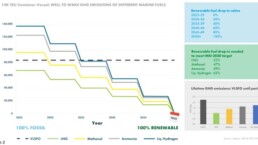

The recent study from UCL; Exploring methods for understanding stranded value: case study on LNG capable ships, is a flawed academic exercise, detached from reality.
In setting out a framework for their analysis the authors make innumerable contestable and unsupported statements.
Somewhat confusingly, given the focus of their paper on stranded value risk, they ignore the fact that LNG dual fuel engines already provide ship owners with an insurance against stranded assets, as they can burn traditional marine fuels and are currently doing so in Europe as a consequence of the unprecedented spike in LNG prices.
Further, their analysis is based on an assumption that the decarbonisation pathway offered by LNG via bioLNG in the medium term to synthetic, or e-LNG, in the long term, will be less “competitive” than ammonia or other electro- fuels. This is highly problematic for a number of reasons. Predicting the future production costs of electro-fuels such as e-ammonia, e-methanol and e-LNG is extremely difficult given that 80% of the cost of producing these fuels is associated with the cost of producing the common renewable hydrogen feedstock. This can only be produced from renewable energy sources which will take years to develop to the necessary scale. Suggesting a particular electro-fuel will ‘win’ based on price, is reckless and is, at best, a guess at this point in time.
Ammonia is a highly toxic fuel, with a volumetric energy density, approximately 50% that of LNG. This means more toxic fuel and less cargo. Regulatory agencies around the world will need to work to counter the dangers of ammonia to protect seafarers as well as port workers and port communities. Ammonia-fuelled engines are in the very early stages of development with massive uncertainties on issues such as pilot fuel requirements, GHG and NOx emissions and potentially deadly ammonia slip. Addressing these issues will demand significant amounts of time and money. Finally, massive infrastructure investments will be required to produce and deliver e-ammonia (and indeed other fuels such as e-methanol and e-liquid hydrogen) to the ships that may use it. Contrast this to the LNG pathway where the transportation and storage infrastructure already exists and is growing globally.
The results reported in this study are meaningless, based as they are on subjective, negative assumptions on LNG. Such flawed analysis can confuse the industry, potentially providing ship owners and investors with justification to sit back, wait and continue to emit GHGs rather than invest in a technology like LNG that offers immediate GHG reductions today together with a clear and competitive pathway to decarbonisation in the decades ahead. Waiting is not an option.



Related News.

OL Shipping Group in Tokyo: Capt. Eberhard Koch calls for realistic solutions to Maritime Decarbonisation
An intensive and engaging couple of days in Tokyo brought together leading figures from the international maritime community, providing a valuable…
Regatta for Peace one of the largest ever in Cyprus
Cyprus will host the first European stop on a global sailing journey leading up to the 2027 America’s Cup in Naples. More than 120 sailors…
The propulsion technology powering the marine energy transition
The marine industry is under increasing pressure to future-proof fleets, balancing the need to reduce emissions and improve efficiency. Propulsion…
Signal Ocean acquires Lgmar
Signal Ocean announced the acquisition of Lgmar, the Athens-based company behind Telix, a maritime email and communication platform in daily use…

Canada clean power push challenged by interprovincial grid limits, says GlobalData
Canada is entering a pivotal phase of power-sector expansion as federal tax credits, the phase-out of coal-fired generation, and accelerating…

Maritime safety depends on human factors and leadership, not procedures alone
Interim survey findings point to a gap between seafarers’ perceptions of risk and injury data Seafarers may misjudge when and where they are most at…

New BIMCO contracts tackle ship recycling and energy-saving retrofits
BIMCO adopted two new contractual solutions designed to help you manage important operational and regulatory challenges: the revised…
Stena Line to acquire vessel and make changes to its network
Stena Line has reached an agreement to acquire the RoRo vessel Somerset from CLdN. Subject to closure and transfer, the vessel would begin operating…
DORIC WEEKLY INSIGHT 16 OCTOBER 2026
Please find below the DORIC Market Insight for the week ending 16th October 2026. Weekly Report 16.10.2026
Important information for port clients and freight carriers effective November 1, a new traffic overpass and port checkpoint will open for traffic to the Port of Riga on Kundziņsala
Starting November 1 of this year, a new traffic overpass connecting Tvaika Street to Kundziņsala will open to facilitate traffic to and from the Port…
Subscribe to our newsletter!
if you dont want to swim alone in the ocean of news, sign up for the newsletter, and you will receive daily all the important news of world shipping!
