Port of Hamburg boosts container throughput market share

- Upward trend for container throughput
- Growth in transhipment
- Downturn in bulk cargo handling
- Double-digit growth in conventional cargoes
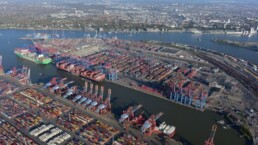
The container throughput trend in the Port of Hamburg in the first half of 2022 was more positive than expected. Total throughput of 4.4 million TEU – 20-ft standard containers – in the first six months of the year represented slight growth of 0.9 percent. Compared to the major competing ports of Antwerp-Bruges, Rotterdam and Bremen/Bremerhaven in Northern Europe, all reporting downturns in container handling, Hamburg was the only major port in the range to report an increase. At the four major ports in the European North Range, for the first six months average container throughput fell by 4.6 percent. Against this trend Hamburg, gained 1.1 percentage points, being the only top port to achieve growth in container handling.
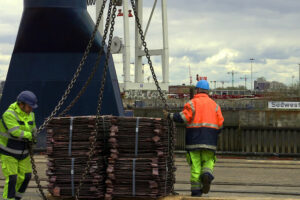
At 61.8 million tons, throughput in Germany’s largest universal port was 2.7 percent lower than in the comparable period of the previous year. The drop in the total throughput can be explained by the weaker figure for bulk cargo handling. At 17.6 million tons, handling in Hamburg was down by 8.9 percent. Totals for each of the three segments were lower. At 3.0 million tons, suction cargoes were down by 7.2 percent, at 10.2 million tons, grab cargoes by 3.2 percent, and at 4.5 million tons, liquid cargoes by 20.5 percent. The overall total was partly the result of stiffer EU sanctions against Russia, along with changes dictated by the market in the trading and transport of raw materials.
Many challenges for the Port of Hamburg
“The first half of 2022 confronted companies in the Port of Hamburg, their workers, also all our logistics partners and port customers, with very special challenges. The war in Ukraine, for instance, led to far-reaching sanctions in foreign trade that affected and will further affect seaborne cargo throughput in the Port of Hamburg. Together with the almost complete cessation of container transport with Russian ports, another consequence of the Russian attack on Ukraine – apart from downturns in general cargo handling – was also a steep reduction in bulk cargo handling,” said Axel Mattern, CEO of Port Hamburg Marketing.
Mattern pointed out that not only war in Ukraine, but also the repercussions of the global corona pandemic, will continue to cause transport and supply bottlenecks for trade and industry. On many routes, this is leading to longer transit times and steeply increased freight rates. In Mattern’s view, the main causes of supply chains thrown off schedule, as well as delays and disruption in worldwide transport processes, should not be attributed to ports alone. Instead, it is at the interface between land and sea transport that such factors as shipping bottlenecks and delays in truck and rail traffic are most strikingly visible and notable for port customers and the public. “The weeklong lockdown in the Port of Shanghai, and ship arrivals thrown off schedule, resulted in extraordinary peak loads at the port’s handling terminals. Containers not collected punctually, and blocking urgently needed handling space, involved additional effort plus problems for the efficient organization of handling and pre- and on-carriage transport between seaports and hinterland destinations,” added Mattern.
Better conditions for all transport modes
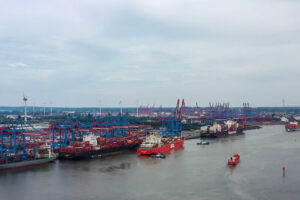
To prevent further disruptions in the Port of Hamburg, the Hamburg Port Authority – HPA ensures the maintenance and further development of the infrastructure. “As the Port Authority our core task is to create a functioning and efficient infrastructure for logistics chains and hence for supplying Germany and other parts of Europe via the Port of Hamburg. If supply chains fail to keep to schedule, as we have been experiencing for months, this task not only attracts more attention from the public but also assumes even greater importance. With the completion of the adjustment of the navigation channel in January, our customers are now able to handle more containers per ship call. That enhances the competitiveness of Hamburg as a centre and enables us to supply the economy and consumers throughout Germany more efficiently. Specifically, 117 Ultra Large Container Ship (ULCS) immediately took advantage of the navigational channel adjustment during the first half of 2022. Compared to 2021, the average draft of such vessels increased by approximately 0.5 metres. Eight percent more containers were handled per ship call. This underlines the immediate acceptance by our customers of the channel adjustment.
With shore power supply for container ships and cruise ships, we are now tackling our next major project. Construction work started in the first half 2022 at the three container terminals Burchardkai, Tollerort und Eurogate, along with the Steinwerder cruise terminal. Trial operation is due to commence in 2023. This makes the Port of Hamburg the European pioneer in the field of shore power supply and sustainability”, explained Friedrich Stuhrmann, Chief Commercial Officer at the HPA
Hamburg’s Top Ten partner countries for seaborne container handling
The EU sanctions imposed on Russia in the first half caused a 50.9 percent drop in container handling between Hamburg and Russian ports to 79,000 TEU. Russia accordingly fell from its Top Ten ranking in fourth place, to 15th place.
No change occurred among the Port of Hamburg’s three most important trading partners on the basis of throughput volumes. These were China, including Hong Kong with 1.3 million TEU, up by 5.8 percent, the USA with 291,000 TEU, 3.9 percent lower, and Singapore, 6.7 percent ahead with 218,000 TEU. These were followed by Poland, up by 53.2 percent at 166,000 TEU, Sweden, 8.3 percent ahead with 157,000 TEU, Finland, 31.5 percent up at 108,000 TEU, Denmark, up 2.8 percent at 103,000 TEU, Brazil, 28 percent lower at 102,000 TEU, United Kingdom 19.8 percent down at 100,000 TEU; and South Korea, 18.6 percent lower at 95,000 TEU. Among the reasons for the satisfactory throughput increases in seaborne container throughput for the Port of Hamburg with Poland, Finland, Sweden and Denmark were the restructuring and concentration of feeder services. The use of Hamburg to serve the Baltic region as a hub for transhipment traffic has increased again. Total first-half container transhipment throughput in Hamburg was up by 2.7 percent at 1.6 million TEU.
Railborne seaport-hinterland transport volume at previous year’s level
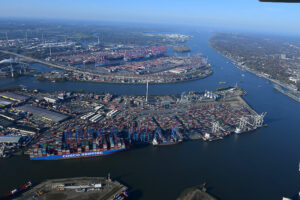
During the first six months of 2022, 1.4 million TEU were transported on the Port Railway network – a drop of just 0.2 percent compared to last year. A total of 23.6 million tons, down 0.3 percent were transported to and from the Port of Hamburg during the first half of the year. “Along with strikes by port workers over several days, extensive construction work in the port area and on the route network were the main causes for the somewhat lower total. With a 52.8 share of the modal split, rail freight transport remains the top carrier for the Port of Hamburg’s incoming and departing traffic,” said Mattern. Around 210 freight trains with more than 5,500 railcars use the Port Railway’s high-performance 300-kilometre network daily. “In recent weeks, various factors – among these the high number of overdue ships – disrupted rail clearance in the Port of Hamburg. Terminal and rail operators are doing their utmost to reduce handling bottlenecks to a minimum where possible, or to avoid these,” added Mattern. Ulfert Cornelius, CEO at EVOS Hamburg agreed: “For Germany and Central Europe, the Port of Hamburg’s superb rail network infrastructure is of fundamental national economic importance. This applies not only to container handling, but also liquid bulk cargoes. That the Port of Hamburg is capable of closing massive gaps in the supply chain of these liquid bulk cargoes, is especially apparent just at the moment. These gaps have occurred due to the present low water level on the Rhine and it was possible to considerably compensate these missing inland waterway transports by rail transports via Hamburg. That has contributed considerably to reducing the negative repercussions on the national economy.”
Prospects for 2022
For the coming weeks, the Port of Hamburg’s marketing organization would like to see an agreement reached between negotiators in the still unresolved tariff conflict between ver.di trade union and German seaport operators. Against the background of a deteriorating overall economic situation, which is likely to be characterised by an expected rise in energy prices and a weakening in consumption, further development of seaborne cargo handling is more likely to weaken by the end of the year. Yet a transfer of bulk cargo shipments caused by the ongoing low water period on the Rhine could ensure growth for a limited period. As a versatile universal port and leading rail port, the Port of Hamburg could benefit from this.
A cargo handling total of around 130 million tons and 8.7 million TEU following stabilization of transport chains and the world economic situation may be optimistic, but is not out of the question.



Related News.

Crewing After 2026: How AI Will Take Over the Routine in 2027
The crewing market of late 2026 is not the market of 2025. Artificial intelligence has moved from presentations into daily crewing work, while the…

Dualog launches secure maritime AI service amid surge in seafarer AI use
The new service, Sparks lets crew and shore teams search company emails, documents and conversations without exposing sensitive fleet information to…

Time Ticking: Two weeks for Governments to Green-Light Framework for Cutting Shipping Emissions
As a crucial fortnight of meetings opens at the International Maritime Organization opens in London, the Clean Shipping Coalition calls on member…

“K” LINE signs contract for construction of two LPG dual-fuel VLGCs
Kawasaki Kisen Kaisha, announces today that it has signed agreements with South Korea-based HD Hyundai Samho regarding the construction of two LPG…

Equinor and VNG sign 18-year gas sales agreement for supplies to Germany
Equinor will supply natural gas to the German energy company VNG until the end of 2044. The 18-year agreement is the longest gas sales agreement…

Open letter to MEPs to reject the motion for a resolution and support the inclusion of Indian ship recycling yards on the European List
Dear Members of the European Parliament, Ahead of this week’s plenary vote, European Shipowners | ECSA, BIMCO, the Cruise Lines International…

ShipVet appoints James Stairmand as Chief Executive Officer
Founder Captain Fintan Cullen moves to a non-executive role as the company builds on investment in its vetting team and technology. ShipVet, the…

USD ≈7bn lost per year the hidden cost of how shipping trades
New Torvald Klaveness study quantifies around USD 7bn a year in potentially avoidable costs in dry bulk and product tanker shipping, with a possible…

APM Terminals Maasvlakte II and Port of Rotterdam Authority take next step in terminal development
APM Terminals Maasvlakte II and the Port of Rotterdam Authority are moving forward in terminal’s development with preparations for a new phase of…

ABP inspiring the next generation
ABP host 500 young people to explore maritime and transport careers More than 500 young people from across Hampshire and the Solent explored career…
Subscribe to our newsletter!
if you dont want to swim alone in the ocean of news, sign up for the newsletter, and you will receive daily all the important news of world shipping!
