Total recoverable oil worldwide is now 9% lower than last year, threatening global energy security
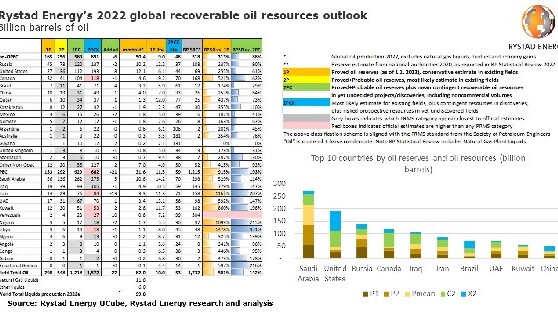

Following publication of BP’s annual Statistical Review, each year Rystad Energy releases our own analysis of the global energy landscape to provide an independent, data-based comparison and evaluation. Continuing the trend from previous years, Rystad Energy’s 2022 review shows a sizeable drop in recoverable oil resources in what could deal a major blow to global energy security.
According to Rystad Energy analysis, global recoverable oil now totals an estimated 1,572 billion barrels, a drop of almost 9% since last year and 152 billion fewer barrels than 2021’s total. Recoverable oil corresponds to the industry term “remaining technically recoverable crude oil and lease condensate”, i.e. expected volumes including fields, discoveries and risked future discoveries.
The drop in reserves is driven by the 30 billion barrels of oil produced last year, plus a significant reduction in undiscovered resources, to the tune of 120 billion barrels. The US offshore sector has contributed the largest total to that drop, where 20 billion barrels of oil will remain in the ground, largely thanks to leasing bans on federal land.
Of the 1,572 billion barrels of technically recoverable oil, only about 1,200 billion barrels are likely to be economically viable before 2100 at $50 per barrel. This economically extractable oil would contribute about 0.1˚C of additional global warming by 2050, and somewhat less by 2100 thanks to natural carbon sinks.
“While the drop in oil availability is positive news for the environment, it may threaten to further destabilize an already precarious energy landscape. Energy security is a matter of redundancy; we need more of everything to meet the growing demand for transport and any action to curb supply will quickly backfire on pump prices worldwide, including large producers such as the US. Politicians and investors can find success by targeting energy consumption, encouraging electrification of the transport sector and drastically improving fuel efficiency,” says Per Magnus Nysveen, Rystad Energy’s head of analysis.
Looking at the longer-term picture, Rystad Energy has updated our estimates for total undiscovered oil from 1 trillion barrels in 2018 to 350 billion barrels in our latest report, due to a rapid collapse in investor appetite for exploration exposure, leading to fewer government leases. This downward revision is good news for carbon compliance but could have negative consequences for global energy security, particularly if electric vehicle adoption falls short of expectations.
The broader climate implications of the total recoverable oil are broadly positive. If all remaining recoverable oil was to be burnt immediately, the global warming impact would be +0.25˚C, based on 350 kg of CO2 per barrel and +0.1˚C warming per 220 Gt CO2 emitted. However, only 35% of carbon emissions from that oil would still be in the atmosphere in 2100, as it takes 80 years for CO2 to be naturally removed from the air. Also, not all oil is burnt for energy; for example, carbon in plastics is released into the atmosphere only if incinerated.
How long can proven reserves last?
Rystad Energy’s updated report includes revisions for proven reserves. Here, we apply a consistent set of conservative probabilities, as opposed to official reporting by authorities which are considered less consistent. This year we found significant differences between OPEC and non-OPEC members in the longevity of proven reserves. All OPEC countries have proven reserves that are expected to last over 10 years, ranging from Iraq with just over 10 years to more than 14 years in Saudi Arabia. In non-OPEC member countries, Mexico ranks last among individual countries with fewer than five years of proven reserves, whereas Canada’s reserves are projected to last almost 20 years.
Where is all the oil?
Referring to the report on recoverable oil resources, Saudi Arabia holds onto the top spot with 275 billion barrels, followed by the US with 193 billion barrels. Russia with 137 billion barrels, Canada with 118 billion barrels and Iraq with 105 billion barrels round out the top five.
In South America – a fast-growing region for oil discoveries and production – Brazil remains in first place, with 71 billion barrels of recoverable oil, ten times the volume of proven reserves, but down four billion barrels from last year. In Europe, both the UK and Norway’s recoverable volumes have fallen by one billion barrels and now stand at 10 billion and 17 billion barrels respectively.
Bucking the trend of most countries losing oil resources this year, the US added 8 billion barrels to its discovered resources.
Source: Rystad Energy



Related News.

Cyprus Maritime Innovation takes Centre Stage at SMM Hamburg 2026
Underscoring its expanding role as a premier international hub for cutting-edge maritime technology and sustainable shipping, the Republic of Cyprus…

Trump seeks to refill US oil reserve with Venezuela deal but faces long delay
U.S. President Donald Trump said on the 30th (local time) that he would refill the U.S. Strategic Petroleum Reserve, which has been depleted with…
US Navy Official visits South Korean Shipyards in private
With U.S. President Donald Trump pushing a plan to allow overseas construction of U.S. warships, attention is focusing on whether the building of…

SES and De Boer Marine expand collaboration with FlexMaritime deployment across Global Markets
SES, a leading space solutions company, and De Boer Marine, a leading provider of top-quality marine equipment and maritime connectivity services,…

New ESG guidance to help maritime industry turn sustainability into commercial advantage
New framework helps shipowners and ports align ESG strategy with access to capital, charterer expectations and long-term asset value. Maritime…

Britannia P&I Club analysis finds four in five crew deaths linked to illness rather than accidents
New report highlights cardiovascular disease as leading cause of fatalities and raises concerns over mental health risks among younger seafarers.…

The Swedish Club launches new Loss Prevention podcast, Knot Another Lesson
The Swedish Club has launched Knot Another Lesson, a new podcast exploring the practical lessons, emerging risks and operational challenges shaping…

Lloyd’s Register appoints Jens Grunenberg as Senior Representative for Germany
Lloyd’s Register has appointed Jens Grunenberg as its Senior Representative for Germany, effective 1 September. Based in Hamburg, Grunenberg will…

Indian Register of Shipping sets sights on Hamburg for European Expansion
Indian Register of Shipping, a leading international classification society and full member of the International Association of Classification…
MOL completes Merger of 6 Ship Management Companies
Unifying Management of Over 200 Vessels and Strengthening Safety Mitsui O.S.K. Lines, announced that it has completed the integration of the MOL…
Subscribe to our newsletter!
if you dont want to swim alone in the ocean of news, sign up for the newsletter, and you will receive daily all the important news of world shipping!
