‘Together in Safety’s “Future Fuels Risk Assessment” studies safety implications of methanol, LNG, hydrogen and ammonia
Operational scenarios used in cross-industry study to evaluate the risks of future fuels
As shipping moves to transition from existing energy sources, the industry must pro-actively develop standard safeguards and control measures for the deployment of future fuels. To facilitate this, ‘Together in Safety’, a non-regulatory shipping industry safety consortium, initiated the “Future Fuels Risk Assessment”, a cross-industry study with nine partners to evaluate potential operational risks of LNG, methanol, hydrogen and ammonia.
The collaborative study, which involved a series of hazard identification (HAZID) workshops across a set of operational scenarios based on a standard tanker design, found that of the four fuels reviewed, methanol poses the least overall risk, followed by LNG, hydrogen and ammonia.
The HAZID risk ratings of the fuels were assessed from a series of “What if” scenarios within four categories: navigation, external events, ship operations and bunkering.
Methanol scored the lowest risk ratings within navigation-related scenarios, such as loss of manoeuvrability, excessive motions or a black-out at sea, as well as in scenarios related to ship operations (other than bunkering), notably cargo operations in case of damage to equipment or vent mast and crew changes during vessel handovers. Methanol also scored the lowest (that is, “broadly acceptable”) risk ranking in the external event scenario of hull breach from ship collision. However, within bunkering scenarios, such as leaks or loss of containment, LNG and hydrogen held “broadly acceptable” risk scores.
Both LNG and hydrogen scored nearly identical risk rankings in all scenarios studied by the HAZID team, with none falling within the “intolerable risk” domain. LNG fared better than hydrogen in one navigation scenario of vessel abandonment due to loss of tank pressure control, tank breach or loss of propulsion. It should also be noted that there are well established international regulations for the use of LNG as fuel on board ships, whereas for hydrogen, no such regulations or guidance are available for either its usage as fuel or storage in the marine environment. For the purpose of the study, the HAZID team only considered cryogenic liquid hydrogen.
Across all the fuels there are several medium risk ratings accepted as “tolerable”, but the study indicated that efforts must ensure that risks are reduced to ‘as low as reasonably practicable’ (ALARP).
Ammonia scored “broadly acceptable” risk as a potential source of ignition in the scenario of tug support or third-party vessel attendance at sea. However, some risks for ammonia as a fuel are classified as high (or “intolerable”) in navigation scenarios like grounding or collision leading to a hull breach, cargo operations in case of damage to equipment or vent mast, and leaks or loss of containment during bunkering. To bring these hazards down to medium or a low-risk ratings, the study offers recommendations for ammonia usage. These include safety equipment for seafarers if there is a risk of gas pocket formation; dedicated emergency training for crew on fuel system safety devices and mitigating damage to fuel system scenarios; and guidelines on fuel system designs that mitigate risks from grounding or collisions.
The ‘Future Fuels Risk Assessment’ study partners include APM Terminals, Carnival Corp, Chevron, Euronav, Lloyd’s Register, Maersk, MSC Ship Management, the Oil Companies International Marine Forum (OCIMF) and Shell.
Grahaeme Henderson, Chair of ’Together in Safety’ said: “‘Together in Safety’ was established three years ago with the principal objective to protect seafarers’ lives, while delivering improved business efficiency and commercial effectiveness. As the shipping industry safety coalition, ’Together in Safety’ represents a new approach with shipping industry groups, companies and service providers, working in collaboration by combining their collective knowledge and expertise on challenges for the benefit of all. This report is of significant importance to the industry and also individual companies who are making decisions on the future fuels, to understand the hazards and potential risk mitigations.”
Nick Brown, CEO, Lloyd’s Register said: “This report by ‘Together in Safety’ illustrates how detailed and holistic risk assessments can identify and focus attention on the solutions needed for the safe use of alternative fuels. Lloyd’s Register is committed to playing our part in robustly assessing and testing the required engineering solutions and operational requirements to enhance the industry’s safety as shipping strives for decarbonisation.”
Bud Darr, Executive Vice President, Maritime Policy, MSC Group said: “Our work through ‘Together in Safety’ is making an important contribution toward our efforts to decarbonise the Maritime Sector. Without the safety issues being thoroughly identified and properly addressed, we will not reach the end state we need. Safety and net zero GHG operations must go hand-in-hand in a world powered by future fuels at sea.”
Tom Strang, Senior Vice President, Maritime Affairs, Carnival Corporation said: “Working together with the other sectors of the maritime industry to share best practices and experience is what ‘Together in Safety’ is all about. The challenges and opportunities identified will help us develop our own approach towards the use of future fuels.”
The “Future Fuels Risk Assessment” study is available at the ’Together in Safety’ website. The consortium will continue to work with the industry to further identify new ways to mitigate risk levels in zero carbon fuels through elimination, substitution, or control in future study projects.



Related News.

Navigating the Multi-Orbit Era: In Conversation with Intellian’s Jon Harrison at SMM 2026
At SMM 2026 in Hamburg, the rapid evolution of maritime satellite communications took centre stage. Across the exhibition halls, discussions among…
Cyprus ports need joint energy and investment strategy, shipping agents chief says
Cyprus needs a coordinated strategy for shipping, energy and environmental protection to support port investment and modernisation, Cyprus shipping…

MASO Public Affairs introduces MASO Regulatory Intelligence
A new subscription service helping businesses understand what is changing and what it means for them MASO Public Affairs introduces MASO Regulatory…
Anglo-Eastern helps turn CMBTECH’s ammonia ambition into an operational reality
From early feasibility study and risk-based design to newbuilding supervision, crew readiness and technical management, Anglo-Eastern drew on its…

Escalation of attacks threatens to derail recovery in Middle East oil exports
World oil demand is forecast to fall by 2.5 mb/d y-o-y in 4Q26 and 2.6 mb/d on average in 2026. As the Iran war manifests itself through restricted…
New study finds shipping pays twice its share to EU ETS earmarked revenues should triple to help build market for sustainable fuels and technologies
Shipping is responsible for around 10% of EU ETS emissions but pays almost 20% of the ETS bill. Unlike other sectors, it has never received free…
MSARC strengthens maritime mass rescue readiness through training and national live exercise off Dakar, Senegal
Joint MSARC–FHAS programme combines three days of SAR training with a national multi-agency live exercise The Maritime Search and Rescue Council ,…
Sogese report deliveries are still being delayed as container freight rates fluctuate
FOR IMPORTERS Spot rates into the Mediterranean are back at January levels, Far East to Europe reliability sits at pandemic lows, and nearly…

Glencore begins trading on Australian Securities Exchange
Glencore has begun trading on the Australian Securities Exchange under the ASX code GLC. Gary Nagle, Glencore’s CEO, said it was an exciting day for…
BIMCO Shipping Number of the Week
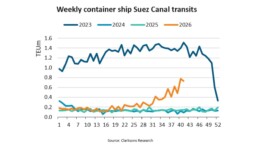
Suez Canal container ship transits exceed 50% of pre-disruption levels "During the first two weeks of October, weekly container ship capacity…
Subscribe to our newsletter!
if you dont want to swim alone in the ocean of news, sign up for the newsletter, and you will receive daily all the important news of world shipping!
