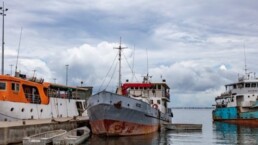

International shipping plays a central role in global trade, carrying 70% of that trade by value and more than 80% by volume. However, it is also a significant source of greenhouse gas emissions, accounting for around 2.89% of global emissions according to the IMO Fourth GHG Study .
The International Maritime Organization (IMO) is the United Nations specialized agency developing global regulations for shipping in areas such as safety, security, and prevention of pollution, including air pollution, from ships.
In April 2018, IMO adopted an Initial Strategy on the reduction of GHG emissions from ships, setting out a vision which confirms IMO’s commitment to reducing GHG emissions from international shipping and to phasing them out as soon as possible. The Strategy is due to be revised and strengthened in 2023. The Initial Strategy contains several candidate GHG reduction measures, categorized into short, mid and long-term measures.
Assessing possible impacts on States of future IMO GHG reduction measures
The Initial Strategy recognizes that the possible impacts on States of candidate GHG reduction measure should be assessed and considered before their adoption and lays out parameters to assess these impacts. These include geographic remoteness, connectivity to main markets, cargo value and type, transport dependency, transport costs, food security, disaster response, cost-effectiveness and socio-economic progress and development. The Procedure for assessing impacts on States of candidate GHG reduction measures is set out in MEPC.1/Circ.
It underscores that particular attention in these impact assessments should be paid to the needs of developing countries, especially Small Island Developing States (SIDS) and Least Developed Countries (LDCs). Transport costs are particularly important in the Pacific region which contains some of the States most vulnerable to climate change and who are already facing relatively high shipping and trade costs, being largely dependent on shipping for trade, including imports of essential goods.
With a view to reduce the carbon intensity of operational shipping by at least 40% in 2030, compared with 2008, MEPC 75 approved, in 2020, a short-term measure combining technical and operational energy efficiency requirements.
In considering the draft amendments to the International Convention for the Prevention of Pollution from Ships (MARPOL Annex VI), many delegations highlighted that, before adopting the short-term measure, it was essential to undertake a comprehensive assessment of its possible impacts on States. Consequently, the impact assessment was initiated in accordance with the approved terms of reference and a Steering Committee established.
UNCTAD was invited by IMO to undertake, based on a prior assessment of impacts of the proposed measure on the world fleet, a quantitative and qualitative comprehensive assessment of the possible impacts of the IMO measure on States. IMO and UNCTAD, as members of the UN family, have a long-standing collaborative relationship. This collaboration has been particularly close during this assessment.
The impact assessment report also suggested possible considerations for future impact assessments of mid- and long-term GHG reduction measures for shipping, in particular (1) to review and determine the availability, reliability, and level of granularity of data and identify main gaps relating to transport cost data pertaining to developing countries, in particular SIDS and LDCs; (2) and to identify capacity-building needs to improve impact assessments, including building the capacity of developing countries, in particular SIDS and LDCs to collect relevant data.
New IMO project seeks to improve availability of maritime transport costs data in the Pacific region in the context of shipping decarbonization
In considering the outcomes of the comprehensive impact assessment, the seventy-first session of the IMO Technical Cooperation Committee (TC) noted the advice from the Secretariat that a number of IMO projects might be of assistance in providing analysis and data, for example the Global Maritime Technology Cooperation Centres (MTCCs) Network, many delegations also supported the strengthening of MTCCs globally and their possible involvement in the delivery of IMO’s technical cooperation activities.
In response to the observations of MEPC and TC, the IMO Secretariat initiated a project aiming to improve the availability of relevant maritime transport costs data for the Pacific SIDS/Pacific Region with a view to facilitating future assessments of the possible impacts on States of potential GHG reduction measures in shipping, including, as appropriate, carbon pricing instruments. To assist in this, the project aims to establish interim baselines and to initiate the modelling of the impact on Pacific SIDS of a hypothetical increase in transport costs or change in connectivity patterns. Central to the project’s success will be its ability to identify the foundation of a system of continued monitoring and collection of data on maritime transport costs in the Pacific region.
The activity will be implemented by MTCC-Pacific, a centre of expertise established by IMO as part of the Global MTCC Network (GMN) and hosted by the Pacific Community (SPC) and the Secretariat of the Pacific Regional Environment Programme (SPREP).
To ensure that the outcomes of the project are transparent and not policy prescriptive, a broad range of organizations, institutions and resources with relevant experience and expertise, including UNCTAD, will to be involved.
The main outcome of this project will be a Study on maritime transport costs data in the Pacific region which is to be submitted to the IMO Secretariat by 1 October 2022.
It is also expected that the project will identify and initiate a possible permanent partnership or structure for the ongoing collection and sharing of maritime transport costs data and other relevant statistics for Pacific SIDS. The project is also expected to enhance the understanding of the determinants of maritime freight rates in the Pacific region.



Related News.

Navigating the Multi-Orbit Era: In Conversation with Intellian’s Jon Harrison at SMM 2026
At SMM 2026 in Hamburg, the rapid evolution of maritime satellite communications took centre stage. Across the exhibition halls, discussions among…
Cyprus ports need joint energy and investment strategy, shipping agents chief says
Cyprus needs a coordinated strategy for shipping, energy and environmental protection to support port investment and modernisation, Cyprus shipping…

MASO Public Affairs introduces MASO Regulatory Intelligence
A new subscription service helping businesses understand what is changing and what it means for them MASO Public Affairs introduces MASO Regulatory…
Anglo-Eastern helps turn CMBTECH’s ammonia ambition into an operational reality
From early feasibility study and risk-based design to newbuilding supervision, crew readiness and technical management, Anglo-Eastern drew on its…

Escalation of attacks threatens to derail recovery in Middle East oil exports
World oil demand is forecast to fall by 2.5 mb/d y-o-y in 4Q26 and 2.6 mb/d on average in 2026. As the Iran war manifests itself through restricted…
New study finds shipping pays twice its share to EU ETS earmarked revenues should triple to help build market for sustainable fuels and technologies
Shipping is responsible for around 10% of EU ETS emissions but pays almost 20% of the ETS bill. Unlike other sectors, it has never received free…
MSARC strengthens maritime mass rescue readiness through training and national live exercise off Dakar, Senegal
Joint MSARC–FHAS programme combines three days of SAR training with a national multi-agency live exercise The Maritime Search and Rescue Council ,…
Sogese report deliveries are still being delayed as container freight rates fluctuate
FOR IMPORTERS Spot rates into the Mediterranean are back at January levels, Far East to Europe reliability sits at pandemic lows, and nearly…

Glencore begins trading on Australian Securities Exchange
Glencore has begun trading on the Australian Securities Exchange under the ASX code GLC. Gary Nagle, Glencore’s CEO, said it was an exciting day for…
BIMCO Shipping Number of the Week
Suez Canal container ship transits exceed 50% of pre-disruption levels "During the first two weeks of October, weekly container ship capacity…
Subscribe to our newsletter!
if you dont want to swim alone in the ocean of news, sign up for the newsletter, and you will receive daily all the important news of world shipping!
