Hydrogen at risk of being the great missed opportunity of the energy transition

Hydrogen Forecast to 2050
Hydrogen has a crucial role in decarbonizing the world’s energy system, but uptake will be too slow. Governments need to make urgent, significant policy interventions, according to a new report by DNV.

In Hydrogen Forecastto 2050, DNV predicts the amount of hydrogen in the energy mix will be only 0.5% in 2030 and 5% in 2050. However, to meet the targets of the Paris Agreement, hydrogen uptake would need to triple to meet 15% of energy demand by mid-century.
“Hydrogen is essential to decarbonize sectors that cannot be electrified, like aviation, maritime, and high-heat manufacturing and should therefore be prioritized for these sectors,” said Remi Eriksen, Group President and CEO of DNV. “Policies do not match hydrogen’s importance. They will also need to support the scaling of renewable energy generation and carbon capture and storage as crucial elements in producing low-carbon hydrogen.”
According to Hydrogen Forecast to 2050, electricity-based green hydrogen – produced by splitting hydrogen from water using electrolysers – will be the dominant form of production by the middle of the century, accounting for 72% of output. This will require a surplus of renewable energy, to power an electrolyser capacity of 3,100 gigawatts. This is more than twice the total installed generation capacity of solar and wind today.
Blue hydrogen – produced from natural gas with emissions captured – has a greater role to play in the shorter term (around 30% of total production in 2030), but its competitiveness will reduce as renewable energy capacity increases and prices drop.
Global spend on producing hydrogen for energy purposes from now until 2050 will be USD 6.8tn, with an additional USD 180bn spent on hydrogen pipelines and USD 530bn on building and operating ammonia terminals, according to DNV’s forecasts.
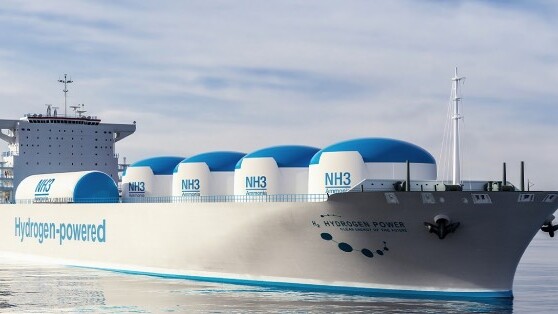
Cost considerations will lead to more than 50% of hydrogen pipelines globally being repurposed from natural gas pipelines, as the cost to repurpose pipelines is expected to be just 10-35% of new construction costs. Hydrogen will be transported by pipelines up to medium distances within and between countries, but not between continents. Global hydrogen trade will also be limited by the high cost of liquefying hydrogen for ship transport and the low energy density of hydrogen. The hydrogen derivative ammonia, which is more stable and can be more readily transported by ship, will be traded globally.
Early uptake of hydrogen will be led by hard-to-abate, high-heat manufacturing processes such as iron and steel production which currently use coal and natural gas. Hydrogen derivatives, such as ammonia and methanol, are key to decarbonizing heavy transport like shipping and aviation, but these fuels won’t scale until the 2030s according to DNV’s forecasts.
Hydrogen will not see uptake in passenger vehicles, and only limited uptake in power generation. Hydrogen for heating of buildings will not scale globally, but will see early uptake in some regions that already have extensive gas infrastructure.

“Scaling hydrogen value chains will require managing safety risk and public acceptance, as well as employing policies to make hydrogen projects competitive and bankable. We need to plan at the level of energy systems, enabling societies to embrace the urgent decarbonization opportunities presented by hydrogen,” added Eriksen.
The uptake of hydrogen will differ significantly by region, heavily influenced by policy. Europe is the forerunner with hydrogen set to take 11% of the energy mix by 2050, as enabling policies both kickstart the scaling of hydrogen production and stimulate end-use. OECD Pacific (hydrogen 8% of energy mix in 2050) and North America (7%) regions also have strategies, targets, and funding pushing the supply-side, but have lower carbon-prices and less concrete targets and policies. Greater China (6%) follows on, recently providing more clarity on funding and hydrogen prospects towards 2035, coupled with an expanding national emissions trading scheme. These four regions will together consume two-thirds of global hydrogen demand for energy purposes by 2050.



Related News.

Cyprus Maritime Innovation takes Centre Stage at SMM Hamburg 2026
Underscoring its expanding role as a premier international hub for cutting-edge maritime technology and sustainable shipping, the Republic of Cyprus…

Trump seeks to refill US oil reserve with Venezuela deal but faces long delay
U.S. President Donald Trump said on the 30th (local time) that he would refill the U.S. Strategic Petroleum Reserve, which has been depleted with…
US Navy Official visits South Korean Shipyards in private
With U.S. President Donald Trump pushing a plan to allow overseas construction of U.S. warships, attention is focusing on whether the building of…

SES and De Boer Marine expand collaboration with FlexMaritime deployment across Global Markets
SES, a leading space solutions company, and De Boer Marine, a leading provider of top-quality marine equipment and maritime connectivity services,…

New ESG guidance to help maritime industry turn sustainability into commercial advantage
New framework helps shipowners and ports align ESG strategy with access to capital, charterer expectations and long-term asset value. Maritime…

Britannia P&I Club analysis finds four in five crew deaths linked to illness rather than accidents
New report highlights cardiovascular disease as leading cause of fatalities and raises concerns over mental health risks among younger seafarers.…

The Swedish Club launches new Loss Prevention podcast, Knot Another Lesson
The Swedish Club has launched Knot Another Lesson, a new podcast exploring the practical lessons, emerging risks and operational challenges shaping…

Lloyd’s Register appoints Jens Grunenberg as Senior Representative for Germany
Lloyd’s Register has appointed Jens Grunenberg as its Senior Representative for Germany, effective 1 September. Based in Hamburg, Grunenberg will…

Indian Register of Shipping sets sights on Hamburg for European Expansion
Indian Register of Shipping, a leading international classification society and full member of the International Association of Classification…
MOL completes Merger of 6 Ship Management Companies
Unifying Management of Over 200 Vessels and Strengthening Safety Mitsui O.S.K. Lines, announced that it has completed the integration of the MOL…
Subscribe to our newsletter!
if you dont want to swim alone in the ocean of news, sign up for the newsletter, and you will receive daily all the important news of world shipping!
