Port of Gothenburg first in the world to provide shoreside power for tankers
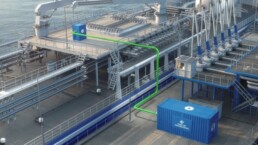

As part of an innovative plan to provide shoreside power for tankers berthed at the Energy Terminal, the Gothenburg Port Authority has created a completely new and unique concept that makes the system safe, environmentally friendly, and cost-effective. The port has teamed up with shipping companies on the island of Donsö, national and European ports, classification societies, local oil companies, and the Swedish Transport Agency. The aim is to set a new global standard for shoreside power for tankers berthed in a hazardous environment
“The greatest challenge is to ensure that tankers that are scheduled to be built are fitted with shoreside power connectors that adhere to a common standard applied at all ports. A further challenge is the constant risk of an explosion when the vessel is berthed at an energy terminal as the combustible and flammable products being pumped could easily be ignited by a spark from the electrical equipment. These challenges have become an intrinsic part of our planning strategy,” said Jörgen Wrennfors, Gothenburg Port Authority production engineer at the Energy Terminal.
Supplying power to vessels at the quayside is nothing new. Back in the 1980s, the Stena Line vessels at Majnabbe were provided with shoreside power and since then a whole series of utility supply facilities have been created throughout the Port of Gothenburg. The most recent example is quay 712 at the Ro-Ro Terminal, where vessels are now being supplied with green power by cable, allowing them to shut down their diesel engines during loading and discharge. Despite this, finding a solution where new tankers at the Energy Terminal can be offered the same shoreside power supply has not been an easy task.
When tankers are at sea their classification specifies that a power supply point can only be located aft of the bridge. Vessel designers have used this as a starting point when designing new vessels fitted with shoreside power connectors. However, this classification does not apply when the tanker arrives at an energy terminal. In the majority of cases it is superseded by the port’s classification, which means the entire vessel is deemed to be an explosive atmosphere, including the aft,” said Jörgen Wrennfors.
The downside of having a power supply point at the aft is that the length of a vessel can vary considerably. In many cases vessels are more than 150 metres long and the quays are considerably shorter. Locating a power connector at the aft would require the ports to build connection cranes at the quayside to reach the connector. Likewise, extremely long cables would be required together with complicated and expensive cranes to lift the cables. Instead of each port needing to adapt, the Port of Gothenburg has applied reverse thinking.
“The standard we are proposing puts the power connection point in the centre of the vessel and we are in the process of formulating a technical requirement specification for shipbuilders to implement this novel approach. As all tankers have their loading crane in the centre of the vessel this would be the optimal solution for lifting the power cable on board. As a result, the length of the vessel would no longer be an issue and the direction in which she docks is irrelevant. We regard this as the best technical solution and it offers substantial cost savings at each berth,” said Jörgen Wrennfors.
Even if the location of the power connector is agreed, the fact remains that power still needs to be supplied in an explosive atmosphere.
“Volatile and highly combustible gases that are present during bunkering and the risk of sparks during connection is a dangerous combination. We have now resolved the problem by working with overpressure in the spaces where the cable is housed and connected. This solution will shut out any explosive gases, making the facility safe,” said Jörgen Wrennfors.
Work on the home front may have gone smoothly but persuading the international shipping community to recognise the underlying benefits of the new standard that is being advocated and opt for the Port of Gothenburg solution is not quite as straightforward.
Bringing about a change in underlying assumptions is essential. It is vital that major ports, oil companies, public authorities, and classification societies are included to ensure we have a new standard in place that everyone adheres to. A solution is currently being produced here at the Port of Gothenburg and we are leading by example. It is our hope that this will be noted and incorporated into international standardisation procedures in the future,” said Jörgen Wrennfors.
Fact file:
- Environmental gain: 1,815 tonnes of carbon dioxide will be saved each year. Green power will be used instead of marine diesel.
- The new facility at the Energy Terminal is designed to be a permanent feature in an explosive atmosphere. Safety equipment will be supplied as standard along with the power supply connector.
- Safety is guaranteed thanks to a new technical solution with overpressure in spaces in which electrical equipment is housed.
- The Donsö-based shipping companies Furutank, Donsötank, Tärntank, Ektank and Veritas Tanker, as well as Tarbit Tanker on the island of Tjörn are all part of the project. They have already ordered vessels on which the new power supply solution has been incorporated. The first prepared vessels were delivered in 2021, and the first vessels that are completely ready for shoreside power connection will be delivered in February 2022.
- Funding: The system will be partially funded with SEK 10.7 million from the government through the Climate Investment Support Programme.
- Project implementation: 2022/2023.
- Completion: In spring 2024 the first tanker will be connected to a green shoreside power supply at the Energy Terminal.
- The Gothenburg Port Authority is currently investing around SEK 600 million in carbon mitigation measures in a concerted effort to achieve the Port’s climate goal by 2030.



Related News.

Navigating the Multi-Orbit Era: In Conversation with Intellian’s Jon Harrison at SMM 2026
At SMM 2026 in Hamburg, the rapid evolution of maritime satellite communications took centre stage. Across the exhibition halls, discussions among…
Cyprus ports need joint energy and investment strategy, shipping agents chief says
Cyprus needs a coordinated strategy for shipping, energy and environmental protection to support port investment and modernisation, Cyprus shipping…

MASO Public Affairs introduces MASO Regulatory Intelligence
A new subscription service helping businesses understand what is changing and what it means for them MASO Public Affairs introduces MASO Regulatory…
Anglo-Eastern helps turn CMBTECH’s ammonia ambition into an operational reality
From early feasibility study and risk-based design to newbuilding supervision, crew readiness and technical management, Anglo-Eastern drew on its…
Escalation of attacks threatens to derail recovery in Middle East oil exports
World oil demand is forecast to fall by 2.5 mb/d y-o-y in 4Q26 and 2.6 mb/d on average in 2026. As the Iran war manifests itself through restricted…
New study finds shipping pays twice its share to EU ETS earmarked revenues should triple to help build market for sustainable fuels and technologies
Shipping is responsible for around 10% of EU ETS emissions but pays almost 20% of the ETS bill. Unlike other sectors, it has never received free…

MSARC strengthens maritime mass rescue readiness through training and national live exercise off Dakar, Senegal
Joint MSARC–FHAS programme combines three days of SAR training with a national multi-agency live exercise The Maritime Search and Rescue Council ,…
Sogese report deliveries are still being delayed as container freight rates fluctuate
FOR IMPORTERS Spot rates into the Mediterranean are back at January levels, Far East to Europe reliability sits at pandemic lows, and nearly…
Glencore begins trading on Australian Securities Exchange
Glencore has begun trading on the Australian Securities Exchange under the ASX code GLC. Gary Nagle, Glencore’s CEO, said it was an exciting day for…
BIMCO Shipping Number of the Week
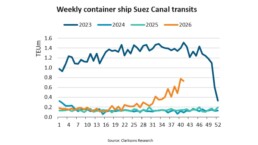
Suez Canal container ship transits exceed 50% of pre-disruption levels "During the first two weeks of October, weekly container ship capacity…
Subscribe to our newsletter!
if you dont want to swim alone in the ocean of news, sign up for the newsletter, and you will receive daily all the important news of world shipping!
