Galileo helps map out safer cycling routes in the Netherlands
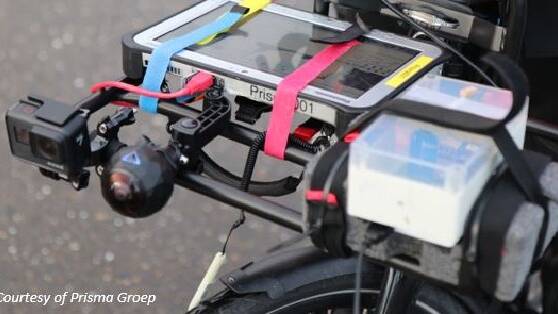

An initiative in the Netherlands leverages Galileo’s enhanced accuracy and positioning to conduct a comprehensive safety assessment of local bicycle paths.
The Dutch love their bikes. In fact, according to a European Commission report on quality transportation, 36% of Dutch people say biking is their preferred method for getting around.
Bolstered by a robust cycling infrastructure, including dedicated paths, protected lanes, and plenty of bicycle parking, 27% of all travel in the Netherlands is done by bike. In cities like Amsterdam and Zwolle, this percentage is even higher.
But, as impressive as these figures may be, one biking-related statistic cannot be ignored: the number of cycling accidents. According to SafetyNL, nearly 50,000 cyclists were seriously injured in 2019. With cycling continuing to grow in popularity, this number will only increase – which is why the Dutch province of Noord-Brabant decided to conduct a trial for comprehensive safety assessment of its bicycle infrastructure.
Carried out in cooperation with Royal HaskoningDHV, BAM Infra Nederland and the Prisma Groep, the initiative used Galileo alongside other technologies to create detailed and comprehensive maps of the area’s bike paths. After assessing their status and analysing traffic safety, each path was given a unique safety score.
A more accurate picture
The inventory was created by equipping bikes and riders with sensors, accelerometers, LiDAR and cameras – and of course, Galileo-enabled GNSS receivers.
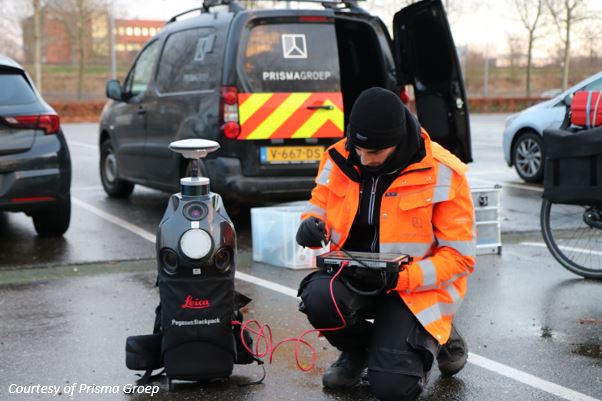
“Using Galileo means more visible satellites and thus increased signal continuity and availability,” says Erik van Duffelen, a project coordinator at the Prisma Groep. “This capability is particularly important in areas with limited line of sight, like bike paths that traverse through urban canyons or under dense tree canopies.”
As the cyclist rides around, the equipment scans the environment, capturing measurements and recording location. During post-processing, the captured data is analysed using artificial intelligence models and algorithms. The result forms the basis of a “digital twin” of the bicycle paths, which not only helps to update older maps, but also includes information about obstacles and other safety hazards. This can be used to improve cyclist safety and to inform future infrastructure development.
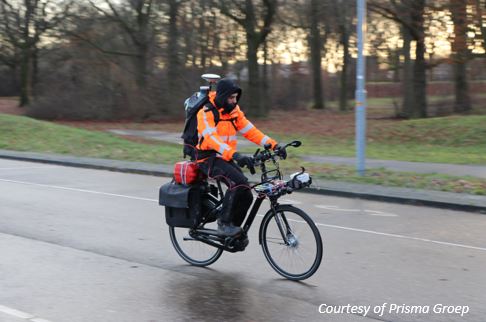
“Galileo gave us a more accurate picture of the bicycle paths and a more precise inventory of the cycling infrastructure,” adds van Duffelen. “Thanks to this level of accuracy and precision, cyclists and authorities alike have the information they need to improve safety.”
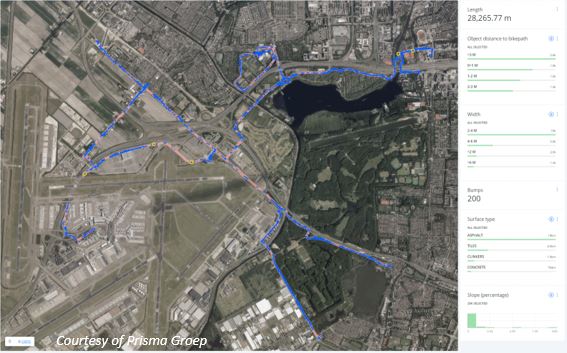
Figure: Sketch of the bicycles paths after processing data
Following a successful pilot programme, the initiative has launched a comprehensive commercial service. Called BikePathfinder (FietsPadvinder; article in Dutch), the service is available to road authorities and other entities working to improve cycling infrastructure and safety.
Figure: FietsPadvinder logo
To learn more about Galileo, its services and differentiators, please register at the European GNSS Service Centre (GSC) or contact the GSC Helpdesk at www.gsc-europa.eu/helpdesk.



Related News.

Cyprus Maritime Innovation takes Centre Stage at SMM Hamburg 2026
Underscoring its expanding role as a premier international hub for cutting-edge maritime technology and sustainable shipping, the Republic of Cyprus…

Trump seeks to refill US oil reserve with Venezuela deal but faces long delay
U.S. President Donald Trump said on the 30th (local time) that he would refill the U.S. Strategic Petroleum Reserve, which has been depleted with…

US Navy Official visits South Korean Shipyards in private
With U.S. President Donald Trump pushing a plan to allow overseas construction of U.S. warships, attention is focusing on whether the building of…

SES and De Boer Marine expand collaboration with FlexMaritime deployment across Global Markets
SES, a leading space solutions company, and De Boer Marine, a leading provider of top-quality marine equipment and maritime connectivity services,…
New ESG guidance to help maritime industry turn sustainability into commercial advantage
New framework helps shipowners and ports align ESG strategy with access to capital, charterer expectations and long-term asset value. Maritime…

Britannia P&I Club analysis finds four in five crew deaths linked to illness rather than accidents
New report highlights cardiovascular disease as leading cause of fatalities and raises concerns over mental health risks among younger seafarers.…

The Swedish Club launches new Loss Prevention podcast, Knot Another Lesson
The Swedish Club has launched Knot Another Lesson, a new podcast exploring the practical lessons, emerging risks and operational challenges shaping…
Lloyd’s Register appoints Jens Grunenberg as Senior Representative for Germany
Lloyd’s Register has appointed Jens Grunenberg as its Senior Representative for Germany, effective 1 September. Based in Hamburg, Grunenberg will…
Indian Register of Shipping sets sights on Hamburg for European Expansion
Indian Register of Shipping, a leading international classification society and full member of the International Association of Classification…

MOL completes Merger of 6 Ship Management Companies
Unifying Management of Over 200 Vessels and Strengthening Safety Mitsui O.S.K. Lines, announced that it has completed the integration of the MOL…
Subscribe to our newsletter!
if you dont want to swim alone in the ocean of news, sign up for the newsletter, and you will receive daily all the important news of world shipping!
