The National Renewable Energy Laboratory’s first wave tank could fast-track Novel Marine Energy Technologies

By 2050, our oceans could contain more plastic than fish. Other, more benign, man-made inventions (like this ocean broom named Jenny) are helping clean up the mess, but these sea sweepers need a power source—preferably a clean one, like, for example, the ocean itself.
Ocean energy, also known as marine energy, is renewable power generated from the motion of ocean waves, currents, and tides. Soon, marine energy could power Jenny along with seafaring robots used in marine research, buoys that monitor for dangerous tropical storms, booming offshore industries that make up the blue economy, and eventually, in part, the U.S. electrical grid. But no marine energy technology has achieved commercial success—yet.
That is where the National Renewable Energy Laboratory (NREL) comes in. At the laboratory’s Flatirons Campus, NREL researchers help shepherd marine energy prototypes from abstract concept to the market. And the laboratory just installed a new tool that fills a critical gap in that soup-to-nuts support.
“There was still a big piece missing,” said Rebecca Fao, a research engineer in NREL’s water power technology group. “We still couldn’t fully emulate the conditions that these devices will experience when they go offshore.”
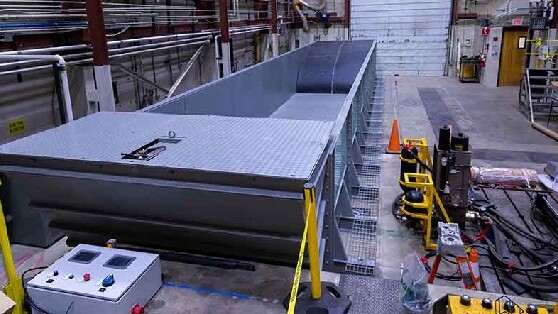
Now, they can—well, almost. Thanks to funding from the U.S. Department of Energy’s Water Power Technologies Office, Fao and her team installed their first wave tank in Spring 2022. The tank, coupled with a motion platform scheduled to arrive in March 2023, is “bringing the ocean to Colorado,” Fao said.
Together, the two tools can help accelerate the development of ocean-bound technologies, including marine energy devices as well as offshore wind turbines and floating solar panels, saving developers time, money, and reducing risk as they develop the renewable energy technologies needed to build a 100% clean energy future.
Previously, ocean energy companies like C-Power trekked to Colorado to get NREL’s expert analysis, for example, on how much energy their devices might produce and how well they could handle the ocean’s big, volatile waves. But once they build their prototypes, these teams headed out to find a wave tank or go straight to the ocean, which can be an expensive and risky gamble. “If something goes wrong during your deployment, it’d be very difficult to go out and fix it,” Fao said. “Oftentimes, you can’t fix it.”
Now, with a wave tank available in house, developers can stay put and try out multiple early-stage, small-scale designs, tweaking as they go, or test how seaworthy their instrumentation systems might be. This fast prototyping speeds the development process and saves developers money, too.
True to its name, a wave tank is a shallow chamber used to create waves. NREL’s is about 45 feet long—about the length of three cars parked in a row—8 feet wide, and a little more than 4 feet deep. Though it is nowhere near the size of the largest wave tank in the world, which is used to study tsunamis, it is plenty big enough to test miniaturized wave energy prototypes. The tank produces waves as tall as 8 inches, which move at varying speeds, and because one side is glass, researchers can also watch what is happening beneath the water’s surface. That is important to assess mooring systems, which tether some marine energy devices to the ocean floor.
Alone, the wave tank is a useful early-stage validation tool. But it is just one member of the vast machinery available at Flatirons Campus. Just by walking across the street, NREL researchers and industry partners can try out new ideas—rapidly—to see which technologies have the most promise. On a single campus, a developer can test their design through theoretical modeling before manufacturing and testing a small-scale prototype and even prepare a full-scale device for the open ocean.
In 2023, NREL researchers will install a motion platform, which, also true to its name, is a platform that simulates motion—in this case, the motion of the ocean. The tool, which can support about 22,000 pounds (the weight equivalent of more than five average-sized cars) and can mimic wave movements of up to about 8 feet, will provide a controlled environment in which to test the dynamic behavior of even larger marine energy prototypes as well as scaled offshore wind turbines and floating solar panels. Because the tool can imitate a wider spectrum of ocean movements and serve more technologies, it will be one more big puzzle piece added to NREL’s theory-to-ocean support.
“Our goal,” Fao said, “is to conduct end-to-end testing of these devices before they go out on open waters. Our new wave tank and motion platform will make this validation possible at one location: NREL.”



Related News.
Cyprus Maritime Innovation takes Centre Stage at SMM Hamburg 2026
Underscoring its expanding role as a premier international hub for cutting-edge maritime technology and sustainable shipping, the Republic of Cyprus…

Trump seeks to refill US oil reserve with Venezuela deal but faces long delay
U.S. President Donald Trump said on the 30th (local time) that he would refill the U.S. Strategic Petroleum Reserve, which has been depleted with…
US Navy Official visits South Korean Shipyards in private
With U.S. President Donald Trump pushing a plan to allow overseas construction of U.S. warships, attention is focusing on whether the building of…
SES and De Boer Marine expand collaboration with FlexMaritime deployment across Global Markets
SES, a leading space solutions company, and De Boer Marine, a leading provider of top-quality marine equipment and maritime connectivity services,…
New ESG guidance to help maritime industry turn sustainability into commercial advantage
New framework helps shipowners and ports align ESG strategy with access to capital, charterer expectations and long-term asset value. Maritime…
Britannia P&I Club analysis finds four in five crew deaths linked to illness rather than accidents
New report highlights cardiovascular disease as leading cause of fatalities and raises concerns over mental health risks among younger seafarers.…
The Swedish Club launches new Loss Prevention podcast, Knot Another Lesson
The Swedish Club has launched Knot Another Lesson, a new podcast exploring the practical lessons, emerging risks and operational challenges shaping…
Lloyd’s Register appoints Jens Grunenberg as Senior Representative for Germany
Lloyd’s Register has appointed Jens Grunenberg as its Senior Representative for Germany, effective 1 September. Based in Hamburg, Grunenberg will…
Indian Register of Shipping sets sights on Hamburg for European Expansion
Indian Register of Shipping, a leading international classification society and full member of the International Association of Classification…
MOL completes Merger of 6 Ship Management Companies
Unifying Management of Over 200 Vessels and Strengthening Safety Mitsui O.S.K. Lines, announced that it has completed the integration of the MOL…
Subscribe to our newsletter!
if you dont want to swim alone in the ocean of news, sign up for the newsletter, and you will receive daily all the important news of world shipping!
