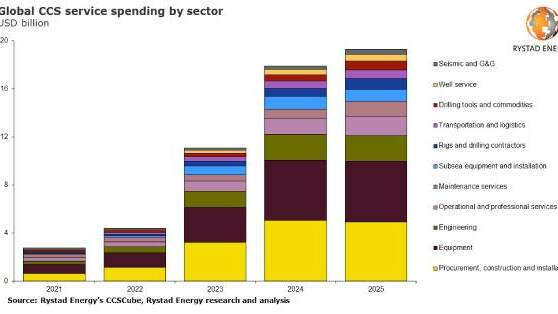

Service sector spending on carbon capture and storage (CCS) developments is set to skyrocket this decade, quadrupling from 2022 to 2025, with cumulative global expenditure over the next three years topping $50 billion, Rystad Energy research indicates.
Total spending for announced commercial projects in 2022 is projected to hit $4.4 billion, up from $2.8 billion last year. Outlay is then expected to nearly triple in 2023, topping $11 billion for the year. Projections show 2024 and 2025 will see an additional $18 billion and $19 billion, respectively, bringing the projected total to $52 billion by the middle of the decade. These totals only include announced projects, assuming all projects move ahead as planned, and do not account for pilot or demonstration-only developments.
The cash will be spent on a broad range of services related to the installation of the capture unit, transportation of the carbon dioxide (CO2) and storage. Europe and North America will drive spending, with 63 out of the 84 announced commercial CCS projects expected to start operations by 2025 situated in these two regions.
“CCS technology is viewed as a fundamental component of the societal decarbonization required for a successful energy transition. Although the technology dates back to the 1970s, the number of CCS project announcements has surged in the last two years, and service sector spending is expected to go through the roof in the coming years as a result,” says Lein Mann Hansen, Rystad Energy senior analyst.
There are 56 commercial CCS projects already in operation globally, capable of capturing up to 41 million tonnes per annum (tpa) of CO2 across various industries. Based on already announced projects, nearly 140 CCS plants could be operational by 2025, capturing at least 150 million tpa of CO2 if all projects move ahead as scheduled. These projects are currently in various stages of development, including feasibility, concept and construction.
Almost two-thirds of the total service spending will go towards equipping the facility with the CO2 capture component and maintaining operations. Engineering, procurement, construction and installation (EPCI) costs will be the primary driver of spending, contributing about $35 billion to the $55 billion total by 2025. Annual EPCI spending will hit $12 billion in 2025, a more than 300% increase from the $2.8 billion projected for this year.
Transportation – which follows capture of the CO2 – will require service purchases worth $8.5 billion through 2025. CO2 can be commercially transported in gas and liquid form to the storage area using pipelines, trucks and ships. Within each project and depending on the transport distance and location of the target storage location, the mode of transportation can vary. Pipelines are widely used to transport CO2, and there are 51 operational onshore pipelines, 38 of which are located in North America.
Onshore storage is currently the dominant mode of storage since it is cheaper and less complex. However, there will be an uptick in the number of offshore storage sites driven by Europe, including the Netherlands and the UK, in the coming years. There are five operational offshore pipelines, but the number could increase to 50 once the under-construction and planned projects with an offshore storage site become operational. Additional capital will, therefore, be required to lay the necessary subsea pipelines to transport the CO2 to the storage site. This will lead to growth in the subsea pipeline, shipping and offshore installation segment in the coming years. Trucks can be used to transport small amounts of CO2 and have the flexibility to collect from and deliver to several locations. Trucks are widely used in countries such as China.
The third and final step in most cases is storage. The process starts with identifying the potential storage location and is followed by drilling wells for injection and monitoring purposes, with associated drilling tools and oil country tubular goods (OCTG) then required. The storage process will incur at least $9 billion in service purchases through 2025.
The majority of these new additions will stem from Europe and North America, which account for 85% of the service purchases expected through 2025. The European market will account for more than 50% of the purchases despite having almost the same number of projects in the pipeline as North America. This is because many of the new upcoming projects in Europe will store CO2 offshore. Offshore storage is more expensive as it requires, for example, laying subsea pipelines for transport using pipelaying vessels, offshore rigs operating at higher rates to drill injection wells, and is coupled with higher labor rates in the region.
The growth in Europe is fueled by high European Union Emissions Trading System (EU ETS) prices along with favorable carbon policies and support for CCS projects. The North American CCS landscape is continuing to gain momentum with multiple projects announced in the US and Canada, driven by national incentives and funds supporting the technology.
Source: Rystad Energy



Related News.
Cyprus Maritime Innovation takes Centre Stage at SMM Hamburg 2026
Underscoring its expanding role as a premier international hub for cutting-edge maritime technology and sustainable shipping, the Republic of Cyprus…

Trump seeks to refill US oil reserve with Venezuela deal but faces long delay
U.S. President Donald Trump said on the 30th (local time) that he would refill the U.S. Strategic Petroleum Reserve, which has been depleted with…
US Navy Official visits South Korean Shipyards in private
With U.S. President Donald Trump pushing a plan to allow overseas construction of U.S. warships, attention is focusing on whether the building of…

SES and De Boer Marine expand collaboration with FlexMaritime deployment across Global Markets
SES, a leading space solutions company, and De Boer Marine, a leading provider of top-quality marine equipment and maritime connectivity services,…

New ESG guidance to help maritime industry turn sustainability into commercial advantage
New framework helps shipowners and ports align ESG strategy with access to capital, charterer expectations and long-term asset value. Maritime…

Britannia P&I Club analysis finds four in five crew deaths linked to illness rather than accidents
New report highlights cardiovascular disease as leading cause of fatalities and raises concerns over mental health risks among younger seafarers.…

The Swedish Club launches new Loss Prevention podcast, Knot Another Lesson
The Swedish Club has launched Knot Another Lesson, a new podcast exploring the practical lessons, emerging risks and operational challenges shaping…

Lloyd’s Register appoints Jens Grunenberg as Senior Representative for Germany
Lloyd’s Register has appointed Jens Grunenberg as its Senior Representative for Germany, effective 1 September. Based in Hamburg, Grunenberg will…
Indian Register of Shipping sets sights on Hamburg for European Expansion
Indian Register of Shipping, a leading international classification society and full member of the International Association of Classification…
MOL completes Merger of 6 Ship Management Companies
Unifying Management of Over 200 Vessels and Strengthening Safety Mitsui O.S.K. Lines, announced that it has completed the integration of the MOL…
Subscribe to our newsletter!
if you dont want to swim alone in the ocean of news, sign up for the newsletter, and you will receive daily all the important news of world shipping!
