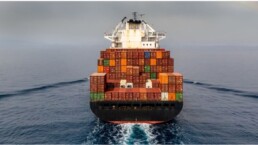

ICC, DCSA, BIMCO, FIATA and SWIFT have launched the Future International Trade Alliance and signed a memorandum of understanding to standardise digitalisation of international trade. Together, the industry associations will collaborate on the development and adoption of relevant standards to facilitate the use of electronic bills of lading.
Established to further digitalisation of container shipping technology standards, Digital Container Shipping Association (DCSA) – a neutral, non-profit group – in conjunction with its nine member carriers, today announced the formation of the Future International Trade (FIT) Alliance with the signing of a memorandum of understanding (MOU) between DCSA, ICC, BIMCO, FIATA and SWIFT in which the organisations commit to collaborating to standardise the digitalisation of international trade.
Through this initiative, the FIT Alliance will work together to generate awareness about the importance of common and interoperable data standards and common legislative conditions across international jurisdictions and platforms. The aim is to facilitate acceptance and adoption of an eBL by regulators, banks and insurers and to unify communication between these organisations and customers, physical and contractual carriers, and all other stakeholders involved in an international trade transaction.
“The digitalisation of documentation for container shipments will add value for international suppliers who rely on shipping across sectors,” said David Loosley, Secretary General and CEO of BIMCO. “Aligning these standards with the electronic bill of lading standard for the dry and liquid bulk sectors, which we are developing with assistance from DCSA, will help accelerate the digitalisation of trade globally.”
“Interoperability between all actors of the trade and transport industry is the key foundation to enable smooth data exchange and to streamline the end-to-end shipping process for our members,” said Dr. Stephane Graber, FIATA Director General. “FIATA, as the owner of the only negotiable multimodal transport document, endorsed by UNCTAD and ICC, is convinced that an industry-wide effort to establish open-source, interoperable, technology-agnostic standards is essential to make digitalization of international trade a reality. FIATA is committed to facilitating adoption of digital processes for freight-forwarders. We took the lead by developing the electronic FIATA Bill of Lading (eFBL) standard, which will further the acceptance of electronic documents by all stakeholders involved in a bill of lading (B/L) transaction. By simplifying their day-to-day business, our members will be able to focus on building truly differentiated offerings for their customers on top of future-proof digital foundations.”
“ICC represents 45 million companies in over 100 countries, and our mission is to make business work for everyone, every day, everywhere,” said John W.H. Denton AO, ICC Secretary General. “Living up to that means finding ways to make international trade far less complex than it currently is. Through the FIT Alliance, we are collaborating with key industry players to create and accelerate the adoption of digital standards for bills of lading that will make international shipping dramatically more simple, secure and seamless. This will drive a sea change in companies’ productivity and business models, the two critical ingredients to help businesses build back better and unleash benefits at an ecosystem level which have never before been achieved.”
David Watson, Chief Strategy Officer at SWIFT, said: “SWIFT is the way the world moves value, connecting 11,500 institutions in more than 200 countries and facilitating over US$2 trillion in global trade every year. We have significantly accelerated cross-border flows in recent years and are innovating at scale to make them instant. To that end, we are delighted to be part of this cross-industry collaboration to tackle friction through standardisation and enable interoperability across the ecosystem to allow rich data to flow freely between multiple platforms.”
“From the beginning, DCSA has understood the importance of cross-industry collaboration to achieve the elusive goal of universal eBL,” said Thomas Bagge, DCSA CEO. “The FIT Alliance is one exciting result of our ongoing effort to drive that collaboration. Container ships carry 90% of the world’s goods. As such, an incredibly diverse set of stakeholders touches the B/L transaction—from government regulators, to insurers, to shippers from every industry. To achieve widespread use of eBL, they must all be on board with adopting digital B/L standards. The agreement between DCSA and these diverse industry associations is an exciting milestone in our journey towards standardising all container shipping documentation through our eDocumentation initiative. We applaud the foresight and leadership of these organisations for joining us in the effort to bring greater transparency, efficiency, reliability and sustainability to the container shipping industry.”



Related News.

Navigating the Multi-Orbit Era: In Conversation with Intellian’s Jon Harrison at SMM 2026
At SMM 2026 in Hamburg, the rapid evolution of maritime satellite communications took centre stage. Across the exhibition halls, discussions among…
Cyprus ports need joint energy and investment strategy, shipping agents chief says
Cyprus needs a coordinated strategy for shipping, energy and environmental protection to support port investment and modernisation, Cyprus shipping…

MASO Public Affairs introduces MASO Regulatory Intelligence
A new subscription service helping businesses understand what is changing and what it means for them MASO Public Affairs introduces MASO Regulatory…
Anglo-Eastern helps turn CMBTECH’s ammonia ambition into an operational reality
From early feasibility study and risk-based design to newbuilding supervision, crew readiness and technical management, Anglo-Eastern drew on its…

Escalation of attacks threatens to derail recovery in Middle East oil exports
World oil demand is forecast to fall by 2.5 mb/d y-o-y in 4Q26 and 2.6 mb/d on average in 2026. As the Iran war manifests itself through restricted…
New study finds shipping pays twice its share to EU ETS earmarked revenues should triple to help build market for sustainable fuels and technologies
Shipping is responsible for around 10% of EU ETS emissions but pays almost 20% of the ETS bill. Unlike other sectors, it has never received free…

MSARC strengthens maritime mass rescue readiness through training and national live exercise off Dakar, Senegal
Joint MSARC–FHAS programme combines three days of SAR training with a national multi-agency live exercise The Maritime Search and Rescue Council ,…

Sogese report deliveries are still being delayed as container freight rates fluctuate
FOR IMPORTERS Spot rates into the Mediterranean are back at January levels, Far East to Europe reliability sits at pandemic lows, and nearly…

Glencore begins trading on Australian Securities Exchange
Glencore has begun trading on the Australian Securities Exchange under the ASX code GLC. Gary Nagle, Glencore’s CEO, said it was an exciting day for…
BIMCO Shipping Number of the Week
Suez Canal container ship transits exceed 50% of pre-disruption levels "During the first two weeks of October, weekly container ship capacity…
Subscribe to our newsletter!
if you dont want to swim alone in the ocean of news, sign up for the newsletter, and you will receive daily all the important news of world shipping!
