NYK starts demonstration project for commercialisation of vessels equipped with domestically produced Ammonia-Fueled engine

NYK Line, Japan Engine Corporation, IHI Power Systems Co., Ltd., and Nihon Shipyard Co., Ltd. are pleased to announce that Japan’s New Energy and Industrial Technology Development Organization (NEDO) has approved the Companies’ participation in a demonstration project for the commercialization of vessels equipped with a domestically produced ammonia-fueled engine as part of the Green Innovation Fund project.* The demonstration project, which is scheduled to begin in December with ClassNK added to the Companies, aims to use ammonia as fuel to significantly reduce greenhouse gas (GHG) emissions during voyages and thus introduce an ammonia-fueled vessel for the good of society earlier than 2030. The Companies will eventually work toward the goal of achieving zero emissions from ships in the future.
Target
The Companies and ClassNK’s greatest goals are to realize the development of an ammonia-fueled vessel that is internationally competitive ahead of other countries, and to lead the development of safety guidelines and laws and regulations related to ammonia-fueled vessels. In order to achieve these goals, marine engine manufacturers, shipyards, class societies, and shipping companies in Japan will work together to consistently cooperate from the research and development stage to engine development, shipbuilding, and commercialization.
Background
With the entry into force of the Paris Agreement in 2016, the global momentum for decarbonization is increasing. The Japanese government has declared that it will reduce GHG emissions to zero as a whole by 2050 and aim for carbon neutrality, and the energy shift toward the realization of a carbon-free society is accelerating. Reducing GHG emissions is also an urgent issue in the shipping industry, and research and development is being conducted to convert marine fuel from conventional heavy fuel oil to liquefied natural gas (LNG) and to popularize next-generation zero-emission fuels such as hydrogen and ammonia. Ammonia does not emit carbon dioxide (CO2) even when burned, so it is expected to be a next-generation fuel that contributes to global warming countermeasures. Furthermore, it is said that by utilizing CO2-free hydrogen** for hydrogen, which is the raw material for ammonia, it is possible to achieve zero emissions in consideration of the fuel life cycle.
Under this background, Japan’s Ministry of Economy, Trade and Industry started the Green Innovation Fund project toward carbon neutrality by 2050, and NEDO has now approved the Companies’ development of vessels equipped with a domestically produced ammonia-fueled engine as part of the Green Innovation Fund project.
Overview of demonstration project and the roles of Companies
NEDO has approved these demonstration projects, (1) the development and operation of an ammonia-fueled tugboat and (2) the development and operation of an ammonia-fueled ammonia gas carrier, and the companies will carry them out.
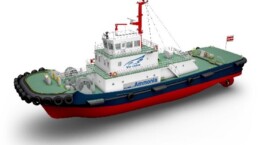
(1) Development and operation of an ammonia-fueled tugboat (A-Tug)
The ammonia fuel will have a flame retardant bottleneck, which is difficult to ignite, so this project assumes that a small amount of fuel oil will be used as pilot fuel. Targeting the delivery of A-Tug in FY2024, the companies aim to reduce GHG emissions by achieving an ammonia fuel mixed combustion rate of 80% or higher.
The companies will confirm safe operation in demonstrations aimed to improve the mixed combustion rate with a view to achieving zero GHG emissions by using biofuel as a pilot fuel in the future.
| NYK Line | Project management, ship design and legal compliance |
| IHI Power Systems Co., Ltd. | Research and design of four-stroke engine*** |
| Nippon Kaiji Kyokai (ClassNK) | Safety assessment of A-Tug |
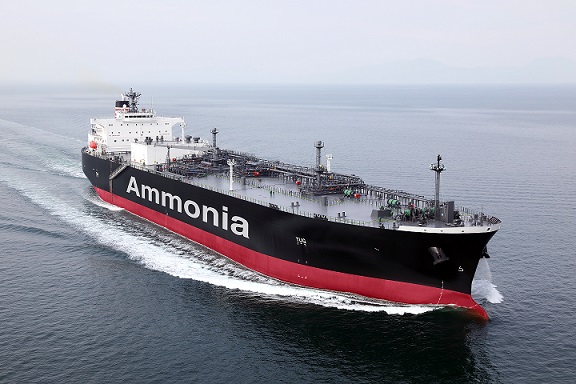
(2) Development and operation of an ammonia-fueled ammonia gas carrier (AFAGC)
Targeting the ship’s delivery in FY2026, the Companies will develop and operate an ammonia-fueled ammonia gas carrier (AFAGC) with the concept of transporting ammonia as cargo and using the cargo and ammonia gas vaporized from the cargo as fuel during the voyage.
The Companies aim to reduce GHG emissions by achieving a maximum ammonia fuel mixed combustion rate of 95% for the main engine that moves the ship, and an ammonia fuel mixed combustion rate of 80% or more for the auxiliary engine that runs the generator.
| NYK Line | Project management, ship design and legal compliance |
| Japan Engine Corporation | Research and design of two-stroke engine (main engine)**** |
| IHI Power Systems Co., Ltd. | Research and design of four-stroke engine (auxiliary engine) |
| Nihon Shipyard Co., Ltd. | Development of hull, examination of ship construction method |
| Nippon Kaiji Kyokai (ClassNK) | Safety assessment of AFAGC |
|
Image of AFAGC |
Schedule
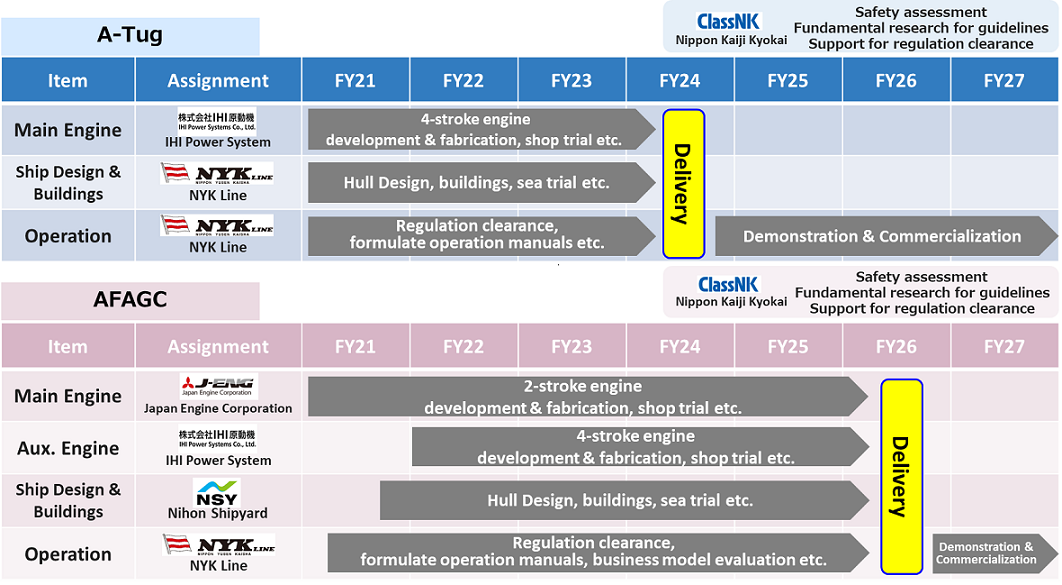
Period: December 2021 to the end of March 2028
|
Demonstration project schedule |



Related News.

Navigating the Multi-Orbit Era: In Conversation with Intellian’s Jon Harrison at SMM 2026
At SMM 2026 in Hamburg, the rapid evolution of maritime satellite communications took centre stage. Across the exhibition halls, discussions among…

Cyprus ports need joint energy and investment strategy, shipping agents chief says
Cyprus needs a coordinated strategy for shipping, energy and environmental protection to support port investment and modernisation, Cyprus shipping…

MASO Public Affairs introduces MASO Regulatory Intelligence
A new subscription service helping businesses understand what is changing and what it means for them MASO Public Affairs introduces MASO Regulatory…

Anglo-Eastern helps turn CMBTECH’s ammonia ambition into an operational reality
From early feasibility study and risk-based design to newbuilding supervision, crew readiness and technical management, Anglo-Eastern drew on its…

Escalation of attacks threatens to derail recovery in Middle East oil exports
World oil demand is forecast to fall by 2.5 mb/d y-o-y in 4Q26 and 2.6 mb/d on average in 2026. As the Iran war manifests itself through restricted…

New study finds shipping pays twice its share to EU ETS earmarked revenues should triple to help build market for sustainable fuels and technologies
Shipping is responsible for around 10% of EU ETS emissions but pays almost 20% of the ETS bill. Unlike other sectors, it has never received free…

MSARC strengthens maritime mass rescue readiness through training and national live exercise off Dakar, Senegal
Joint MSARC–FHAS programme combines three days of SAR training with a national multi-agency live exercise The Maritime Search and Rescue Council ,…

Sogese report deliveries are still being delayed as container freight rates fluctuate
FOR IMPORTERS Spot rates into the Mediterranean are back at January levels, Far East to Europe reliability sits at pandemic lows, and nearly…

Glencore begins trading on Australian Securities Exchange
Glencore has begun trading on the Australian Securities Exchange under the ASX code GLC. Gary Nagle, Glencore’s CEO, said it was an exciting day for…

BIMCO Shipping Number of the Week
Suez Canal container ship transits exceed 50% of pre-disruption levels "During the first two weeks of October, weekly container ship capacity…
Subscribe to our newsletter!
if you dont want to swim alone in the ocean of news, sign up for the newsletter, and you will receive daily all the important news of world shipping!
