Econowind turns ten as maritime players turn to wind-assisted ship propulsion to tackle rising fuel costs
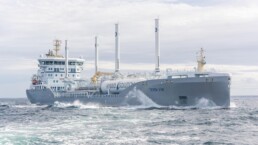

From wooden prototypes on a car roof to more than 170 VentoFoil units sold, the Dutch wind-assisted ship propulsion (WASP) specialist looks back on a decade of practical engineering and a changing industry.
Econowind is celebrating its tenth anniversary, with more than 170 VentoFoil units sold to shipping companies around the world. Reaching the ten-year mark highlights both the company’s journey from early start-up to established scale-up, and a broader shift in how global commercial shipping views wind power.
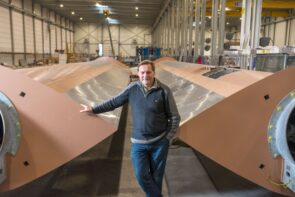
When founder Frank Nieuwenhuis launched Econowind in 2016 in collaboration with ship design firm Conoship International, many in the maritime sector were still sceptical about wind-assisted ship propulsion, so he set out to show that compact, vertical wings could cut a cargo ship’s fuel use. His first tests were very hands-on: he bolted wooden prototypes to the roof of his car and used a vacuum cleaner to mimic the suction that keeps air flowing smoothly over the wing. Later, he tested an early prototype on a car trailer.
Early pioneers did not just have to sell a new technology, they had to sell wind itself as a credible modern energy source. When early setbacks tested Nieuwenhuis’ resolve, Gavin Allwright of the International Windship Association (IWSA) persuaded him to persevere.
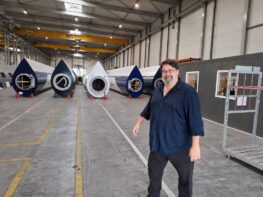
Taking the concept to sea was not smooth, as early trials required manual operation by an onboard technician, and showed that smaller wings delivered limited savings on larger ships. Econowind responded by developing automated bridge controls that respond to changing winds. It also added tilting designs, so crews can lower the wings during cargo handling or heavy weather. That engineering work laid the foundation for the 3-series VentoFoil, the company’s best-selling unit.
Over the past ten years, Econowind has grown alongside the wider WASP market. What began as a handful of trial installations is now a recognised commercial segment, with installations roughly doubling every twelve months.
“In terms of the number of vessels installed, Econowind is right in the front line, definitely one of the frontrunners,” says Gavin Allwright, Secretary General of the IWSA.
“What has changed most over the past decade is perception: shipping now sees wind not as a romantic throwback, but as a 21st-century toolbox of commercial solutions.”
Much of that growth comes down to cost and pressure to act. With fuel accounting for around half of a ship’s operating expenses, shipping companies and charterers are facing high and unpredictable fuel prices, alongside the heavy cost of long-term decarbonisation. Alternative fuels such as green methanol and ammonia remain expensive, and the production and bunkering networks they require are still being built. Meanwhile, rules such as the EU Emissions Trading System (EU ETS) and FuelEU Maritime, which grants a reward factor for wind propulsion and allows operators to pool compliance surpluses, are turning emissions reduction into a direct financial case.
VentoFoils ease the load on a ship’s main engine, giving operators a practical way to reduce fuel burn and compliance costs without relying on new fuel supply chains that are still taking shape. Wind propulsion also works well alongside hull and voyage optimisation as well as future low-carbon fuels.
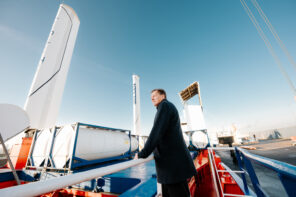
Looking back on the past decade, Nieuwenhuis says: “This journey has been full of trials and learning by doing. It would not have been possible without the people behind Econowind and everyone who supported us along the way.”
To mark the anniversary, Econowind is launching a series of ten stories, each told by a different voice. Together, clients, shipyards, and other maritime stakeholders tell the story of how both the company and commercial wind propulsion have developed over the decade.
Entering its second decade, Econowind is focused on expanding its manufacturing capacity and rolling out the 30-metre steel 5-series VentoFoil for deepsea fleets. Ten years after testing its first scale models, the company aims to help make wind assistance a standard part of life at sea.
“Wind propulsion is approaching an inflection point. The groundwork has been laid by technology providers such as Econowind, and the sector is now absolutely ready to ride the wave,” Allwright adds.



Related News.

Greece has the most to lose from delays in shipping’s green transition, new analysis finds
UCL and WWF Greece report finds the IMO Net-Zero Framework offers Greek ship owners the clarity they need, and the best protection against a…

Snow Land joins Cool Carriers as the world’s first reefer with a gate rudder, a new chapter for sustainable and efficient reefer shipping
Cool Carriers, the world’s largest operator of specialised reefer vessels, took delivery of Snow Land from Kitanihon Shipbuilding in Japan on 12…

IBIA launches Marine Energy Outlook Survey as Annual Convention in New York
IBIA - The International Bunker Industry Association officially launched its Marine Energy Outlook Survey during the IBIA Annual Convention in New…

Why did ITF staff vote to strike again?
Staff at the International Transport Workers’ Federation (ITF) headquarters in London have voted to give their union a strike mandate. According to…

Nearly half of maritime crew tickets booked a week ahead are cancelled
Two new C Teleport reports show when maritime and aircrew teams book crew flights, how often they cancel, and what late booking costs, with a…

Kpler completes $1.5bn+ Sixth Street investment and continues accelerating growth
Investment backs Kpler's bold ambition to shape the future of global trade intelligence. Kpler, a leading provider of global physical trade…

How SAL and DNV are strengthening heavy-lift shipping
From classification and newbuilding support to operational tools and advisory expertise, SAL and DNV have been collaborating for decades. The…

PSA Singapore breaks ground on Tuas Port Phase Two to strengthen Global Trade Connectivity
PSA Singapore marked the groundbreaking of Tuas Port Phase Two, a significant step in the development of the world’s largest fully automated…

 …

BIFA welcomes UK–EU trade progress and calls for clarity on implementation
The British International Freight Association (BIFA) has welcomed progress made at today's UK–EU Summit in Brussels, highlighting the potential…
Subscribe to our newsletter!
if you dont want to swim alone in the ocean of news, sign up for the newsletter, and you will receive daily all the important news of world shipping!
