

Seafarers may be reluctant to go ashore when ports reopen after the coronavirus pandemic despite some of them spending a year or more away from family and friends, according to a mental health expert.
Charles Watkins, a clinical psychologist and Managing Director of Mental Health Support Solutions, believes crewmembers will likely suffer from post-covid stress disorder when allowed to set foot on dry land.
“Although initially happy about ports opening and being able to take shore leave, some seafarers will be hesitant to go ashore due to possibly experiencing a temporary phobic avoidance of countries that were hit hard during the pandemic,” said Mr Watkins, whose company provides 24/7 professional mental health support and guidance across the maritime sector.
Many crewmembers working throughout the pandemic have been stranded on ships, owing to nations closing their borders to contain the virus. Nevertheless, Mr Watkins does not expect seafarers to demand shorter contracts once the shipping industry returns to normal.
“There is still a need to make money, so the length of contract isn’t a big issue because seafarers were used to prolonging their time at sea even before the pandemic,” he said. “If anything, the bigger challenge for them has been getting on board to work. With fewer crew changes taking place, many seafarers have stayed aboard longer to continue making money and providing for their family.”
Captain Faouzi Fradi, Group Director of Crewing and Training at Columbia Shipmanagement (CSM), believes improvements in diet and mental health support has made life more comfortable for crewmembers stuck on vessels. “Giving crew free, unlimited access to the internet has helped as they can stay in contact with their loved ones,” he said. “Food is now more nutritious and we’re seeing an increase in vitamins and supplements available onboard. I think these benefits will continue after covid-19.”
The switch from class-based learning to online courses is another upside for covid-hit seafarers. Captain Fradi said that crewmembers now have more access to eLearning programmes – a growing trend that will likely gather momentum following the pandemic. “Before covid-19, some seafarers had to travel for training but that’s no longer the case,” he said.
Like many businesses, international catering management and training provider MCTC has had to move some of its courses online. However, the business can now train double the number of seafarers studying nutrition and diet virtually compared to in person. The company is still running food preparation courses, albeit with slightly fewer participants to comply with social distancing rules.
The continued growth in demand for online learning after the pandemic – considered likely by some industry figures – is good news for OneLearn Global, an eLearning training provider to the maritime, energy, hospitality and industrial sectors. Nigel Cleave, Senior Adviser at OneLearn Global, believes online learning is key for companies looking to hire fresh talent in a post-covid landscape.
“Modern-day learning techniques are needed to inspire and attract Millennials and Generation Z to the industry. These people are digital natives who behave and learn differently to older generations due to their lifelong relationship with technology.
“Training programmes should offer fresh, bright, agile and really motivational content that can be accessed both online and offline at any time and from anywhere in the world. Younger generations want a simple-to-use, engaging and intuitive learning experience, which we offer through our cloud-based learning management system.”
The focus on health, diet, nutrition and training suggests that some shipping companies have made life as comfortable as possible for seafarers stuck on vessels because of covid-19. But their hands are tied when it comes to getting crewmembers who want to go home back on dry land, according to Captain Fradi.
“Governments talk about prioritising seafarers, but then we see one million people ahead of them in the queue for vaccinations,” he said. “If the International Maritime Organization made vaccinations for crewmembers compulsory, countries would be able to send them anywhere in the world.
“The big issue is that seafarers can’t stop moving from point A to point B, as that’s their job. But because they’re always travelling, they could carry or transmit the disease, which is a risk for countries that allow crew changes. It’s a complex matter, which is complicated further by the travel and entry restrictions around the world.”



Related News.

Navigating the Multi-Orbit Era: In Conversation with Intellian’s Jon Harrison at SMM 2026
At SMM 2026 in Hamburg, the rapid evolution of maritime satellite communications took centre stage. Across the exhibition halls, discussions among…
Cyprus ports need joint energy and investment strategy, shipping agents chief says
Cyprus needs a coordinated strategy for shipping, energy and environmental protection to support port investment and modernisation, Cyprus shipping…

MASO Public Affairs introduces MASO Regulatory Intelligence
A new subscription service helping businesses understand what is changing and what it means for them MASO Public Affairs introduces MASO Regulatory…
Anglo-Eastern helps turn CMBTECH’s ammonia ambition into an operational reality
From early feasibility study and risk-based design to newbuilding supervision, crew readiness and technical management, Anglo-Eastern drew on its…

Escalation of attacks threatens to derail recovery in Middle East oil exports
World oil demand is forecast to fall by 2.5 mb/d y-o-y in 4Q26 and 2.6 mb/d on average in 2026. As the Iran war manifests itself through restricted…
New study finds shipping pays twice its share to EU ETS earmarked revenues should triple to help build market for sustainable fuels and technologies
Shipping is responsible for around 10% of EU ETS emissions but pays almost 20% of the ETS bill. Unlike other sectors, it has never received free…
MSARC strengthens maritime mass rescue readiness through training and national live exercise off Dakar, Senegal
Joint MSARC–FHAS programme combines three days of SAR training with a national multi-agency live exercise The Maritime Search and Rescue Council ,…

Sogese report deliveries are still being delayed as container freight rates fluctuate
FOR IMPORTERS Spot rates into the Mediterranean are back at January levels, Far East to Europe reliability sits at pandemic lows, and nearly…

Glencore begins trading on Australian Securities Exchange
Glencore has begun trading on the Australian Securities Exchange under the ASX code GLC. Gary Nagle, Glencore’s CEO, said it was an exciting day for…
BIMCO Shipping Number of the Week
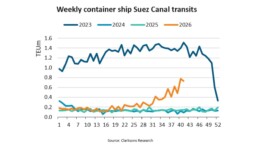
Suez Canal container ship transits exceed 50% of pre-disruption levels "During the first two weeks of October, weekly container ship capacity…
Subscribe to our newsletter!
if you dont want to swim alone in the ocean of news, sign up for the newsletter, and you will receive daily all the important news of world shipping!
