Airbus takes Sentinel-1 data from orbit to Earth…and into the cloud
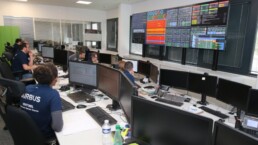

The two Sentinel-1 satellites that orbit the Earth are generating vast amounts of imagery with C-band radars – delivering trillions of data bytes every month.
After their launches in 2014 and 2016, these spacecraft – which are equipped with Airbus-built synthetic aperture radar instruments – have provided users with imaging data for such applications as environmental monitoring, understanding the effects of climate change, and safeguarding everyday lives.
As manufacturer and operator of the Sentinel-1 data segment for the European Space Agency (ESA), Airbus was asked by ESA to carry on the success story and look at digitalising this vital asset after six years of outstanding performance since launch of the first Sentinel-1.
Under the Copernicus Earth Observation programme (a joint initiative of the European Commission and the European Space Agency), ESA requested transfer of operations of the Copernicus Sentinels’ data segment to commercial cloud environments. Airbus therefore set about developing a highly capable cloud-native solution and smoothly migrated the Sentinel-1 operations to a commercial cloud while continuing to deliver higher levels of operational performance.
Replacing the standard ground-segment infrastructure
Until recently, the enormous amount of data transmitted by Sentinel-1 satellites have been housed in a physical ground-based infrastructure that required relatively complex accessibility for users through Unix-based computer operating systems. This changed recently when Airbus completed a highly successful migration of the data segment to the commercial cloud – with the radar imaging data now available through much simplified internet-type connectivity and an easy-to-use graphic-rich dashboard.
Emmanuel Lebret, the Airbus project manager, said the Sentinel-1 data migration was handled in less than two years without technical glitches, and performed at a very competitive cost.
This experience positions Airbus for future data migration opportunities to the cloud, including missions beyond Sentinel-1 within the framework of Europe’s ambitious Copernicus programme, as well for as satellite imaging systems acquired by other customers.
A highly valued migration solution by Airbus
Key elements of the Airbus-managed migration were its development utilising 100% open-source cloud-based components (avoiding possible intellectual property rights issues), and the cloud-native solution with a micro-service architecture (which maximises the cloud’s benefits in terms of scalability and performance).
Lebret added that Airbus achieved its goals of maintaining the performance, reliability and agility levels of storage systems on the ground while enabling the customer to benefit from cost reductions that come with cloud-based storage – all while maintaining service levels so the transfer was transparent to users.
Another advantage is the ability to easily operate and monitor the cloud system via the internet with proper levels of security – and facilitating the access so that even a smartphone can be used.
“Our Sentinel-1 data segment migration to the cloud was very smooth…and there were no interruptions of service”. Airbus project manager Emmanuel Lebret
The data segment’s migration – which is part of the Copernicus Ground System Transformation Programme – was managed in a design-to-cost approach through modelling for cost estimations, technical trade-offs and a balancing between timely performance and costs. This reflected the Airbus operations team’s customer-oriented approach, and its focus on end-user satisfaction, according to Lebret.
Additionally, the Sentinel-1 migration solution is “cloud agnostic” – enabling its deployment by any cloud provider, thereby preventing potential “lock-ins” by commercial cloud services suppliers.
“This has been a major achievement, and it represents a turning point in transforming the Copernicus Space Component’s operations…” Betlem Rosich, ESA’s Copernicus Ground Segment Operations Manager
Betlem Rosich, ESA’s Copernicus Ground Segment Operations Manager, commended Airbus for developing a high-performance cloud-native solution and efficiently migrating Sentinel-1 operations to a commercial cloud – all while continuing to deliver excellent levels of operational performance.
“This has been a major achievement, and it represents a turning point in transforming the Copernicus Space Component’s operations towards a more adaptative, scalable, modular and cost-effective service-based operations architecture,” she said.
Ready for future scale-ups of the cloud infrastructure
With the Sentinel-1 data segment now in the cloud, its resources will enable scale-ups to meet the very significant increases in Copernicus data expected in the coming years – avoiding the need for future investments in hardware-based infrastructure that would become obsolete every several years.
The pair of Sentinel-1 satellites (designated Sentinel-1A and Sentinel-1B) circle the Earth in the same orbital plane, positioned 180-degrees apart to provide coverage of the globe every six days. Their radar instruments are capable of penetrating clouds and acquiring data both in daylight and at night.
There are broad applications for Sentinel-1 data, from observations of sea ice zones, the arctic environment and maritime surveillance to the tracking of land surface motion (landslides, volcanoes, tectonics, etc.); risk management in flooding and other situations; support to emergency/humanitarian services; and the mapping of forests, water and agriculture.



Related News.

Navigating the Multi-Orbit Era: In Conversation with Intellian’s Jon Harrison at SMM 2026
At SMM 2026 in Hamburg, the rapid evolution of maritime satellite communications took centre stage. Across the exhibition halls, discussions among…

Cyprus ports need joint energy and investment strategy, shipping agents chief says
Cyprus needs a coordinated strategy for shipping, energy and environmental protection to support port investment and modernisation, Cyprus shipping…

MASO Public Affairs introduces MASO Regulatory Intelligence
A new subscription service helping businesses understand what is changing and what it means for them MASO Public Affairs introduces MASO Regulatory…

Anglo-Eastern helps turn CMBTECH’s ammonia ambition into an operational reality
From early feasibility study and risk-based design to newbuilding supervision, crew readiness and technical management, Anglo-Eastern drew on its…

Escalation of attacks threatens to derail recovery in Middle East oil exports
World oil demand is forecast to fall by 2.5 mb/d y-o-y in 4Q26 and 2.6 mb/d on average in 2026. As the Iran war manifests itself through restricted…

New study finds shipping pays twice its share to EU ETS earmarked revenues should triple to help build market for sustainable fuels and technologies
Shipping is responsible for around 10% of EU ETS emissions but pays almost 20% of the ETS bill. Unlike other sectors, it has never received free…

MSARC strengthens maritime mass rescue readiness through training and national live exercise off Dakar, Senegal
Joint MSARC–FHAS programme combines three days of SAR training with a national multi-agency live exercise The Maritime Search and Rescue Council ,…

Sogese report deliveries are still being delayed as container freight rates fluctuate
FOR IMPORTERS Spot rates into the Mediterranean are back at January levels, Far East to Europe reliability sits at pandemic lows, and nearly…

Glencore begins trading on Australian Securities Exchange
Glencore has begun trading on the Australian Securities Exchange under the ASX code GLC. Gary Nagle, Glencore’s CEO, said it was an exciting day for…

BIMCO Shipping Number of the Week
Suez Canal container ship transits exceed 50% of pre-disruption levels "During the first two weeks of October, weekly container ship capacity…
Subscribe to our newsletter!
if you dont want to swim alone in the ocean of news, sign up for the newsletter, and you will receive daily all the important news of world shipping!
