An expenditure splash of $810 billion is expected for the offshore wind industry this decade
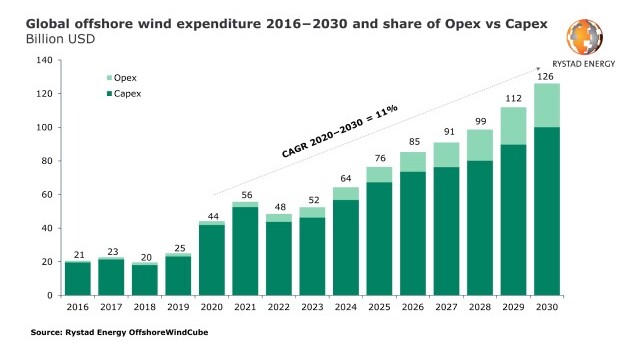

The offshore wind industry’s global installed capacity is set to exceed 250 gigawatts (GW) by 2030, driven by a surge in coming projects, a Rystad Energy report shows. The combined capital and operational expenditure for the decade is set to add up to an eye-popping $810 billion, signaling an increasing shift of investments from oil and gas to renewable energy technologies.
The cumulative installed capacity of global offshore wind projects climbed to 33 GW in 2020 – a significant achievement for an industry that has nearly tripled its size since 2016. We expect the world’s installed capacity to hit an estimated 109 GW by 2025 and rise further to 251 GW by 2030, growing by 22% a year on average.
This massive boost in capacity will involve a steep increase in global spending. Rystad Energy estimates that total expenditure will amount to $56 billion in 2021 as almost 13 GW of capacity is expected to be commissioned, lifting the cumulative global installed capacity to 46 GW.
Yearly spending will continue to rise to $126 billion in 2030, after a short-lived dip in 2022 and 2023. Capex today accounts for 95% of the total expenditure, with opex representing only 5%. The capex share is expected to decline to about 80% by 2030, as all the new installed capacity will require more operational spending to run and maintain.
In fact, 2030 will be the year of the inflection point when offshore wind capex will be on par with offshore oil and gas greenfield capex (excluding exploration work), at about $100 billion.
Europe, as the most mature market, is still expected to dominate offshore wind spending this decade, totaling about $300 billion. Some of the assets with the largest expenditures are located off the UK, including Orsted’s 4.8 GW Hornsea Two, Three and Four projects, which are lined up for more than $14 billion in capex. The giant Dogger Bank projects, to be developed in three 1.2 GW phases by SSE, could see more than $11 billion in capex, while Scottish Power Renewable’s 3 GW East Anglia Hub will likely involve capex of beyond $8 billion.
China dominated annual spending between 2019 and 2021 due to its substantial annual capacity additions. This decade, the country is forecast to spend about $110 billion. Outside of China, Asia is expected to see significant investments this year, driven by Vietnam and Taiwan. Spending in South Korea and Japan will also increase beginning in 2023 as more projects are lined up.
Meanwhile, the Americas region is falling behind due to the US Jones Act and delayed permitting processes for the US offshore wind industry, which are pushing back the expected start-up years for a number of wind farms. The region is expected to spend just over $70 billion this decade on offshore wind projects – still a significant sum, but well below that of other global regions.
Rystad Energy expects North and South America will only start spending substantial amounts on offshore wind in 2023. The first large-scale project in the US will be the 800-megawatt (MW) Vineyard Wind 1 scheme developed by Avangrid and the Copenhagen Infrastructure consortium off the coast of Massachusetts, with an estimated investment of $2.8 billion.
Turbine manufacturing costs represent the largest share of capex for offshore wind developments with almost 40% of total investments. This trend is expected to continue as countries, especially European ones, are increasingly deploying large turbines.
Foundation manufacturing is the second major cost element for building an offshore wind farm, with a share of about 15% of overall capex during towards 2030. The share of foundation spending to capex should remain at the same level since we do not expect a significant influx of floating foundations this decade.
Cable manufacturing, consisting of array and export cables, accounts for about 14% of the total capex. Combined with the cable installation cost, the segment weighs in at about 20% of capex. This cost is not expected to increase as we approach 2030, as larger turbines help reduce cable and installation costs despite projects moving increasingly further from shore.
“The colossal level of investments anticipated in the offshore wind industry this decade reflects the ambitious targets set by companies and governments alike. As the market matures and economies of scale are achieved, investments could surge further, sparking even more installed capacity,“ says Petra Manuel, offshore wind analyst at Rystad Energy.
Source: Rystad Energy



Related News.
Cyprus Maritime Innovation takes Centre Stage at SMM Hamburg 2026
Underscoring its expanding role as a premier international hub for cutting-edge maritime technology and sustainable shipping, the Republic of Cyprus…

Trump seeks to refill US oil reserve with Venezuela deal but faces long delay
U.S. President Donald Trump said on the 30th (local time) that he would refill the U.S. Strategic Petroleum Reserve, which has been depleted with…
US Navy Official visits South Korean Shipyards in private
With U.S. President Donald Trump pushing a plan to allow overseas construction of U.S. warships, attention is focusing on whether the building of…

SES and De Boer Marine expand collaboration with FlexMaritime deployment across Global Markets
SES, a leading space solutions company, and De Boer Marine, a leading provider of top-quality marine equipment and maritime connectivity services,…

New ESG guidance to help maritime industry turn sustainability into commercial advantage
New framework helps shipowners and ports align ESG strategy with access to capital, charterer expectations and long-term asset value. Maritime…

Britannia P&I Club analysis finds four in five crew deaths linked to illness rather than accidents
New report highlights cardiovascular disease as leading cause of fatalities and raises concerns over mental health risks among younger seafarers.…

The Swedish Club launches new Loss Prevention podcast, Knot Another Lesson
The Swedish Club has launched Knot Another Lesson, a new podcast exploring the practical lessons, emerging risks and operational challenges shaping…

Lloyd’s Register appoints Jens Grunenberg as Senior Representative for Germany
Lloyd’s Register has appointed Jens Grunenberg as its Senior Representative for Germany, effective 1 September. Based in Hamburg, Grunenberg will…

Indian Register of Shipping sets sights on Hamburg for European Expansion
Indian Register of Shipping, a leading international classification society and full member of the International Association of Classification…
MOL completes Merger of 6 Ship Management Companies
Unifying Management of Over 200 Vessels and Strengthening Safety Mitsui O.S.K. Lines, announced that it has completed the integration of the MOL…
Subscribe to our newsletter!
if you dont want to swim alone in the ocean of news, sign up for the newsletter, and you will receive daily all the important news of world shipping!
