Robots could replace hundreds of thousands of oil and gas jobs, save billions in drilling costs by 2030
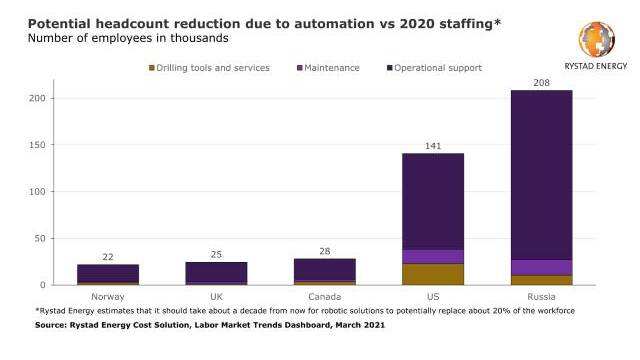

Even when the Covid-19 downturn is finally past us, operators will have to continue exploring new avenues for cost reductions to be better equipped to withstand future market declines. In a report that looked into the adoption of robotics across the petroleum industry, Rystad Energy found that existing solutions could replace hundreds of thousands of oil and gas jobs globally and reduce drilling labor costs by several billion dollars by 2030, if there is an industry push for such a transition.
One of the segments with much to gain from the adoption of robotics is drilling, as it is highly cost-intensive and involves carrying out dangerous tasks in challenging environments. Robotic solutions have already been introduced successfully in drilling operations, with companies such as Nabors at the development forefront.
Applying current supplier specs, which suggest that robotic drilling systems can potentially reduce the number of roughnecks required on a drilling rig by 20% to 30%, Rystad Energy estimates that such a reduction in both offshore and onshore drilling crews can bring cost savings of more than $7 billion in wages in the US alone, based on present wage levels.
Inspection, maintenance and repair (IMR) operations are also ideal for robotic operations and is the segment where adoption of robotics has gained the most traction among operators in recent years. This has so far mainly been limited to subsea IMR activities, but we are now starting to see IMR robotics solutions also being used for topsides.
Overall, Rystad Energy believes that at least 20% of the jobs in segments such as drilling, operational support, and maintenance could in theory get automated in the next 10 years. Looking at the current staffing headcount of some key oil and gas producing countries, the US could reduce its staffing needs by over 140,000 employees and Russia by over 200,000 personnel. Canada, the UK, and Norway could shed between 20,000 and 30,000 jobs each.
“Despite the huge potential of robotics, operators should be aware that these savings will be partially offset by the considerable investments required for the adoption of these solutions, which may vary depending on the cost structure and whether the robots are owned or leased,” says Sumit Yadav, energy service analyst at Rystad Energy.
Nevertheless, the next generation of robotics solutions is already emerging within subsea IMR in the form of perpetually underwater robotics solutions that offer significantly lower costs and better reach than a conventional remotely operated vehicle (ROV). While a conventional ROV needs to be sent down from the surface, these new systems can stay underwater permanently and easily access places that are difficult to reach for conventional ROVs, irrespective of the weather conditions.
A notable example is the self-propelled robotics arms unit Eelume, developed by Kongsberg Maritime and used by Norwegian operator Equinor. Owing to their snake-like design, the robotic arms have the flexibility and agility to transit over long distances and carry out subsea IMR activities such as visual inspection, cleaning, and operating valves and chokes in highly confined spaces.
Not all digitization and robotization translates into a reduction in manpower, however. For instance, Transocean has introduced wearable safety technology that alarms a crew member if they come too close to the drilling equipment. If the crew member still doesn’t maintain a safe distance, the alarm will shut down the equipment.
Similarly, Diamond Offshore has launched the industry’s first cybernetic blow-out preventer (BOP) service. The service named Sim-Stack makes a virtual replica of the BOP hydraulically and electrically to assess its overall health and regulatory compliance. The system provides much faster information on component failures, reducing downtime and improving safety, and can also be used to train personnel, according to the rig operator.
While the emergence of robotics in the oil and gas industry seems inevitable, we believe that full-scale adoption is still a few years away as the long-term reliability of robotics in complex 3D environments such as those found on offshore platforms is yet to be tested. Another challenge in the implementation of robotics is limited communication capabilities, especially between robotics units. If robots are to fully replace humans, it is imperative that these systems communicate seamlessly to unlock true value. The implementation of such communication systems is both complex and costly.
Finally, job cuts due to robotics are likely to be met with some resistance from labor organizations, and robotized work processes may also need to pass regulatory hurdles as authorities seek to ensure that the operational changes brought on by the new technology satisfy safety and environmental standards.
Source: Rystad Energy



Related News.
Cyprus Maritime Innovation takes Centre Stage at SMM Hamburg 2026
Underscoring its expanding role as a premier international hub for cutting-edge maritime technology and sustainable shipping, the Republic of Cyprus…

Trump seeks to refill US oil reserve with Venezuela deal but faces long delay
U.S. President Donald Trump said on the 30th (local time) that he would refill the U.S. Strategic Petroleum Reserve, which has been depleted with…
US Navy Official visits South Korean Shipyards in private
With U.S. President Donald Trump pushing a plan to allow overseas construction of U.S. warships, attention is focusing on whether the building of…

SES and De Boer Marine expand collaboration with FlexMaritime deployment across Global Markets
SES, a leading space solutions company, and De Boer Marine, a leading provider of top-quality marine equipment and maritime connectivity services,…

New ESG guidance to help maritime industry turn sustainability into commercial advantage
New framework helps shipowners and ports align ESG strategy with access to capital, charterer expectations and long-term asset value. Maritime…
Britannia P&I Club analysis finds four in five crew deaths linked to illness rather than accidents
New report highlights cardiovascular disease as leading cause of fatalities and raises concerns over mental health risks among younger seafarers.…

The Swedish Club launches new Loss Prevention podcast, Knot Another Lesson
The Swedish Club has launched Knot Another Lesson, a new podcast exploring the practical lessons, emerging risks and operational challenges shaping…

Lloyd’s Register appoints Jens Grunenberg as Senior Representative for Germany
Lloyd’s Register has appointed Jens Grunenberg as its Senior Representative for Germany, effective 1 September. Based in Hamburg, Grunenberg will…
Indian Register of Shipping sets sights on Hamburg for European Expansion
Indian Register of Shipping, a leading international classification society and full member of the International Association of Classification…
MOL completes Merger of 6 Ship Management Companies
Unifying Management of Over 200 Vessels and Strengthening Safety Mitsui O.S.K. Lines, announced that it has completed the integration of the MOL…
Subscribe to our newsletter!
if you dont want to swim alone in the ocean of news, sign up for the newsletter, and you will receive daily all the important news of world shipping!
