The share of gas flared in the Permian has fallen to its lowest level of the Shale era
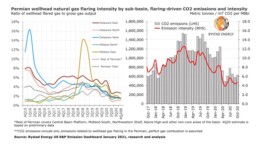

The share of gross gas output that is flared at the wellhead in the US’ prolific Permian Basin has plummeted to a modern Shale-era record low, a Rystad Energy report shows, with an analysis of preliminary data suggesting only 1.6% of the basin’s gas production was flared in the fourth quarter of 2020. The absolute amount of the flared gas likely averaged at around 390 million cubic feet per day (MMcfd) in the last three months of the year.
The basin’s wellhead flaring intensity declined to 1.6%, down from 1.7% in the third quarter of 2020. New Mexico’s Delaware North is the only major sub-basin which saw a sequential increase in flaring in the fourth quarter, but it is also the region with the lowest flaring intensity among the play’s major sub-basins. It is also currently the one with the most significant activity levels.
Delaware East is the only region where flaring intensity remains above 2.5%, with Delaware West largely tracking the overall basin’s trend in the second half of last year. Midland North and Midland East both posted a wellhead flaring intensity of 1.4% in the fourth quarter.
“One needs to go back to early 2012 to see flaring levels that low. But back then, shale activity was just starting to pick up. As reporting standards 9 years ago were not as reliable, flaring could have been a bit higher than what we see in the data, so it is safe to assert that wellhead flaring has never been this low in the Permian in the shale era,” says Alexandre Ramos Peon, vice president at Rystad Energy’s shale research team.
Assuming perfect combustion, or 100% CO2 and no methane, we calculate wellhead flaring CO2 intensity per barrel of oil produced for the Permian Basin. While a modest increase, from 4.4 to 4.6 kg CO2 per barrel of oil, was recorded between September and October, wellhead flaring CO2 intensity in the basin remains below 5 kg CO2 per barrel – a level which has not been seen since 2011.
A small increase in emission intensity is possible in the first quarter of this year as oil production stabilizes, while flaring finally begins to reflect the increase in fracking activity. While we do expect most operators to exhibit little to no correlation between activity levels and wellhead flaring trends now, there are still some smaller producers that operate under the legacy model and tend to flare gas on new completions if gathering infrastructure capacity lags drilling and completion (D&C) work.
Most of the large Permian producers remain committed to their flaring intensity goals and have not demonstrated any sudden uptick, based on the latest data. As of the second half of last year, of the 45 largest gas producers in the Permian Basin, 20 exhibit a flaring intensity of 1.2% and below and 13 are in the 1.3-2.2% range. The remaining 12, with a higher flaring intensity, represent a mix of private producers and companies which initiated large completions during the same time period, and which were put on production recently.
While some operators were already at a very low flaring intensity level in 2019, some operators showed significant improvements between the second half of 2019 and the third quarter of 2020. We observe a clear structural shift in the industry’s attitude toward their operations’ environmental aspects, which establishes a good foundation for responsible development in 2021-2022.
SM, Ovintiv, Sable, Discovery, Capitan, Diamondback, Parsley, including Jagged Peak, Hunt, Primexx, BTA, DoublePoint, Surge, Rosehill, Marathon, BP, Luxe and Endeavor are among the example of companies that have achieved the most systematic and sizeable reduction in flaring intensity between the second half of 2019 and the first half of 2020, and the first half and second half of last year.
Source: Rystad Energy



Related News.

Columbia Group calls for greater focus on retaining women at sea as second She Beyond Conference takes place
Columbia Group has called on the maritime industry to create a future where women can thrive, progress and lead at sea, as it celebrated the second…
Neptune Group Welcomes “NIKOS TRAVLOS”
The new vessel proudly bears the name of Neptune's founder, who laid the foundation for the creation and enduring evolution of the Group. Her…

Wildcat Defense enters into exclusive agreement to acquire Fraser Shipyards
American family firm takes the next step in its strategy to rebuild U.S. shipbuilding and repair capacity, following its offer for Austal USA.…

Kawasaki signs strategic partnership MOU with Romania’s Transgaz for Onshore Hydrogen Gas Transport
Establishing a model for large-scale hydrogen supply and transport via pipelines Kawasaki Heavy Industries, announced at the Romania–Japan…

UK P&I Club and TT Club secure regulatory approval for Thomas Miller acquisition
The UK P&I Club and TT Club announce the successful completion of their joint acquisition of the Thomas Miller Holdings group, marking a major…

Valenciaport presents its Sandbox at PEIC’26 as a tool to bridge the gap between innovation and implementation
The opening session featured a discussion between Valenciaport President Mar Chao and Valenciaport Foundation Director Antonio Torregrosa. The…

Major investments strengthen Gothenburg RoRo Terminal
Expanded terminal areas, new rail connections and modernised quays are among the investments that have strengthened Gothenburg RoRo Terminal in…

ABP appoints key roles in the Humber
Associated British Ports has made two key appointments at its container terminals strengthening its unitised operations at the ports of Immingham…

Xinhua Silk Road 2026 North Bund Forum unveils 20 shipping-related achievements
The 2026 North Bund Forum opened in Shanghai on October 20 with 20 key shipping-related achievements spanning international cooperation, green…
Ports encouraged to prepare now for advanced nuclear in maritime and clean energy
New joint Lloyd’s Register and British Ports Association paper sets out a practical readiness pathway for ports considering nuclear-powered vessels,…
Subscribe to our newsletter!
if you dont want to swim alone in the ocean of news, sign up for the newsletter, and you will receive daily all the important news of world shipping!
